ELAC Concentro 2.0 M 807 loudspeaker


Only when I recently started driving a German-made car – a Mini built in Leipzig, actually – did I grasp the concept of that country’s approach to over-engineering: the thing has four ways of opening the boot, two of them remotely, for heaven’s sake, and three of putting it into its raciest engine/transmission/noise mode.
I couldn’t help but think of that when first encountering ELAC’s £37,000-a-pair Concentro 2.0 M 807 flagship speakers. Available in gloss black or white, with a choice of black or grey ‘Deco ring’ trims around the drivers, these sit at the peak of a reinvented Concentro series starting with the (much simpler) S503.2 bookshelf/standmount design, yours for around £6500 a pair.
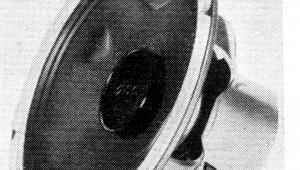
But on the M 807s, the eye is instantly drawn to that polygon of six 40mm A-XR (Aluminium-coned eXtended Range) midrange drivers, their ‘faceted’ cones enhancing stiffness without adding weight, surrounding the sixth-generation JET 6c AMT (Air Motion Transformer) tweeter. The tweeter operates down to 2.65kHz before handing over to the midrange array, which carries the baton down to 650Hz.
Focal point
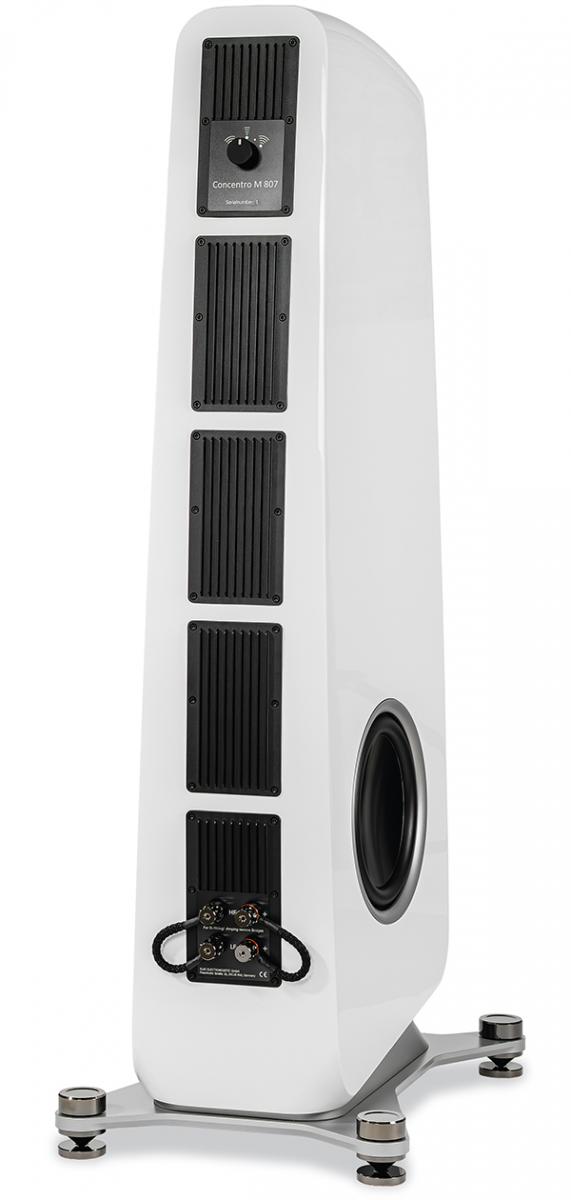
This ring design, which ELAC calls its VXe (Variable Coaxial electric) array, and which enhances the sense of the treble/midrange package as something akin to an ideal point source, isn’t a unique arrangement but here it goes further by providing a rear-panel ‘directivity control’ [see boxout]. This allows the array’s acoustic output to be steered across the horizontal plane, focused or diffused, to compensate for the room, the speaker position and the listener’s personal taste. You want sharp focus? It can be done. You want the impression of a piano filling the room from wall to wall? Likewise.
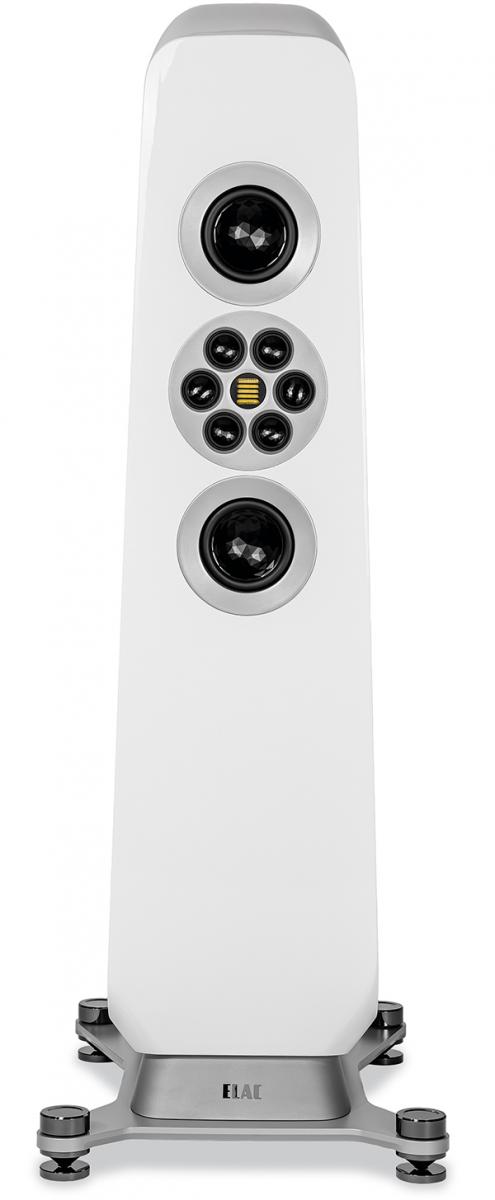
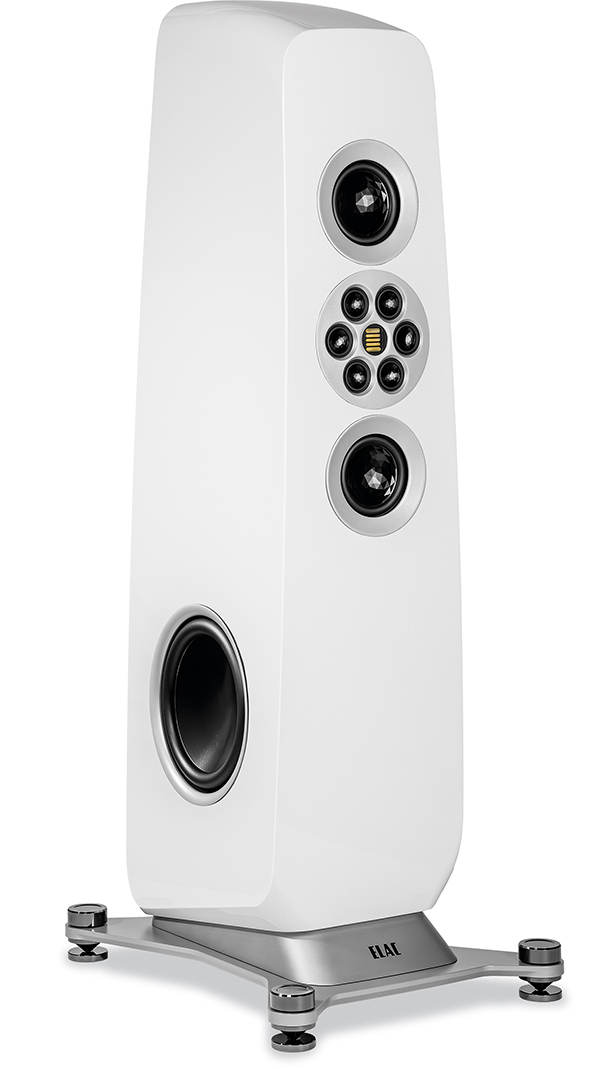
That directivity control is indicative of the M 807’s complex design. Above and below the VXe array on the baffle are 115mm aluminium-sandwich coned ‘low-midrange’ drivers, again with that ‘crystal-effect’ stamping aiding rigidity, and kicking in at around 650Hz. Below those, stirring into life below 150Hz, are two side-firing sandwich-coned 250mm bass drivers, also aluminium and tuned with a substantial downward-venting port (of which more later). With that upper roll-off, these constitute what is almost a built-in subwoofer section, taking the speaker’s bass response down to a claimed 24Hz. Meanwhile, the upper frequency extension of the M 807 is stated as 50kHz [see PM's Lab Report].
 Magic circle
These ELAC flagships are a little tougher to drive than the 4ohm rating might suggest [again, see PM's Lab Report] but the company suggests amps in the 80W-600W range, and they thrived on the end of the hardly lily-livered Constellation Revelation 2 [HFN Jan ’25] fed from the dCS Varèse streaming ‘stack’ [HFN Feb ‘25] in the HFN Reference Listening room [see p43].
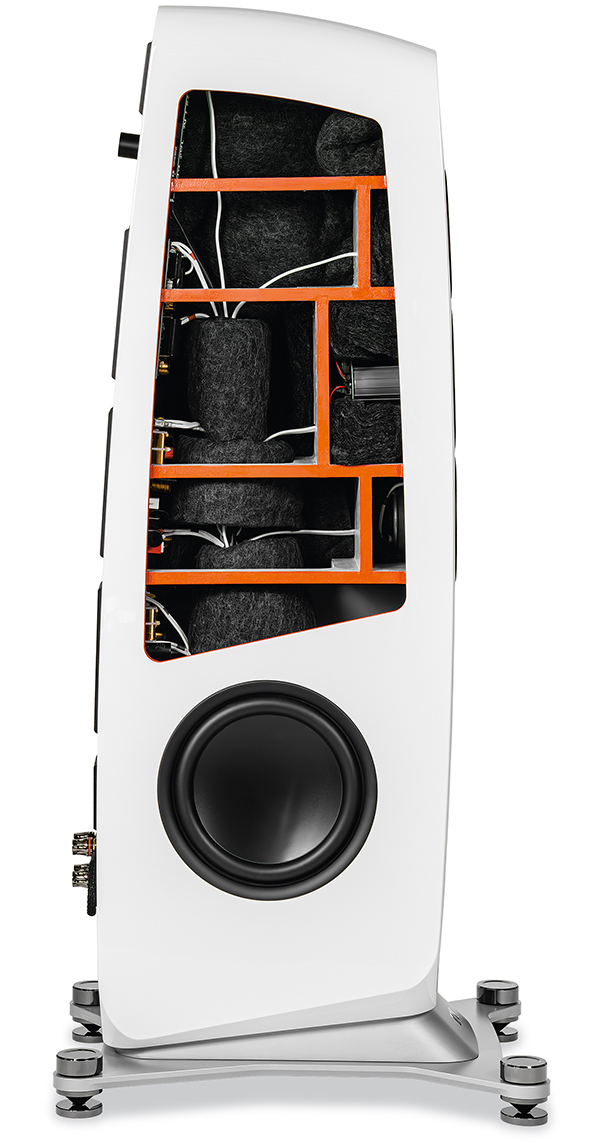
So yes, despite the presence of just two sets of terminals, this is a true four-way design. The terminals are sensibly low-down on the cabinet rear, using high-quality heavy-duty hardware in a black chrome finish and supplied with links for single-wire operation. The crossovers use selected premium-grade film capacitors, air coils, and non-inductive MOX (metal oxide) resistors. Each crossover section is mounted to its own aluminium heatsink panel, lined up the length of the speaker’s spine [see cutaway pic, p48].
For all that, the M 807 is a relatively elegant floorstander. There’s no mistaking its presence in the listening room, but it stands a reasonable 1.34m tall, tapers down from a maximum width of 46cm, and is a smidge under 60cm deep. Big, then, but impressively rather than oppressively so, with only the somewhat industrial-looking, and suitably hefty, grey alloy plinth to break the smooth curves. The styling and finish of the curvaceous main enclosure is immaculate, the industrial design being the work of an unnamed consultancy located in ELAC’s home city of Kiel.
But back to the plinth… Its outrigger legs carry substantial – and also very heavy – floorspikes but, for all their substance, they are not especially deep. This is fine on hard floors, for which protective footers are supplied, but with carpets there’s always the risk that your prized tufted Axminster will ‘short’ the big, down-firing bass reflex port, diminishing its effect. The M 807 looks like a prime candidate for the old slate/paving stone platform trick should your tastes run to wall-to-wall carpeted floors, which admittedly seem to be something of a British thing.
Within the cabinet the drivers work into separate chambers whose divisions also serve as additional bracing for the entire structure, contributing to the all-up weight of 62kg per speaker. Crucially, the six midrange drivers in the VXe array are mounted into individual, sealed tubes, attenuating their rear output while ensuring each plays an unencumbered role in the ‘steering’ adjustment.
Initial impressions? Superb multi-driver integration and rock-solid imaging – at least once you get that directivity control ‘dialled in’, and, in the large HFN room, just a little gentle toe-in. Bass extension is prodigious, the M 807 easily the match of any speaker I’ve heard in this room.
That clean low-end reach was much in evidence with bass supremo Pino Palladino’s That Wasn’t A Dream set with guitarist Blake Mills [Impulse/New Deal 00602478375874]. The grumbling low frequencies of the extended ‘Heat Sink’ were crisply defined and especially convincing. Meanwhile the slick driver integration contributed to the soundstaging of the lead instruments in all their processed glory, filling and bouncing around the room to startling effect. The sonic image here was as immersive as it was three-dimensional.
With the far more conventional (and resolutely mono) recording of Miles Davis’s ‘A Night In Tunisia’, from the recent 2025 remaster of Miles ’55 – The Prestige Recordings [Bandcamp; 192kHz/24-bit download], the sound remained tight and crisp. There was excellent character to Miles’s horn, the piano, and the rhythm section unearthed from the original analogue recordings by engineer Paul Blakemore. The one-channel sound, with its tendency to wander as one moves either side of the ideal central listening position, rather gives the game away, as does the abrupt change in noise-floor between tracks. However, the tonality of the instruments was beyond reproach, and these ELAC floorstanders give them full scope to be heard and appreciated.
The M 807s delivered pin-point imaging with Joyce DiDonato’s glorious recording of Dido’s Act 3 lament from the recent Il Pomo d’Oro release of Purcell’s Dido And Aeneas [Erato 2284884; 96kHz/24-bit] – and with wonderful warmth in the accompaniment and radiant timbre to the voice. And that was so even when playing the recording at high levels – or, as PM put it after popping the door to the room, ‘Do you realise how loud this is?’. Even so, ELAC’s loudspeakers remained super-clean and controlled, with not a hint of that distortion-induced soprano ear-bashing effect.
Drama class
That same clarity of tone and excellence of character was true with Ian Bostridge’s often system-challenging voice in Britten’s song-cycle Our Hunting Fathers [Warner Classics 2173294999], while the exemplary accompaniment from the Britten Sinfonia under Daniel Harding sounded suitably spiky and dramatic. This ability with the complexities of ensemble and orchestral music was also apparent with the recent BBC Philharmonic/Hallé Choir/ Storgårds recording of Shostakovich’s Third Symphony, coupled with the First in the fifth instalment [Chandos CHAN20398] – still with me? – of the orchestra’s complete cycle.
Here the ELAC floorstanders delivered a winning combination of stunning weight and near-forensic detail. The sound built from the simple woodwind opening into the drama of the full orchestral sections, conveyed with massive power when required and yet with all the space the composer wrote into the score. Speed and deftness in the scherzo was followed by huge scale in the final moderato, with a considerable contribution from the always-reliable Hallé singers.
Peter Gabriel’s ‘The Rhythm Of The Heat’, from the re-released Live At WOMAD 1982 set [Real World; 96kHz/24-bit], was thrilling stuff – close vocal focus and thundering bass and percussion, really filling the room with a sound that would surely rattle any loose fittings. As would the new Steven Wilson remix of Deep Purple’s classic 1972 Made In Japan live album [Universal; 96kHz/24-bit download], where ‘Smoke On The Water’ benefitted from the extra resolution and slammed hard – and with good audience ambience from those oh-so-polite Osakans.
The ELAC M 807s also sounded big and bold with Hans Zimmer’s score for F1: The Movie [Atlantic 075678594861], delivering all the bombast of the main theme and the vivid energy of the climactic ‘Three Laps Is A Lifetime’ cue, with its swelling strings joined by – umm – driving percussion.
Feat of strength
On a smaller scale, the speakers were just as convincing with the funky ‘Two Trains’, from the 2023 remaster of Little Feat’s Dixie Chicken [Warner Records 603497837465]. Here they delivered a punchy, good-time rock feel, with fine guitar tone and those of-a-time female backing vocals (in this case a stellar lineup including Bonnies Bramlett and Raitt, and Gloria Jones). A late reviewer of my acquaintance often enthused about the output of ‘the Feat’, and listening to this jazzy, folky, down-home sound played this well, one can understand why.
During something of a folky interlude, I moved on to Folk Bitch Trio’s ‘That’s All She Wrote’ from Now Would Be A Good Time [Jagjaguwar download], enjoying the focus of the M 807s, the three voices distinct yet blending beautifully. Meanwhile, ‘Timbuktu’ from Les Amazones d’Afriques’ Amazones Power [Real World CDRW228] was offered with room-busting weight and beautiful resolution, a scale matched by the massive, unstoppable ‘Whirl-Y-Reel 1 (Beard And Sandals Mix)’, from Afro-Celt Sound System’s trendsetting Vol.1: Sound Magic [Virgin 7243 8 41736 2 3]. This eclectic mix of growling bass, unusual electronica and transcontinental instruments – Gaelic pipes whirling above synthesised sub-Saharan percussion – was totally joyful.
Loud and proud
And what about Peat & Diesel’s ‘Stornoway’, from their folk/thrash crossover set Uptown Fank [Wee Studio Records]? Well, the wistful opening sounded lovely and then, after a few beats on the drumstick, the musicians leapt into life – accordion, bass and drums blazing, and the snarling vocals clean and clear. Well, as clean and clear as they can be – this band carries its rawness as a matter of pride, and the effect was both infectious and irresistible via ELAC’s new flagships.
Hi-Fi News Verdict
Notwithstanding the distraction of fiddling with those dispersion controls, and the need for a solid floor for the reflex port to achieve full potential, these big, complex speakers are a captivating listen. The sound integrates superbly, bass is as massive and powerful as anyone could want, and they’re as impressive with big, dense mixes as they are with super-clean, simple recordings. Notch one up for over-engineering, then…
Sound Quality: 89%
 | |||||||||||

|
|
| |||||||||





















 SPONSORED VIDEO






| Equipment Reviews | |
Music Reviews Awards | |
Latest News Features | |
Resources Newsletters | |
Subscriptions |
WHERE TECHNOLOGY BECOMES ENTERTAINMENT
 © 2026 Hi-Fi News
AVTech Media Ltd
All rights reserved