Yamaha CDX-10000 CD player
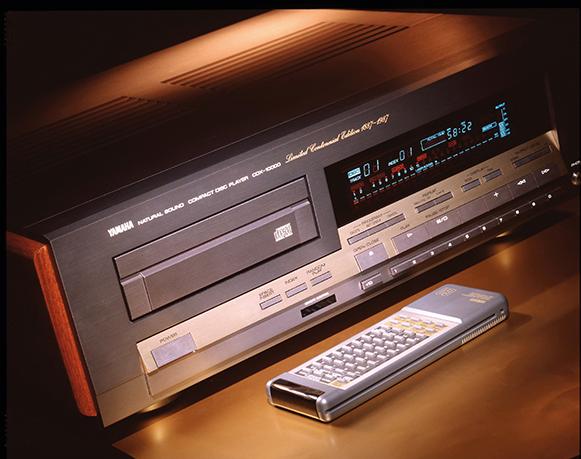

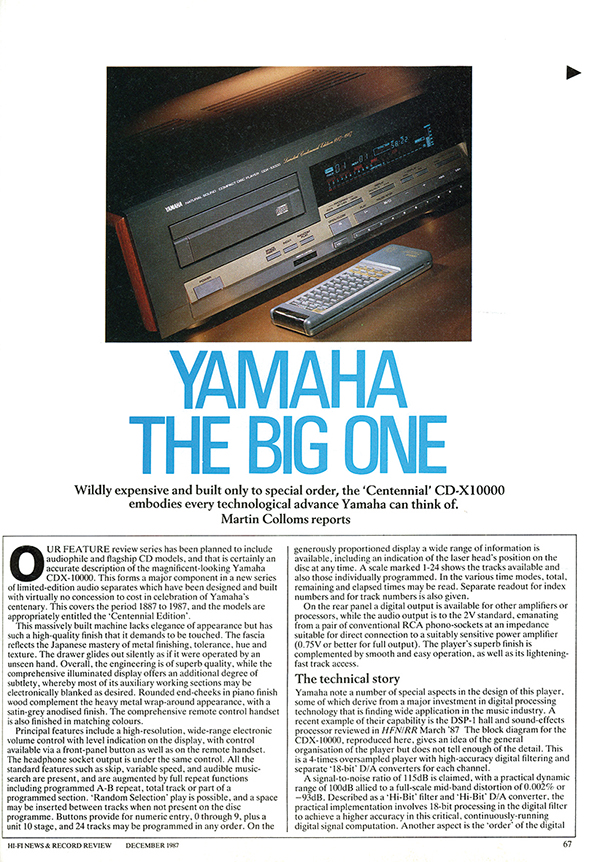
Our feature review series has been planned to include audiophile and flagship CD models, and that is certainly an accurate description of the magnificent-looking Yamaha CDX-10000. This forms a major component in a new series of limited edition audio separates which have been designed and built with virtually no concession to cost in celebration of Yamaha’s centenary. This covers the period 1887 to 1987, and the models are appropriately entitled the ‘Centennial Edition’.
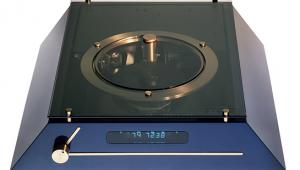
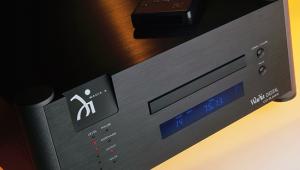
This massively built machine lacks elegance of appearance but has such a high-quality finish that it demands to be touched. The fascia reflects the Japanese mastery of metal finishing, tolerance, hue and texture. The drawer glides out silently as if it were operated by an unseen hand. Overall, the engineering is of superb quality, while the comprehensive illuminated display offers an additional degree of subtlety, whereby most of its auxiliary working sections may be electronically blanked as desired. Rounded end-cheeks in piano finish wood complement the heavy metal wrap-around appearance, with a satin-grey anodised finish. The remote control is also finished in matching colours.
Information overload
Principal features of the CDX-10000 include a high-resolution, wide-range electronic volume control with level indication on the display, with control available via a front-panel button as well as on the remote. The headphone socket output is under the same control.
All the standard CD features such as skip, variable speed, and audible music-search are present, and are augmented by full repeat functions including A-B, total or part-track repeat. ‘Random Selection’ play is possible, and a space may be inserted between tracks when not present on the disc. Buttons provide for numeric entry (0-9, +10), and 24 tracks may be programmed in any order. On the generously proportioned display a wide range of information is available, including an indication of the laser head’s position on the disc at any time. A scale marked 1-24 shows the tracks available and also those individually programmed. In the various time modes, total, remaining and elapsed times may be read. Separate readout for index numbers and for track numbers is also given.
Smooth operator
On the rear panel a digital output is available for other amplifiers or processors, while the audio output is to the 2V standard, emanating from a pair of conventional RCA phono sockets at an impedance suitable for direct connection to a suitably sensitive power amplifier (0.75V or better for full output). The player’s superb finish is complemented by smooth and easy operation, as well as its lightning-fast track access.

Yamaha notes a number of special aspects in the design of this player, some of which derive from a major investment in digital processing technology that is finding wide application in the music industry. A recent example of this capability is the DSP-1 hall and sound effects processor [HFN Mar ’87]. A block diagram for the CDX-10000 only gives a general idea of the player’s organisation – this is a 4x oversampled unit with high-accuracy digital filtering and separate ‘18-bit’ DACs for each channel.
A signal-to-noise ratio of 115dB is claimed, with a practical dynamic range of 100dB allied to a full-scale mid-band distortion of 0.002%. Described as a ‘Hi-Bit’ filter and ‘Hi-Bit’ D/A converter, the practical implementation involves 18-bit processing in the digital filter to achieve a higher accuracy in this critical, continuously running digital signal computation.
Another aspect is the ‘order’ of the digital filter, with 96th typical for modern high-quality players. The higher the order, the less ripple in the fine structure of the amplitude-frequency response. In an illustration of Yamaha’s high technology, the filter used in the CDX-10000 comprises a staggered pair of 255th and 41st linear-phase FIR filters. As a result, ripple is reduced to a claimed ±0.0001dB and the filter is built on a single chip of 49,000 transistors to the fine-tolerance 1.5μm fab rule.
Following the digital filter (YM3404), the digitally coded stereo signal is sent via the YM3615 attenuator/volume control. In the digital domain, the action of a manual analogue potentiometer is carried out by mathematical computation of the signal – multiplication for louder, and division for softer, levels. In order that no quality degradation of the 16-bit code occurs, the attenuator chip is designed to calculate at the 20-bit level, allowing sufficient dynamic range to accommodate the input signal fully, even when attenuated. This 20-bit operation provides a 120dB control ‘window’, while its resolution is impressive at 240 steps of 0.4dB, with superb channel balance.
Digital thinking
Regarding Yamaha’s use of 18-bit DACs, it explains that recorded music signals rarely make use of a 16-bit peak dynamic range, and recognises that all converters exhibit a lack of precision on the lowest bit or two. The CDX-10000 monitors the digital audio data in advance, and when the top two or loudest bits are not used (ie, during normal level passages) the stream is shifted up by two bits to occupy the most linear portion of the D/A converter, with noise and distortion reduced by 12dB. This bit-shifting cannot improve upon the quality of the input, but assures that subsequent losses are minimised.
If the bit-set is lifted by two bits, a gain increase of 12dB or 4-times has occurred. Thus in ‘Hi-Bit’ mode the processor must also reduce its output by 4x and, in practice, this is done after D/A conversion at the YM3023 chip, which primarily performs the sample-and-hold function. All this operates at 4x oversampling, or 176.4kHz.
Conversion is achieved by two Burr-Brown PCM56P K chips, with individual shunt-regulator supplies for ±6V. Following sample-and-hold, the audio signal remains direct-coupled to the line-output terminals, DC offset compensated by internal pre-set adjusters. Integration occurs within a 5532 op-amp stage, followed by a passive transistor-switched de-emphasis, buffered by a further 5532, this last including ultrasonic filtering. Another 5532 filter stage then occurs, its output buffered by a discrete power driver, a Class A complementary stage included within the feedback loop of the 5532. A combination of complementary series-and-shunt muting transistors are employed to ensure almost total muting. Separate IC amplifiers drive the headphone sockets.
The CDX-10000’s digital/analogue separation even extends to separate mains transformers, while internal metal compartments physically separate the circuitry. Optical couplers send data between the two, avoiding common grounds. A special grade of PCB dielectric has been chosen for the audio section, while the laser transport is mounted on a mechanical isolation suspension. Laser scan is fast, accomplished by a combination of a linear motor and a high-acceleration, coreless, brushless drive-motor. Great care has also been taken over the drawer mechanics to ensure smooth operation.
 Class act
Priced £2700, the CDX-10000 is one of the most expensive CD players currently available, and assessment of its performance must ultimately reflect that fact. But Yamaha can smile now, for this ‘Centennial Edition’ player is clearly of world-class sound quality – indeed, in some respects it sets new standards.
In scaled terms, the subjective sonic rating was 91%, which is a high score given the present state-of-the-art, and only beaten (marginally) by the early 1987 production CAL Tempest and the late 1987 production Cambridge Audio CD1. Given this solid foundation, Yamaha’s CDX-10000 showed true excellence in stereo image focus, even to the extent of hinting at perceptible ‘phasiness’ and blurring on the part of the references. The focus was most appealing in the treble, where the subjective effect was one of great precision and accurate control of placement despite the harmonic complexities of some instruments.
Clearly of high resolution, the player delivered much fine detail and, again, its very good performance in the treble register was appreciated. For example, different treble sounds were clearly resolved in character, while massed ranks of string players were not subject to the usual degree of muddle and ‘grind’.
Ascetic purity
Essentially neutral, the CDX-10000 kept a pleasant balance between bass, mid and treble though it did possess its own character. This was hard to pin down at first but became more familiar with continued listening, and finally demonstrated its own appeal. Hard to convey adequately, the performance was more abstract than emotional, akin to the ‘Japanese sword’ quality of its finish, an ascetic purity rather than a cheerful romanticism. Its sound verged on the contrived, but in a wholly believable manner. In standing back from the usual audio presentation, the player seems to distance itself from the musical performance, allowing the latter to generate its own drama. The CDX-10000 sounded formal and polite, with a shade of restraint placed on musical dynamics. With only a mild loss of stereo depth it rates ‘very good’ on this parameter, while stage width was excellent.
Taking specific areas, the bass was judged deep, extended and powerful, with a good slam and a ‘tuneful’ character. The mid lacked the usual hardness and showed a sweet violin tone, but sounded slightly ‘electronic’ nonetheless. Comment has already been made concerning the fine treble detail and focus, but this was supplemented by a finding of a very slight ‘sheen’ in the extreme treble, associated with a trace of excess ‘air’ and harmonic ringing, despite a general aspect of restraint and control in the treble register. Its precise focus, and musical if dry character, led to extended listening sessions.
Conclusion
Expensive it may be, but the finish, operation and build quality of this CD player are all in the highest class. It performed extremely well in lab testing, complemented by a fine result during our auditioning. The sound was as pure and focused as the superb external finish suggested, and as such the Yamaha CDX-10000 joins that small circle comprising the world’s finest CD players.











 SPONSORED VIDEO






| Equipment Reviews |  |
Music Reviews Awards | |
Latest News Features | |
Resources Newsletters | |
Subscriptions |
WHERE TECHNOLOGY BECOMES ENTERTAINMENT
 © 2026 Hi-Fi News
AVTech Media Ltd
All rights reserved