Unitra WSH-805 integrated amplifier
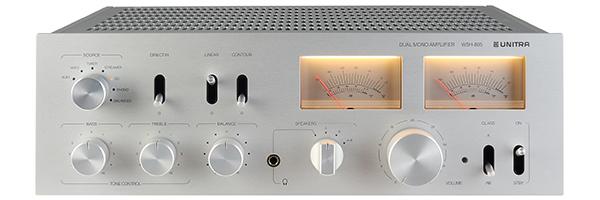

While not a household name in the UK, the Warsaw-based Unitra brand caused quite a stir in its native Poland when revived in 2021. Its storied past [see boxout] played a role in this, but so did the reimagined products themselves, thanks to their nostalgia-inducing 1970s aesthetic. Moreover, while the new Unitra designs are predictably more up-to-date under the hood, they sport some idiosyncratic features. The monochrome E ink display of the CSH-801 CD player is an illustration of this, as are the remote-actuated lever switches on the £4499 WSH-805 auditioned here.
The company stresses that all R&D and manufacturing is based in Poland, and principally in Warsaw itself. The WSH-805 is currently the brand’s flagship integrated amplifier, a fully analogue, dual-mono design that can be manually switched between Class AB and Class A operation [see PM's Lab Report]. There’s also a pricier Classic Edition available in some countries, featuring wood side panelling and brass knobs, but technically it’s the same amplifier. True to the retro vibe, the WSH-805 eschews all things digital, and Unitra has recently launched the DSH-805 DAC to complement the amp for this reason. The seven analogue inputs here include one on balanced XLRs, plus a switchable MM/MC phono stage.
Blast from the past
Both the black and silver versions of the WSH-805 should hit the spot if you lust after kit from yesteryear, and considering the late ’70s Unitra WSH-205 was used as a visual template [see boxout], that comes as no surprise. This new amp is not a direct copy, of course, but the layout has familiar elements, starting with the brushed aluminium front panel that’s slightly larger than the actual chassis. Then there are those five large lever switches that change position with a satisfying ‘clunk’. Cleverly, an actuator moves these switches when prompted by Unitra’s one-piece aluminium remote [see p71].

Neither can you do nostalgia without VU meters, a notion the WSH-805 embraces fully. Missing these large, illuminated displays is impossible – they have five levels of brightness and the top setting will likely attract moths and small aircraft from miles around. Five aluminium dials (including a motorised volume rotary), one chunky speaker A/B/A+B selector and a 6.35mm headphone output complete a fascia that looks both packed and sleek at the same time. The build quality and heftiness of these control elements make the 18kg WSH-805 appear authentically luxurious, just as the overall fit and finish will give the likes of Yamaha’s traditional A-series amplifiers [HFN May ’21] a good run for their money.
This being a retro-inspired model, tone and balance controls are given a prominent position, but there are unusual options including that ability to switch the WSH-805’s output stage into pure Class A operation (which is mirrored by the dual scales on the VU meters). The slightly mysterious-sounding Linear and Contour toggles allow you to bypass the tone controls and engage a dynamic loudness function. Toggling ‘Linear’ to the Off position is a good idea because, as PM notes in his Lab Report (and can clearly be heard), even in the tone controls’ default 12 o’clock position there’s some HF lift.
Neatly does it
Considering it’s a niche application, the WSH-805’s ‘Direct In’ switch – for using the amp with an external preamplifier – is larger and more conspicuous than needed, but that’s hardly a major gripe. And while attention is drawn to the beautiful front panel, the neat layout on the rear [p71] deserves praise too. There’s a lot going on here, but ample space between the various banks of connectors makes attaching cables easy. The internal construction is also high-quality, with the amplifier’s dual-mono architecture maintained right down to individual L/R transformers and power supplies.

As PM also reveals in his Lab Report, the switch between Class AB and Class A operation is the real deal. This is not a design that starts in Class A territory and transitions into AB when more power is required, as is the case with designs from Pass Labs [HFN Jul ’25] and almost every other push-pull Class A hi-fi amp. The bias current is increased in Class A mode, so those internal heatsinks get a workout, but when ~10W/8ohm is reached the WSH-805 clips – high sensitivity loudspeakers are a must in this mode!
 Different class
That said, in my modestly proportioned room, those 8W of Class A power proved perfectly usable when driving a pair of Radiant Acoustics Clarity 6.2 standmounts at regular listening levels. Getting the speaker’s Purifi Ushindi woofer to move during the fusion of black metal, EDM and Nordic folk that is ‘Mothlike’ on Myrkur’s Spine [Relapse Records; 96kHz/24-bit] wasn’t an issue. There was a satisfying foundation of bass to support the ‘wall of sound’ behind the vocals of Myrkur and Arjan Miranda.
The Clarity 6.2s can be neutral, even matter-of-fact sounding, so the denser and warmer approach of the WSH-805, together with a Marantz SACD 30n [HFN Jan ’21] used as a streaming source, made for an enjoyable complement. Nor is the WSH-805 too laidback, allowing the bass drums of ‘Valkyriernes Sang’ to appear powerful, if not ultra-precise. In Class A mode, I appreciated its portrayal of the reverb-rich vocals, smooth and full of character.
Hahn’s solo
These qualities ensured Hilary Hahn’s violin on Bach’s ‘Partita For Solo Violin No. 3 in E major’ [Hilary Hahn Plays Bach; Sony Classical SICC 354] flowed beautifully, revealing how developed the 17-year-old’s technique already was on her debut album. Hearing Hahn’s virtuoso playing through Unitra’s amplifier, it became clear why this 1997 recording is still considered a gold standard.
Switching to Class AB, the WSH-805 gained confidence when blasting out Built To Spill’s eight-minute indie classic ‘Goin’ Against Your Mind’ [You In Reverse; Warner Bros. 9362-49363-2]. The guitars appeared bigger, and there was more punch to the drums, although the general tonality didn’t shift enormously. People expecting two vastly different sonic palettes might be disappointed, but regardless, the Class AB option should be your default when driving trickier speakers or when higher sound levels are desired.

With the comparatively livelier Monitor Audio Gold 300 6G floorstanders [HFN Oct ’24], this novel amplifier came into its own playing ‘Angel’ by Depeche Mode [Delta Machine; Columbia 88765460632]. By delivering textured bass tones with force, and placing electronic effects across a wide soundstage, the sometimes overwhelming nature of the band’s music was communicated as intended – deep, dark and intense. David Gahan’s singing was also well handled, his vocals remaining the focus even while the WSH-805 showed itself to be an amplifier for people who want to be immersed in the whole performance.
To hear something with a little more speed, I dug out Thelonious Monk’s famed Live In Rotterdam 1967 set [FON 1704029], reissued in 2017 as part of Fondamenta and Devialet’s ‘The Lost Recordings’ series. Again, this Unitra amp got right to the heart of the music. There was a real feeling of being in the audience of the legendary gig, with the piano of The Mad Monk as much in the picture as the solos of his jazz quartet and guest horns.
The contrabass of Larry Gales on ‘We See’ was a standout moment, the WSH-805 extracting all the information surrounding his nimble playing, including the fast-paced drum work of Ben Riley. While there wasn’t the impression that Unitra’s range-topping amp offers the ultimate in resolution, it still delivered a thrilling performance packed with detail.
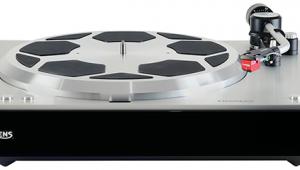
This Polish manufacturer builds attractive-looking turntables, and the availability of a Unitra headshell suggests it may return to producing its own cartridges (which it used to do under the Fonica brand name). As such, the WSH-805’s support for both moving-magnet and moving-coil – something absent on many integrated rivals – makes sense.
Grand piano
For my audition, I chose a Technics SL-1200GR2 deck [HFN Sep ’24] fitted with a Nagaoka MP-700 cart [HFN Aug ’25]. Listening to a 1980s Mozart recording from Deutsche Grammophon’s La Grande Musique [DG 2864091], the WSH-805’s MM phono input impressed. Once again, the amp appeared to transfer all the key musical information present, without veering into sharp or clinical territory. ‘Concerto Pour Piano et Orchestra No 21’, featuring pianist Géza Anda, sounded full-bodied, with a black background aiding the rendition of its soft passages.

The piano here was a real delight to listen to, sounding natural and free of harshness. This recording dates from more or less the same moment as when the WSH-805’s inspiration, Unitra’s WSH-205, was on the market, and looking at the gentle movements of the VU meters, it was easy to be transported back to very different times.
Hi-Fi News Verdict
While brand nostalgia does not resonate with everyone, the WSH-805’s 1970s aesthetic remains enticing in its own right. The novel ‘dual’ Class A and AB approach is intriguing, offering two separate topologies in one box even if the amplifier’s ‘voicing’ doesn’t vary enormously. Whatever mode you choose, Unitra’s WSH-805 serves up a stress-free, organic sound suited to hours of musical discovery.Sound Quality: 85%
 | |||||||||||

|
|
| |||||||||














 SPONSORED VIDEO






| Equipment Reviews | |
Music Reviews Awards | |
Latest News Features | |
Resources Newsletters | |
Subscriptions |
WHERE TECHNOLOGY BECOMES ENTERTAINMENT
 © 2026 Hi-Fi News
AVTech Media Ltd
All rights reserved