The price of success
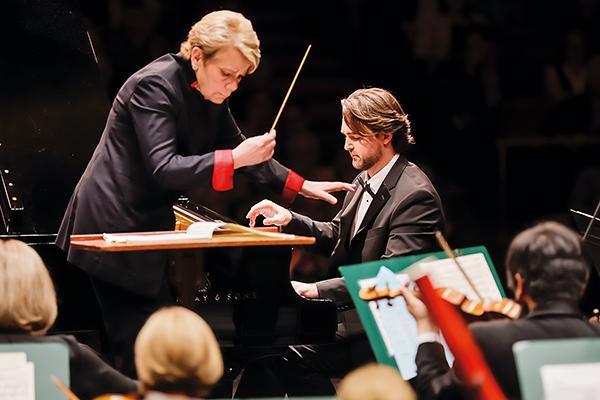
The winner of this year’s Van Cliburn International Piano Competition will have the musical world at their feet – won’t they? Self-confessed ‘jaded hack’ Peter Quantrill has his doubts
With the Moscow Tchaikovsky Competition effectively cancelled for the foreseeable future, the Van Cliburn International Piano Competition has become the world leader in identifying and rewarding the next Horowitz, Lang Lang or... Van Cliburn. A third the size of nearby Dallas, Van Cliburn’s home town of Fort Worth, Texas becomes Piano City for three weeks, once every three years.
A neon sign high over Sundance Square winks with the competition’s logo through the night. During the day, pianists old and young stretch their fingers at the free-to-play piano installed in the square. Pianophiles, agents, record company executives and, yes, jaded English hacks assemble in Bass Hall every evening during Finals week, and then settle their hash over beers at Durty Murphy’s pub around the corner.
Going global
At the time of writing – having heard the six finalists play one concerto, with another to come – the result is in the balance. The bullet-proof technique of Carter Johnson, in Prokofiev 2, and the recreative fantasy of Philipp Lynov, in Liszt 2, make them front-runners to take the $100,000 prize and associated career-launching prestige.
Who benefits from this exhibition of pianistic virtues and virtuosity? The winners, of course – all to join the tiny magic circle of soloists making their way around the world to play Brahms 1 in Tokyo one week, Tchaikovsky 1 in Boston the next. And these days, even such success is not guaranteed. Eric Lu, winner of the 2018 Leeds Competition (arguably second only in importance to the Van Cliburn), is back on the circuit because the string of gigs which came with the prize has dried up.
Compared to musical contests in other fields – violin, cello, singing – the tension inherent in a piano competition is acute. Contenders often sound at their best, most fully themselves, in previous rounds, when playing solo recitals. This is not surprising. Unlike their colleagues, pianists are used to making music alone. They are their own orchestra.
Something often happens in a concerto final, beyond the difficulty of physical and artistic coordination with an orchestra when rehearsal time may be limited to an hour or two. One or two of the Van Cliburn finalists treated the orchestra as a backing track for their own vision of a piece. Again, this is understandable, when they are the ones so anxiously projecting that vision in search of recognition. But it doesn’t make for a satisfying performance, and feels unrepresentative of the pianist’s own gifts.
I do not envy the judges attempting to distinguish between, and balance out, the qualities of pianism and musicianship, even when they have a contender’s previous rounds to bear in mind. In any case, concerto writing is often less involved than a solo piece, because of the soloist’s role as a protagonist, antagonist or partner to the orchestra. Compare, for instance, Schumann’s Kreisleriana or Liszt’s B minor Sonata with their concertos, and you’ll see what I mean.
Repertoire refresh?
A related issue presents itself, perhaps more common to other music competitions. With each new edition of the Leeds or the Van Cliburn, an anguished cry goes up. Why do they have to perform Schumann and Prokofiev all over again? Did the concerto literature really ossify around a century ago?
Of course not, and with the return of tonal melody to the writing of most art-music composers in the course of the present century, no shortage of additions to the repertoire present themselves. But can young soloists really be expected to learn concertos by (for example) Kenneth Fuchs or Thomas Adès on the basis that they will be asked to play them again by the world’s orchestras? It’s a gamble that most soloists, and competitions, are understandably wary of taking. Meanwhile, the next Van Cliburn winner awaits their moment of fame. What they do with it is up to them.






















 SPONSORED VIDEO






| Equipment Reviews |  |
Music Reviews Awards | |
Latest News Features | |
Resources Newsletters | |
Subscriptions |
WHERE TECHNOLOGY BECOMES ENTERTAINMENT
 © 2026 Hi-Fi News
AVTech Media Ltd
All rights reserved