Nakamichi 1000mb/1000p CD player
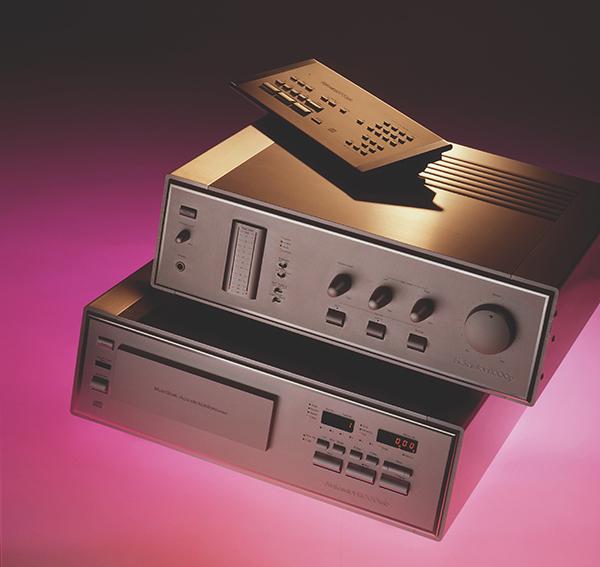

This two-box system from Nakamichi follows its 1000 DAT/1000p D/A converter [HFN Oct ’89], but here the company has taken advantage of the modular nature of the DAC to design a completely new processor board with fresh digital, analogue and power supply circuitry. The 1000mb CD transport doesn’t need reinventing however – it’s all new.
One unlikely feature of the transport is the Music Bank system, which allows the player to store six discs internally, plus a seventh which is handled in the traditional way. The disc loading drawer (or mouth?) swallows discs for stacking internally and looks rather like a fixed version of a Pioneer multi-disc cartridge.
Conventionally, this kind of feature doesn’t really belong on a high-end product, any more than automation on a turntable or auto-reverse on a cassette deck. But the mechanism is entirely consistent with previous Nakamichi practice. It is also reasonably quick and extremely smooth and quiet. There’s little of the grinding and clanking of gears and cams that afflict most multi-disc players. There are restrictions however: 8cm discs should not be used, even when mounted in a 12cm adapter, except in single play mode.
The 1000mb has several play options, including random and programme play of up to 50 tracks from any or all discs, tape synchronisation facilities, and intro-scan. The control system also allows rapid access to any individual track on any disc. A superb remote extends the basic control set found on the front panel. This remote control can stand on a table and is built to the same heavy duty standards as the player. It does not need to be pointed towards the player to make it work. A rear panel remote control bus link allows synchronised operation when recording onto a Nakamichi cassette or DAT recorder.
Big and beautiful
Even by the standards of the butchest high-end CD players, these two units are ridiculously heavy, the transport tipping the scales at 17kg, and the D/A converter at 17.5kg. Both share dimensions of 435x133x370mm (whd), which is big by any standards. They are fabricated from thick aluminium extrusions, brushed and lacquered for cosmetic reasons, and compartmentalised internally for acoustic and electrical screening purposes as part of a package of measures controversially billed as ‘Acoustic Isolation’.
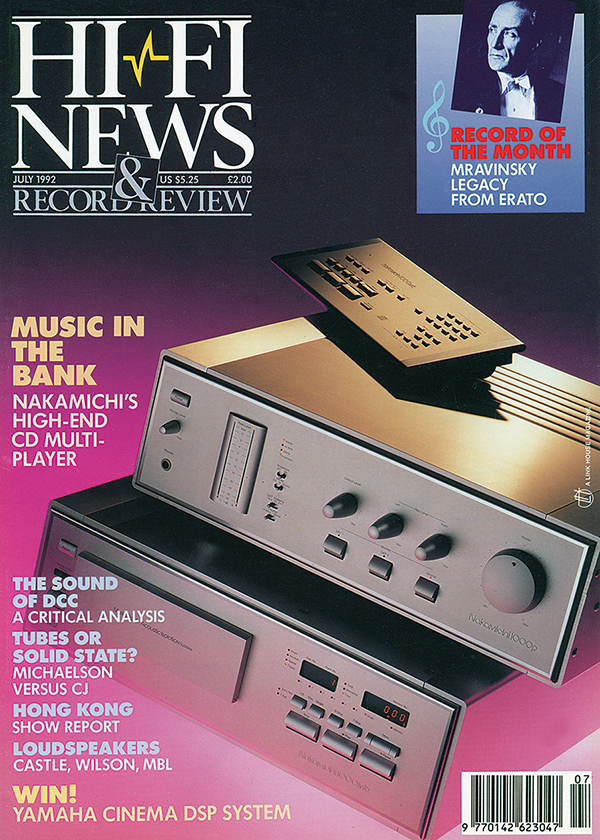
Above: Cover of HFN July ’92
The compartment that houses the transport is hermetically sealed, with foam sealing around the edges and a heavy door with a rubber sealing ring at the front that closes manually over the loading tray. The disc platform is additionally decoupled from the outside world by a dual suspension system based on rubber dampers and coil springs. A long motor shaft reduces grinding vibration, and the thick alloy metalwork provides damping of structural-borne noise.
The 1000mb’s power supply is hidden in a sealed, full-depth compartment along its left-hand edge. The accessible aluminium sections (which are sometimes double skinned, damped and/or otherwise reinforced) are 5mm thick. Meanwhile, the DAC is stuffed with a mass of copper screening and has a massive power supply section including two separate encapsulated transformers. Key components on the multilayer PCBs are disguised with Nakamichi badging – in all cases construction is extremely complex.
The player has electrical and optical sockets on a removable board, an arrangement that in principle means other interfaces could be used. The digital processor has three removable boards. One is the A/D section, which is equipped with switch-selectable balanced and unbalanced line input sockets. The D/A board has similar options, except that the unbalanced output comes in two flavours: fixed and variable. The latter uses a front panel volume control, a facility that enables the unit to act as a rudimentary preamplifier. Finally, there is a DIF (Digital Interface) board that has optical and electrical inputs and outputs for two digital recorders and one digital source.
Raise the resolution
The basic modus operandi of the D/A board (the current issue being the DA-111p, replacing the DA-101p) hasn’t altered since our DAT 1000 review though its execution is entirely different. In brief, the DAC section uses an unusual form of parallel processing based on 16-bit DACs of high precision to achieve greater resolution than is easily available using, say, 20-bit DACs of marginal precision. Nakamichi points out that conversion-error signals cause noise that is modulated by the input signal.
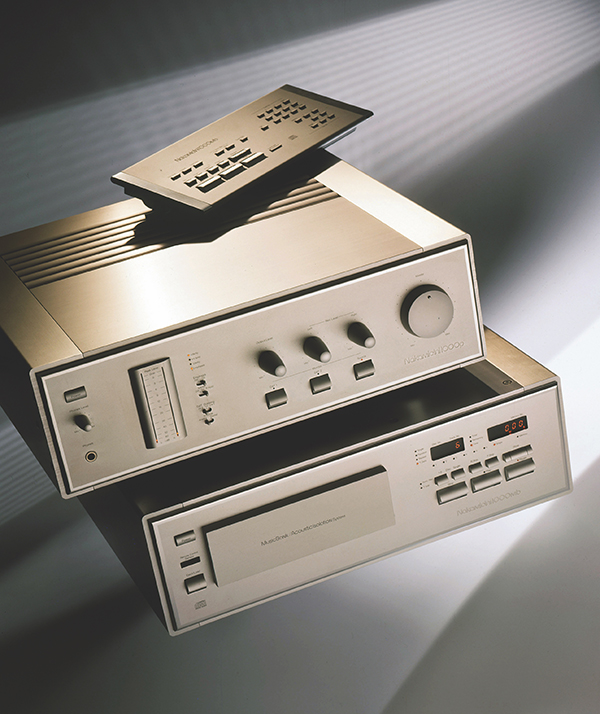
Above: Both the 1000p [top] and 1000mb [bottom] featured standard- width aluminium chassis with internal compartments screened for both acoustic and electrical isolatio
The converter is built around two Philips TDA1541 S1 Crown ICs, one of which handles the first 14 bits. The second DAC processes another six bits, which is summed with the output of the other DAC to produce 20 bits of processing accuracy – though not musical data of course, which is limited to 16 bits. In a further refinement, the DACs are checked at power on by successively adding the lowest two bits, and producing a correction signal if it fails to exactly sum to the next higher bit. These corrections are stored in ROM, and added to the datastream as required.
The ROMs holding the error correction data are also checked for linearity against a high-precision 22-bit converter. Additionally, some glitches that occur in the converter as the signal traverses certain thresholds are predictable, so are processed and applied in antiphase to the main signal to cancel the original distortion.
Digital downsizing
This basic topology is common to old and new processing boards alike, but where the old board apparently used 30 ICs for signal summation and other housekeeping tasks, Nakamichi has now integrated their functions onto a single programmable IC from US company Xilinx. The digital section is also now extremely compact and has no hard wiring, partly thanks to a new dual-layer PCB. These measures reduce the amount of digital real estate to a fraction of its former value, reducing power supply demands, and contributing greatly to an important reduction in internal electrical noise.
The space saved has been used to replace the analogue op-amps with discrete circuits of higher performance in a DC-coupled configuration, and with improved passive and active output Bessel filters. Regulated power supplies are now positioned where they’re needed to reduce noise. The output is driven by complementary power transistors, which enable the processor to drive a 600ohm studio line, if required. The previous output board lacked this capability.
 Disc delights
No comparison of old versus new digital processors was possible, and in the absence of the DAT recorder, our audition of the 1000p was restricted to the D/A role, taking CD from the partnering transport and other models from Linn, Meridian, Roksan and Wadia. The matching processors were also on hand.
The first point to emerge was that in its new form, the 1000p finally makes good. The 1000mb transport is of comparable standard, and it is hard not to imagine it showing Nakamichi’s DAT hardware a clean set of heels.
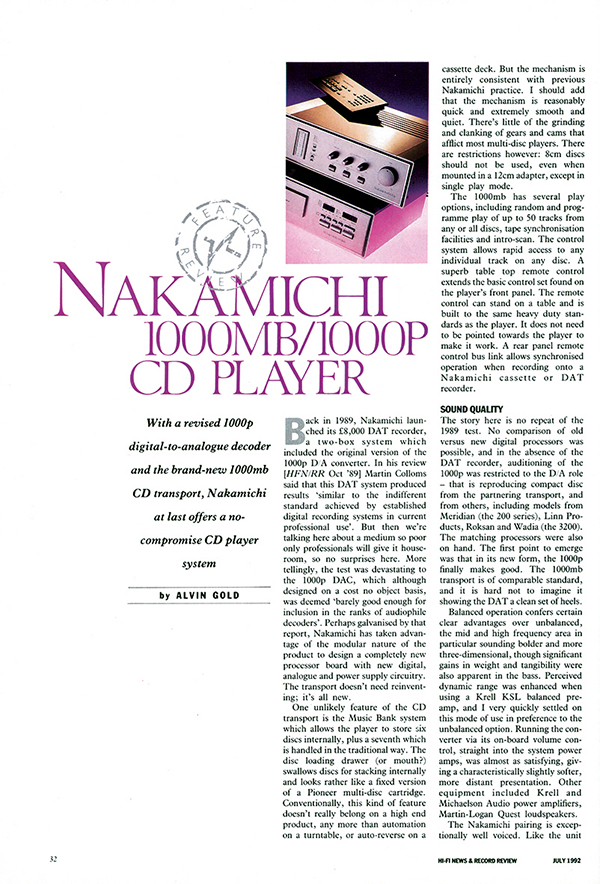
Above: First page of original review from HFN Jul ’92, including opening picture taken in the in-house photographic studio
Balanced operation confers certain clear advantages over unbalanced, the mid and high frequency area in particular sounding bolder and more three-dimensional, though significant gains in weight and tangibility were also apparent in the bass. Perceived dynamic range was enhanced when using a Krell KSL balanced preamp, and we very quickly settled on this mode of use in preference to the unbalanced option. Running the converter via its onboard volume control, straight into the system power amps, was almost as satisfying, giving a slightly softer, more distant presentation. Other equipment included Krell and Michaelson Audio power amplifiers, and MartinLogan Quest speakers.
Sweet ’n’ subtle
Nakamichi’s pairing is exceptionally well voiced. The treble is airy and delicate, subtle yet exquisitely detailed. The mild roll-off at the top end may have been responsible for an occasional slightly cloying sweetness in the sound, but it was not at the expense of air, detail or presence, and surprisingly there is no perceptible dulling of tone.
In what appears to be a contrast with the previous model, there’s a strong but not overstated dynamic capability which stretches throughout the midband as much as in the bass. The Nakamichi player’s boldness, range and polish was shown in a ravishingly resolved string sound in ‘Im Abendrot’ from the new Te Kanawa/Solti version of Strauss’s 'Four Last Songs' [Decca], the opening of which can sound fierce and cluttered with some hardware, or lacking in internal separation and resolution with others. This boldness was confirmed in ‘Sonata For Unaccompanied Violins’ [London Musici on Conifer], where the instrumental tone had the perfect blend, sharpness and penetration without being in any danger of going over the top.
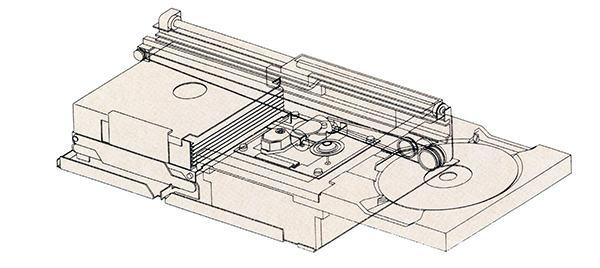
Above: Line drawing illustrating the loader and laser transport from the 1000mb’s multi-disc Music Bank mechanism
Bass otherwise mirrors the treble in being very precisely drawn. It has clear delineation of instruments with good start and stop qualities with percussive instruments like piano, which was handled in an attractive and accomplished manner. The wide ranging capabilities of the Nakamichi pair were confirmed time and time again, for example in the track ‘First Song’ from David Sanborn’s Another Hand [Elektra]. With other processors, the drums were in the same plane as the rest of the instruments when they entered the song half way through, but with this system everything resolved itself into separate layers, and the sound sprang into life. Hi-hat sounded especially three dimensional, with no trace of spit or edge beyond what should be there, yet there was real finesse and clarity and an assured sense of timing.
Best of all was the Nakamichi player’s ability to mix two qualities that are often mutually incompatible: information and euphony. This is one of the smoothest and sweetest CD players I have encountered. I rarely ended up feeling that the music had been manipulated or processed.
But this system isn’t for everyone, even leaving cost (£3000/£3500) aside. Dividing the player into two and substituting other components, the new Roksan DA1 DAC goes a long way to matching the Nakamichi 1000p in overall presentation and in perceived resolution. Similarly, the Philips-based Wadia 3200 CD transport offered a more solid and three-dimensional quality on many discs than the 1000mb, even via the coaxial connection (it sounds better still via its AT&T optical interface).
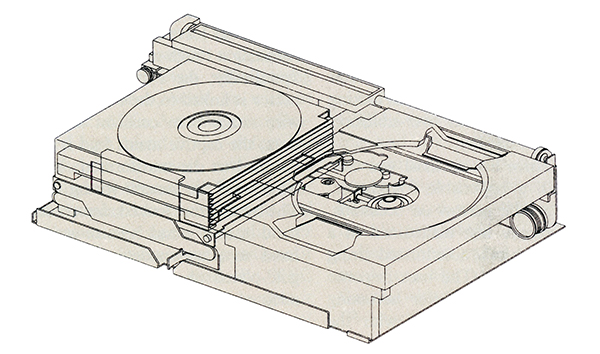
Above: Second line diagram from Nakamichi illustrating how discs are stored in advance of selection for playback – up to 50 tracks, across multiple discs, could be programmed
Nakamichi’s combi has excellent consistency, and responded little to changes in positioning, the type of support used, or the replay volume selected, all of which generally affect reproduction in subtle ways. These two components are well matched and deserve each other. They display a touch of synergy, which is not to be overlooked.
Conclusion
Normal considerations of value for money break down at this price level: you’re buying (if you buy) for reasons which are partly intangible, and which are certainly not wholly rational. The 1000p converter now broadly justifies its complexity and price, though it seems that Nakamichi has had to work very hard to achieve results that have been equalled – and in a few cases even bettered – by others at lower prices, albeit usually with less operational flexibility and without the promise implied by its modular construction.
The same could be said of the transport, which was bettered by Wadia’s 3200 in a direct comparison, but by very few others – and the Music Bank facility is unique in this class of product. It’s a little disappointing that Nakamichi hasn’t opted for the intrinsically superior AT&T digital interface, if only as an option, though the modular design makes this a future possibility. Still, the combination is beguiling, and one which is genuinely listenable.










 SPONSORED VIDEO






| Equipment Reviews |  |
Music Reviews Awards | |
Latest News Features | |
Resources Newsletters | |
Subscriptions |
WHERE TECHNOLOGY BECOMES ENTERTAINMENT
 © 2026 Hi-Fi News
AVTech Media Ltd
All rights reserved