Mark Levinson No30 dual-box DAC
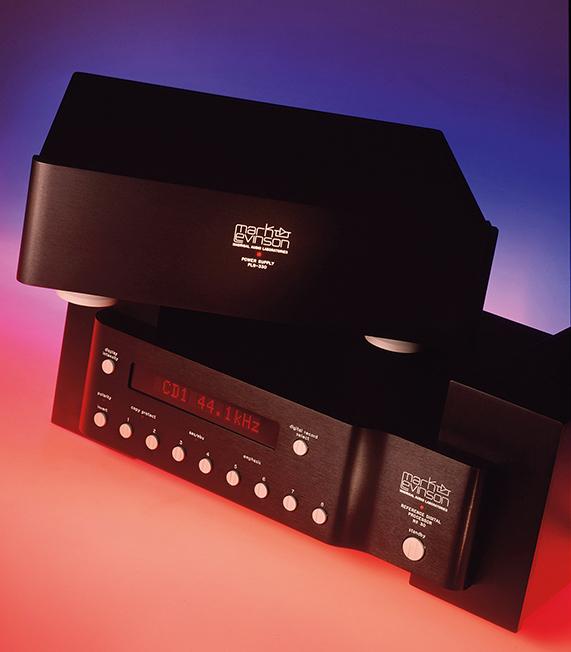

The Mark Levinson No30 can be regarded as the ultimate exposition in digital decoding design at the present state-of-the-art. A matching transport, called the No31, will soon be made available, for the designers are anxious not to be found wanting in any department – save, it must be said, that of economy.
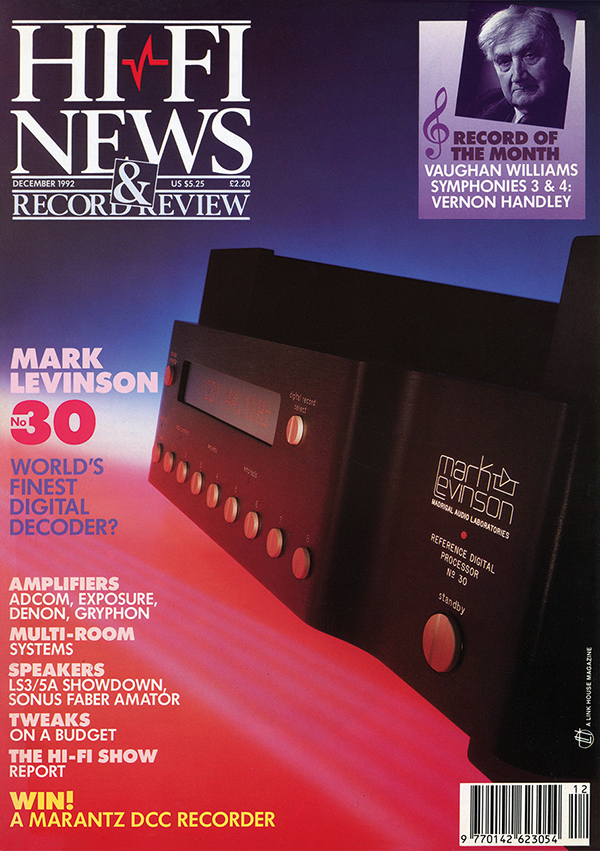
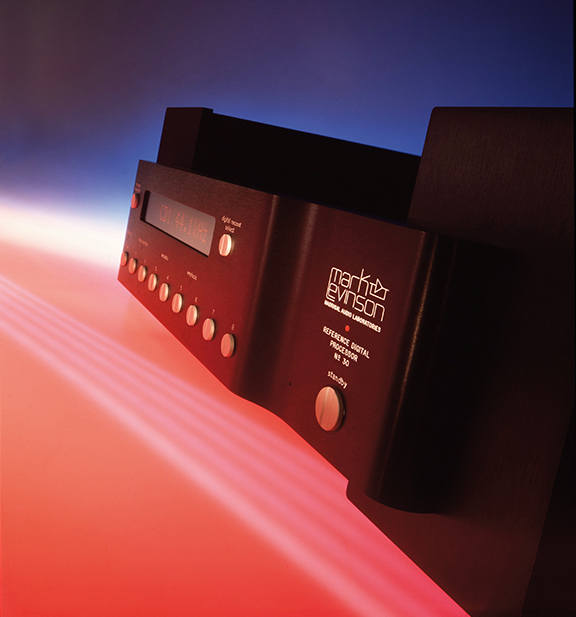
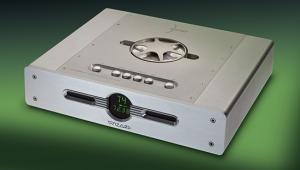
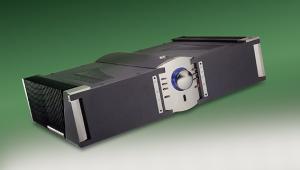
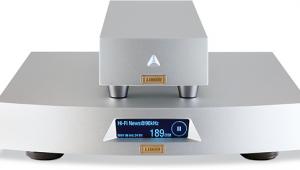
Built in a striking package, the No30’s massive, distinctive and eye-catching control console is flanked by tower-like structures, and the unit is accompanied by a substantial outboard power supply. This is form governed by function, and a commitment to every minute detail of good design and engineering practice.
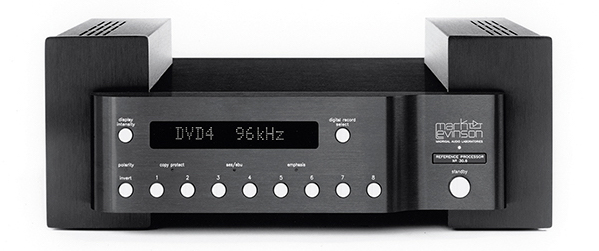
On the curve-edged front panel there is a large alpha-numeric display executed in a matrix of red LEDs. This provides information on the data status, the source selected, and incoming sampling rate.
Numbered inputs may be assigned to specific legends, and up to eight digital inputs may be connected in all input formats – AES/EBU (balanced), phono coaxial (unbalanced), Toslink and AT&T optical. Another button actuates the digital output to a recorder, and there is also a user control of display intensity. One button offers absolute phase inversion while another switches between standby and operate. Indicators signify absolute phase, copy protect codes, AES/EBU status bits and pre-emphasis.
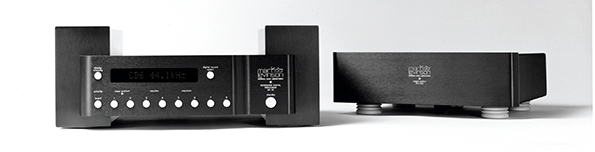
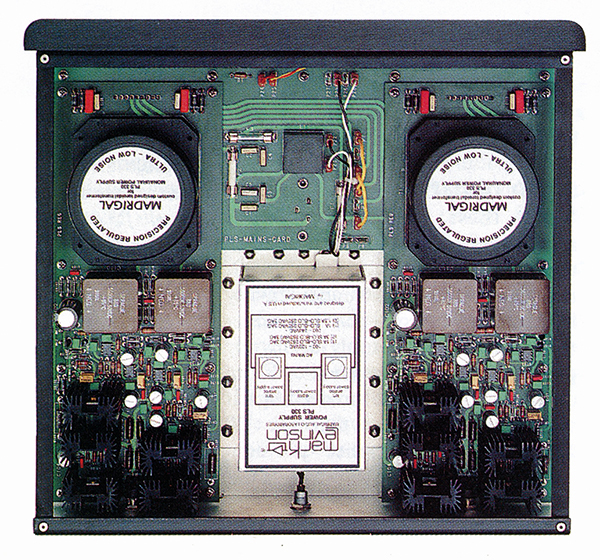
A particular field of expertise for Mark Levinson is power supplies, and this knowledge has been applied in large measure to the No30. Contained within the power supply box are three independent supplies. A 45W switchmode unit feeds the digital section, which is well filtered and floats clear of the other supplies, referenced by one clean ground. The two audio channels are allocated separate toroidal mains transformers and pre-regulators.
Digital diva
A pre-programmed micro-processor provides the housekeeping function in the DAC and this may be upgraded for future developments. Subtlety of detailing is exemplified in the action of the phase invert switch: here, the level is quickly ramped down in the digital domain before changeover, and ramped up again after the changeover for audibly glitchless operation.
Digital data is acquired and locked in an UltraAnalog unit, custom designed and specified for low recovered jitter. While other high-end decoder designers have grown their own digital filters – and certainly sound quality differences are attributable to different filter software design – Mark Levinson has chosen a high-performance industry standard, available on a single chip and made by the Japanese specialist NPC. This operates with 20-bit output codes at 8-times oversampling.
All three digital sections are located in the central part of the ’30, and at this point the digital audio data is converted into positive and negative phases and, again, balanced to deliver a four-line double-balanced feed to the D/A towers. In each of these is a pair of UltraAnalog 20-bit hybrid DACs operating as a differential set. The converters are built to an exclusive specification, and are operated for minimum noise and highest possible linearity. A Bessel filter using current feedback op-amps follows the DAC and leads to the DC servo’d discrete component output amplifier. Teflon dielectric PCBs are used for these critical analogue areas.
Concerning the extensive use of local regulation, often cascaded, the sophisticated power supplies employ current source/current drain techniques to achieve maximum stability and minimum noise.
Astonishingly for a DAC, the two-box No30 is rated at 125W power consumption, and it certainly runs warm. In fact, the D/A towers are designed to reach a point of thermal equilibrium for optimum low-level resolution. This takes several hours to achieve, and the D/A sections are thus powered up even when the unit is in standby mode.
No chances were taken with evaluation. Innumerable details required attention to ensure that all the performance which might be available was actually realised. A veritable galaxy of audio gear was brought into play over a period of several weeks to help explore subjective performance subtleties.
Taking the power amplifier(s) first, these comprised the Mark Levinson No23.5, the Krell KSA-150B, an Audio Research D400, and bi-amped Meridian 605 monoblocks. Pre-amplification was dominated by the Mark Levinson No26.5, and a Krell KSP-7B. Good service was also given by an Audio Research LS2B.
Digital audio competition was from an Accuphase DP-70V, still holding up very well as one of those rare integrated transport and decoder references. Also available was the Luxman D500X ‘Ultimate’, Theta’s Pro Basic II, Meridian’s 602/605 combination, and the new PDT-3 transport from Proceed, recommended by Mark Levinson for the No30. The PDT-3 is equipped with all four output formats – phono unbalanced, AES/EBU balanced, plus Toslink and AT&T opticals (the latter bayonet types) and this aided further comparison.
A Mark Levinson MDC 1 PRO cable was supplied for use in balanced AES mode, and is said to surpass the performance of even the high-speed AT&T optical connection. Alternative transports were sourced from Wadia, Meridian and Accuphase – at times, there was a greater difference in sound between the choice of digital interface and/or cable (optical or wired), than between these.
 For your reference
While these various equipment alternatives helped to explore some of the more subtle aspects of the No30, this unit set such a fundamentally high standard from the beginning that our extensive trials ultimately proved to be rather academic. From an early stage in the proceedings it was abundantly clear that the ’30 aspired to the reference position. Indeed, if it hadn’t it would have been seen as a failure, in view of the great engineering effort and cost expended on its development.
For the many listeners who contributed to the auditioning, the reward lay in the exploration of the rich character of the No30 and the unexpected exposure of formerly hidden depths of information on many familiar CDs.
The main impression given by the No30 was of an unparalleled stereo image, and this ultimately remained the most memorable aspect of its performance. Given the very high standards set by the other references, it still seems extraordinary that those silver discs, with all the necessary and unnecessary compromises which have gone into their production, could be induced to release so much more information. The ’30 dug into the data presented to it and showed a very high level of info retrieval. In the perceived soundstage, without reservation, the result was absolutely ‘state-of-the-art’. The necessary superlatives may tire the reader but they are inescapable. Focus was excellent, specific solo images being finely concentrated.
Moreover, those tightly resolved placements were well presented over the whole impressive width of the perceived soundstage, and over many layers of depth perspective. The ’30 tells you exactly what went on at the recording stage from the hall acoustic to the placement of the performers. Even so, I felt that lurking in all that excellence was the feeling that perspectives were also slightly distant, with a detectable hint of ‘Levinson darkening’.
We also heard a grand sense of scale backing the extraordinary focus. The soundstage was full-sized, very spacious and ‘three-dimensional’. Transparency was extremely good, rivalling the ability of the Wilson Audio WATT speakers used, and allowing a clear view into the soundstage. Little was obscured or veiled. The rock-solid imaging lent an air of authority which was both appealing and relaxing.
The No30 was found to be very well balanced, essentially neutral and also capable of very high resolution over the entire frequency range. No area can be fairly singled out, but mention must be made of the bass which sets new standards for extension, articulation, slam and power. Ambience and space were also clearly evident down to the low-frequency range.
Over the broad midrange the sound was slightly darkened: a richer, faintly sepia-tinted view was identified here in contrast to the ‘whitened’ glare often found with digital replay. Some listeners habituated to digital audio might find the No30’s tonal quality to be mildly dulled, almost creamy, but the level of detail reproduced largely helps to dispel that notion.
There was an interesting ambiguity to be found in the treble. Having excellent focus and an unprecedented amount of detail, harmonic subtlety and ‘air’, it could be a mite unforgiving on rougher sources. A tinge of grain or sheen was also identified higher up the frequency range. Such criticism would only be made by comparison with the finest low-bit high oversampling systems (this is generally their strongest area).
Inner silence
The No30 was truly dynamic. Sudden transitions from soft to loud were explosive, subjectively exciting, and seemingly effortless. No change in its ability to resolve detail was detected on complex or simple material, and that ‘contained’, compressed quality evident with many low-bit systems was quite absent here. The ’30 was consistently expressive in its clear, pure rendition of transients.
Another factor contributing to the dynamic quality was the feeling of silence underneath the music. It would seem that the ’30 contributes substantially less spurious noise or modulation effects in its operation than its competitors. One is not really aware that these almost subliminal disturbances are normally present until a unit such as the No30 clears them away. Then they become audible by their absence! This inner silence allowed instruments to breathe more naturally into clear space.
Lest we imagine that the ’30 was perfect, there was in my view an area of marginally weaker performance, namely rhythm – certainly the most contentious aspect of the sound, and one where the reader must rely on their own experience and opinion. My rating here was ‘good plus’ where ‘very good’ or ‘excellent’ would have been expected.
Rhythm and timing are key elements in the performance of the Wilson WATTs, and they show that the ’30 has a more ‘considered’ or ‘magisterial’ view of musical rhythm than they do. Complex patterned beats, particularly in rock, are not given the same degree of analysis as the musical and stereo aspects. The timing sounds ‘slower’ than some of the references, and thus more suited to large orchestral forces than fast rock or intimate jazz. With speakers of lesser rhythmic ability this aspect may become less important.
Conclusion
Summing up Mark Levinson’s DAC is not entirely straightforward. Taking the easy bit first, the No30 delivers a superbly accurate decode of digital data. Its frequency responses are perfectly smooth and flat, and extend to very low frequencies for simple or double tones. Linearity is superb. The output is to the CD standard, sourced from a highly load-tolerant drive impedance.
As regards construction, the unit is superbly built as well as excellently documented. It will last and last, with a useful life extending into tens of years if so required. Moreover, its modular design will allow for logical upgrades as the digital art advances.
Taken overall, the sound quality is certainly at the state-of-the-art; in some respects, the ’30 is pre-eminent. These could well sway the prospective buyer to eliminate all other contenders. Specifically, these include the spacious and highly focused soundstage, the pleasing sense of distance and scale, the near-magical orchestral brass quality, and the superb resolution of detail. The ’30 also manages to convey a proper sense of weight, of foundation, and this is reminiscent of the largest US audiophile power amplifiers.
Despite all these sonic riches, I felt some disappointment. Perhaps I had expected too much. For me at least, the No30 fails to satisfy fully in the matter of listener involvement. While its resolution and reach were admirable, its performances often seemed more ‘academic’ than expected. I sought a more heartfelt insight into music as decoded by this great digital engine. It must, however, be said that my Wilson WATT 3/Puppy 2 loudspeakers were more revealing of this aspect than, say, models from MartinLogan or Apogee. In many respects I believe that this is one of the world’s greatest designs, but I still cannot give it an unreserved approval considering the price.
Ken Kessler's verdict
Say it slowly: twelve thousand, nine hundred pounds. Crazy, huh? And just how do you approach a D/A converter – not even a whole CD player – costing as much as a VW Golf or a Rolex? I suppose reverence is a good place to start, but I’ve been at this for too long to let price tags hammer me into submission. Not that its sheer presence isn’t enough to make you go ‘Whoa!’. Let’s face it: no single piece of digital hardware, at least not any I’ve ever seen, seems so over-engineered, so bombproof, so utterly complete.
The No30 has to be the 1992/3 State of the Perceived Value Art. Two boxes, one holding a power supply fit for an amp, one looking like Darth Vader’s laptop. Enough inputs to satisfy a reviewer in the midst of a CD transport survey. Smooth action, wonderful read-outs, the smell of computers, and a dark, looming presence telling you that it’s a Very Serious DAC Indeed.
But the No30 didn’t, well, move me. It’s almost too insistent on its own greatness, all but defying you not to like it. Have I the fortitude to stand up against most of this planet’s reviewers by not falling in lust with the No30? It is, after all, the most detailed DAC I’ve ever used. The sound, like the unit itself, is so solid and so tactile that you cannot help but hear more of a performance than you might through other DACs. But now I’m wondering if we do need to hear every mote of dust whirling through the studio when the recording was being made.
Granted, the No30 retrieved a bit more low-level info than all the other DACs I had to hand. Granted, it behaved impeccably. But it was more like a handle-barred Colonel than the young Elvis. Or, to put it another way, it was all manners and no soul. But I’m firmly in the minority, being the only one who didn’t choose the No30 during the listening tests.
On vocals, it lacked smoothness. On brass, I missed punch. The No30 couldn’t be bettered for bass extension and weight, but the others made rhythm section gymnastics easier to follow. The funk machine behind Sam & Dave on ‘Hold On, I’m Comin’ was my torture test. Here, a Krell Studio DAC made music; the No30 made sounds.
Maybe what it gets down to is personal taste. The most vivid contrast was spatial presentation, the No30’s hovering in line with and behind the speakers, others spreading it out in front and behind. And it’s the latter which rocks my socks.
My advice? Make damned certain that you audition this only with the preamplifier you own – a Mark Levinson preamp, for example, was clearly more in sympathy with the No30 DAC than either a Classé DR-4 or a Krell KRC, both of which favoured digital converters from Vimak and Krell. Listen to it in AES/EBU mode. Use Mark Levinson cable. Make certain it’s been on for at least a day. Who knows? Maybe you’ll confirm what many suspect: that I’m as deaf as a doorpost.











 SPONSORED VIDEO






| Equipment Reviews |  |
Music Reviews Awards | |
Latest News Features | |
Resources Newsletters | |
Subscriptions |
WHERE TECHNOLOGY BECOMES ENTERTAINMENT
 © 2026 Hi-Fi News
AVTech Media Ltd
All rights reserved