KEF Reference 104/2
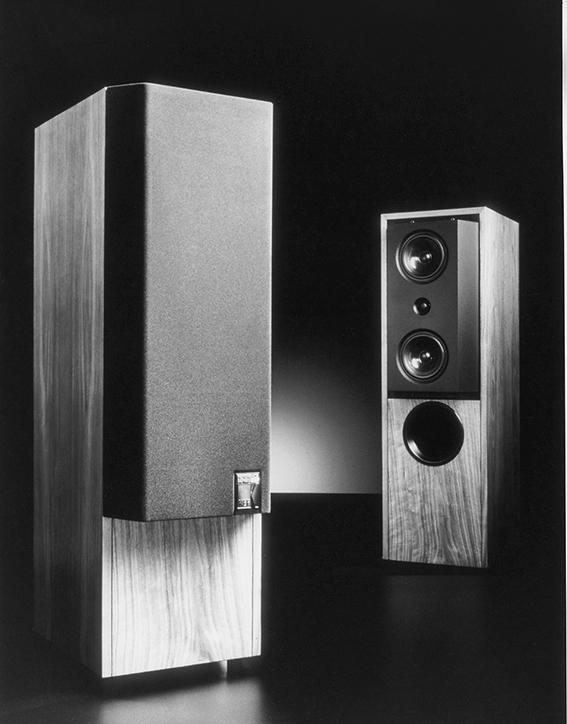

The giant professional KM1 apart, KEF has been pretty quiet in the large loudspeaker market during the past year or two. The Reference series has run on without much fanfare, and most of the action has been with the budget ‘C’ range, particularly the highly competitive Coda, now in Mark 3 guise.
Now a new Reference series speaker has finally appeared. The 104/2 has just been launched in the States at the Chicago CES, where it apparently caused quite a stir. Hopefully the ‘2’ suffix will eventually be dropped as this model is designed to occupy a similar position to the original 104, which was a runaway bestseller in its time.
Origin story
That speaker reached its peak some seven years ago, so given the inflation of intervening years, the £600 ‘Mark 2’ appears to hit the price target (although in truth loudspeakers have tended to become cheaper rather than more expensive over the period since that first 104). Looking back, the original was a two-way compact design built in a well braced and damped enclosure. The bass/midrange driver was an advanced 200mm (8in) plastic cone with a fast, light, short motor coil working in a long magnet gap, an expensive but technically rewarding technique. The equally advanced crossover was designed with an ‘Acoustic Butterworth’ response which was properly married to the drivers. The treble unit was the long established T27, a 19mm plastic dome tweeter, and an ABR ‘reflex’ radiator, based on the B139 bass unit, was fitted below the main driver to extend the low frequency response. Sensitivity was around 85-86dB/1W/1m, and the power handling between 50W-75W depending upon the type of program and the bass content. Shelf use was possible but open stands were recommended.
Scaled-up sequel
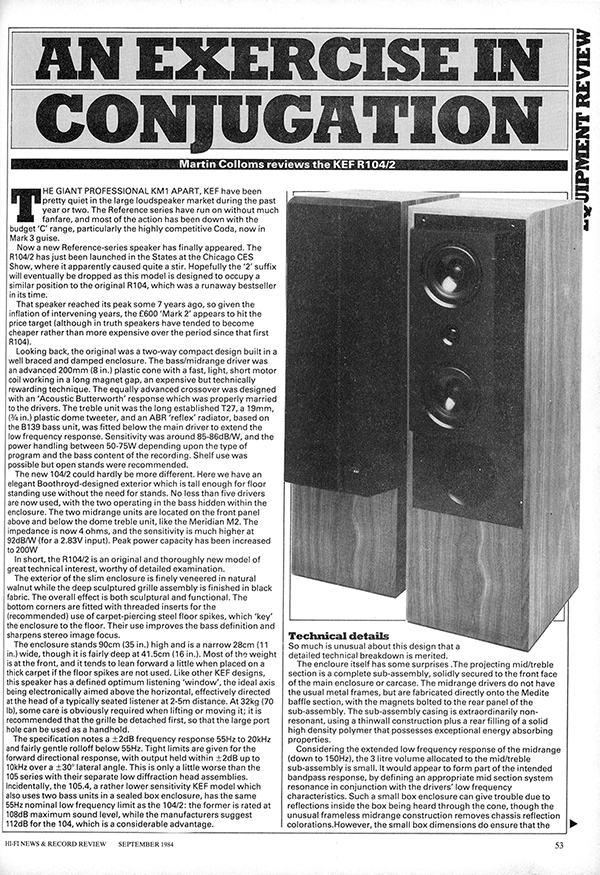
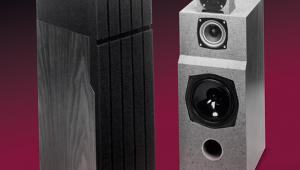
The 104/2 could hardly be more different. Here we have an elegant Boothroyd-designed exterior which is tall enough for floorstanding use without the need for stands. No fewer than five drivers are now used, with the two operating in the bass hidden within the enclosure. The two midrange units are located on the front panel above and below the dome treble unit, like the Meridian M2. The claimed impedance is now 4ohm, and the sensitivity is much higher at 92dB/1W/1m (for a 2.83V input). Peak power capacity has been increased to 200W.
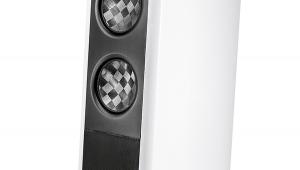
The exterior of the slim enclosure is finely veneered in natural walnut while the deep sculptured grille assembly is finished in black fabric. The overall effect is both sculptural and functional. The bottom corners are fitted with threaded inserts for the (recommended) use of carpet-piercing steel floor spikes, which ‘key’ the enclosure to the floor. Their use improves the bass definition and sharpens stereo image focus.

The enclosure stands 90cm tall and is a narrow 28cm wide, though it is fairly deep at 41.5cm. Most of the weight is at the front, and it tends to lean forward a little when placed on a thick carpet if the floor spikes are not used. Like other KEF designs, this speaker has a defined optimum listening window, the ideal axis being electronically aimed above the horizontal, effectively directed at the head of a typically seated listener at 2m-5m distance. At 32kg, some care is obviously required when lifting or moving it; it is recommended that the grille be detached first, so that the large port hole can be used as a handhold.
The specification notes a ±2dB frequency response (55Hz to 20kHz) and a fairly gentle roll-off below 55Hz. Tight limits are given for the forward directional response, with output held within ±2dB up to 10kHz over a 30° lateral angle. This is only a little worse than the 105 series with its separate low-diffraction head assemblies.
Incidentally, the 105.4, a lower sensitivity KEF model which also uses two bass units in a sealed enclosure, has the same 55Hz nominal low frequency limit as the 104/2: the former is rated at 108dB maximum sound level, while the manufacturer suggests 112dB for the 104/2, which is a considerable advantage.
Look, no frames!
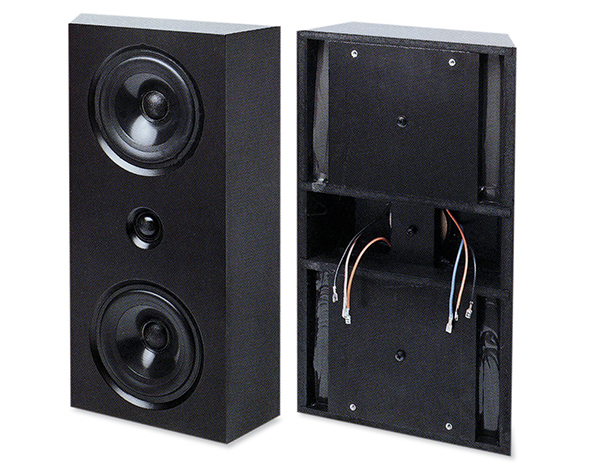
So much is unusual about this speaker’s design that a detailed technical breakdown is merited. The enclosure itself has some surprises. The projecting mid/treble section is a complete sub-assembly, solidly secured to the front face of the main enclosure or carcase. The midrange drivers do not have the usual metal frames, but are fabricated directly onto the Medite baffle section, with the magnets bolted to the rear panel of the sub-assembly. The sub-assembly casing is extraordinarily non-resonant, using a thinwall construction plus a rear filling of a solid high density polymer that possesses exceptional energy-absorbing properties.
Considering the extended low frequency response of the midrange (down to 150Hz), the three-litre volume allocated to the mid/treble sub-assembly is small. It would appear to form part of the intended bandpass response, by defining an appropriate mid section system resonance in conjunction with the drivers’ low frequency characteristics. Such a small box enclosure can give trouble due to reflections inside the box being heard through the cone, though the unusual frameless midrange construction removes chassis reflection colourations. However, the small box dimensions do ensure that the standing wave modes are located high in the frequency range where acoustic absorption can be very effective. Clearly this is the approach that KEF has chosen to adopt here.
The main carcase has a total volume of some 50 litres and is split into three sections. The upper and lower decks are separately sealed enclosures driven by 200mm bass drivers. The fabric of a bass enclosure is usually excited at unwanted frequencies by vibrations which are produced by magnet reaction to cone drive, coupled via the bass driver frames. In the past KEF engineers have reduced this by, for example, mounting the bass driver on compliant bushes to decouple it above a certain designed frequency, such as 100Hz. But excitation of the 104/2 carcase is controlled by a novel technique, combining two bass units operating in opposing directions.
Despite their physical displacement, one located in the upper and one in the lower sealed boxes, these are mechanically linked by a rigid non-magnetic tie rod. Because their frame motions are in opposition, unwanted vibrations are thereby cancelled. Furthermore, the coupled bass unit assembly is then partially decoupled from the carcase, and ‘floats’ to a small degree within the system, further reducing unwanted cabinet excitation.
Bandpass theory
The three-box construction itself results in a very rigidly braced enclosure, and there is also additional central bracing. Cabinet resonant modes are therefore well above the main bandpass of the low frequency system. A further detail concerns the large acoustic port which forms a bandpass filter for the low frequencies in conjunction with the central cavity which is shared by the bass drivers. It is not, however, a reflex port, and is based on the theory first outlined by Laurie Fincham in the 1979 AES paper ‘Bandpass Loudspeaker Enclosure’.
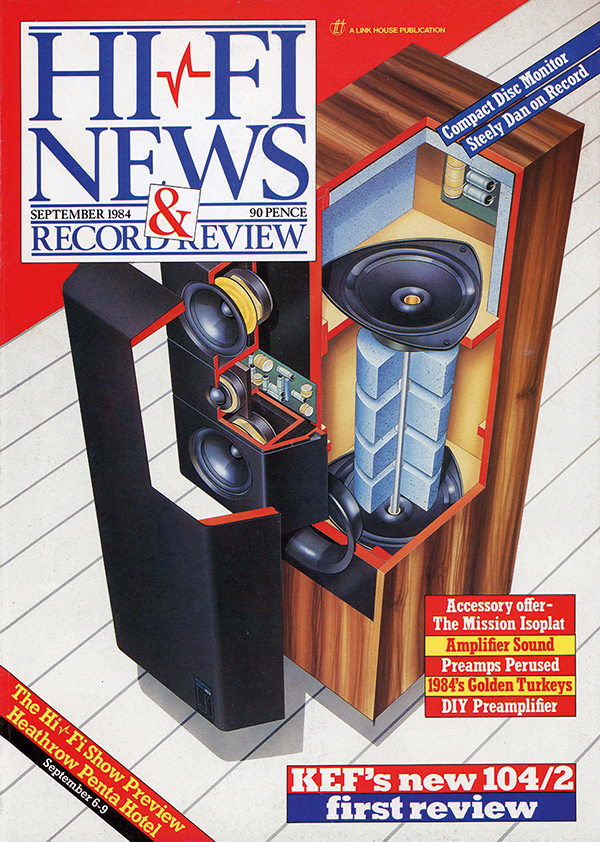
In a reflex design, a normally mounted bass driver has its output augmented by the resonance of the port. The effective mass of the air in the port reacts with the ‘springiness’ of the enclosure volume of air. In this new design, the bass drivers feed power into the central enclosure, and this is then tuned by the large port over a bandpass range of frequencies. This port is approximately the size of a 110mm driver, and is shaped to facilitate a smooth high velocity airflow free from chuffing and wind noise.
The lower frequency limit is determined from the simple equivalent circuit made up of the port air mass in conjunction with the central volume compliance, forming a second order filter. Hence the speaker has a fairly gradual 12dB/octave roll-off, compared with the higher 24dB/octave rate of a reflex box; sealed-box systems are also usually second order, and are often preferred for their smoother low frequency output.
Wave, goodbye
Above the port resonance, which is set at a fairly high frequency to maximise the low frequency power output of the bass units, the port continues to transmit audio power, acting as a ‘window’ to the sound from the two bass cones. Standing waves in the centre enclosure are controlled by the thick foam discs visible in the cutaway [see illustration, below].
The upper limit of the 104/2’s bandpass bass system is controlled conventionally by the crossover network, and is set at a lowish 150Hz. Unwanted cavity colourations are largely avoided by keeping the frequency range below the region of standing wave modes, so they cannot (in theory at least!) be excited. In practice, however, some air path leakage will occur from the midrange sub-assembly into the lower bass cavity which will try and excite its modes.
The air mass in the port, weighing about 3g, acts as a low mass, perfectly suspended linear piston of great excursion capability (calculated to be in the region of 5-10cm, compared with the 1cm or so allowed for a coned driver). This is the secret of the 104/2’s high power handling and claimed low distortion at low frequencies. The port design gives it a high volume velocity, and it can pump lots of pure bass. The enclosure grille has been designed as an integral part of the system, and although it works well with it removed, the final touch of response integration only occurs when it is in place – a rare accomplishment.
Maximum power
Inherited from KEF’s 105 and 101 models (to name but two), the 104/2’s mid units are a new version of the popular B110. This is normally a steel-framed 110mm doped Bextrene cone unit, and its original version is still found in the LS3/5A, Linn Isobarik and Kan. The two midrange drivers work in parallel for maximum power handling, which is necessary because of the speaker’s 150Hz lower crossover point. A delay is applied to the upper unit to provide directional control of output in the vertical plane.
The treble is handled by a version of KEF’s T33 25mm doped fabric dome tweeter. This has a large magnet and ferrofluid damping to maximise thermal power handling and reduce the dynamic compression which can occur due to an excessive temperature rise in the voice-coil. Such a rise increases the electrical resistance, which then mis-matches the crossover (and conjugate impedance network) and attenuates the output, compressing the signal over a long time constant and altering the frequency response. All the units are effectively vertically in line, providing lateral radiation symmetry and encouraging stable stereo imaging.
Innovation continues in the electrical characteristics of the speaker. When aiming at a high sound output it is clear that a prime objective must be to extract as much power (ie. pure volts x amps = watts) from a modern amplifier as possible. Given a maximum power input, the speaker itself should also be made as efficient as is practicable for the price, bearing in mind the constraints of the desired low frequency bandwidth and a uniform axial frequency response with low colouration.
Most modern amplifiers have load-tolerant output stages with good current capacity in order to meet the demands made by many modern loudspeakers. While nominally rated at 8ohm, many multi-way designs can draw currents which are out of phase with the supplied voltage, at levels which are equivalent to the demands of a 2-4ohm resistor. Indeed, tests for such tolerance are now routinely applied to amplifiers.
Demand and conquer
For years KEF has argued in favour of properly designed 8ohm impedance speakers, but now with the 104/2 it has chosen to exploit the status quo in return for higher apparent sensitivity. Since most amplifiers will now produce around twice their 8ohm rated power when driving a laboratory 4ohm resistor (in anticipation of even more severe speaker demands), KEF decided to make this new loudspeaker behave like a 4ohm laboratory resistor. When compared with 8ohm speakers, the 104/2 draws twice the power to provide 92dB/1W characteristic sensitivity at 1 metre. But this watt is related to an 8ohm load, so in truth the 104/2 is really an 89dB/1W 4ohm speaker.
It is worth pointing out that although amplifiers behave better driving pure resistors, such a load draws more real power. Consider a conventional multi-way speaker with an 8ohm rating. At certain frequencies the impedance modulus might drop temporarily to 5ohm, while on short complex transient peaks the overall current drawn could reflect, say, 3ohm. But averaged over a longer period of time, the load of a nominal loudspeaker equivalent is probably nearer 12ohm.
On such a load the amplifier is gently cruising in thermal terms compared with its continuous 8ohm rating. In contrast, the 104/2 will continuously demand 4ohm power delivery. When driven hard, I would expect amplifiers to run pretty hot, and this indeed was the case. Consequently, if long-term high levels are required, amplifiers with good 4ohm continuous ratings should be used. Furthermore, as the 104/2 load is constant with frequency, some amplifiers may not sound as loud on peaks with the 104/2 as on other loudspeakers. This will be a particularly true of valve models with their highish output resistance and very good delivery into higher impedances.
On the plus side, the resistive nature of the loudspeaker means that peak current protection circuits in some amplifiers are less likely to be triggered, so with many amplifiers the 104/2 may actually sound louder – only trial will decide.
Made to match
How has KEF managed to flatten the impedance curve and remove the reactive phase components? The answer lay in exploiting its computer-aided crossover design facility to incorporate a compensation called ‘conjugate impedance matching’. In essence this is simply a series of electrical networks of resistors, inductors and capacitors which cancel all the peaks and compensate for the phase shifts, resulting in a low constant input resistance for the system. In practice, it is too difficult to add such a network to the crossover after the design has been completed; rather the compensation needs to be incorporated from the outset. Initially compensation is made for each driver’s natural impedance curve, which would otherwise vary with frequency. The compensated drive is then fed an equalised signal to impose the required acoustic response.

Additional impedance compensation then takes account of the equalisation which itself has added a reactive impedance variation. Finally, the crossover network proper comes next and is almost an ideal textbook type, thanks to the use of fully compensated drivers and equalisation. The desired listening axis tilt is accomplished by an all-pass delay network in series with the upper midrange driver, and this also requires compensation in turn.
The end result, using a textbook load-matched crossover, is that the highly complex speaker system has a flat resistive input characteristic. Choice of loudspeaker cable becomes less critical with the 104/2, since a high series resistance cannot change the frequency response. Conversely, high resistance wire will result in some power loss, and the use of long lengths of spaced twin cable with significant loop inductance may give rise to some high frequency attenuation.
As much as 1.2dB loss at 20kHz is possible with the 104/2 load, so the manufacturer has left a touch of rising inductive impedance in the high frequency range to help offset this cable effect. Due to its controlled loading, the 104/2 is an excellent choice as an analytical tool for speaker cable evaluation.
Electrical connection is made via sturdy 4mm socket/binding posts. As one might expect in a high power speaker, there is (optional) overload protection for the high frequency section, to protect it in cases of gross clipped overdrive. The useful floor spikes have already been mentioned, and it should be noted that their threaded holes communicate with the lower bass chamber, so would constitute a leak which would affect the bass if they are not fitted.
 Explicit sounds
Fitted with the floor spikes, the speakers were first tried at the normally optimum position, 0.8m from the back wall, 1.3m from the sides and angled in towards the listener. We later experimented with straight ahead positioning and back-to-wall placement. The listening chain consisted of Absolute Wire loudspeaker cable, Krell KSA50 and Magnum 350W power amplifiers, Sugden and DNM preamplifiers, a Yamaha CD-X1, and an Alphason/Lux 300/VdH MC1 disc source.
From the first the 104/2 proved to be most impressive. Areas of its performance were exemplary, and these catch one’s attention at first hearing. The midrange was crisp, clear and full of sparkling detail, giving the impression of great clarity and transparency, while the treble was unobtrusive in a musical sense, sounding essentially smooth yet revealing considerable detail and tone colour. The usual ‘wispy’ or ‘gritty’ effects found with many soft dome tweeters appear to have been kept under control.
The 104/2’s bass was ‘punchy’, giving clean attack with a lack of boom and an ability to ‘play tunes’ evenly in this register. The stereo was to KEF’s traditional high standard – stable and well-focused, with both depth and width dimensions properly represented. Here the midrange clarity proved an asset, giving a transparent ‘life’ to the stereo images, and in the conventional sense, colouration levels were as low as the fine engineering approach promised. The usual ‘boxiness’ particularly associated with larger enclosures was quite absent, and the stereo soundfield was well detached from the enclosure positions.
As auditioning proceeded, however, there developed an awareness of something ‘strange’ about this speaker, which even now I can only imperfectly characterise in terms of colouration and stereo balance. The sound was somewhat ‘thin’ tonally through the mid register, favouring violin at the expense of cello, for example.
Hard and fast
Alternatively, the ‘edge’ and attack, rather than the natural ‘thwack’, was favoured on percussion. Singing voices were ‘lightened’, and grand piano lacked some of the body resonance which helps provide the sense of scale of the instrument. On some piano records the effect was mildly ‘clangy’, though midrange resonances were not identified as such. Further up the range, a hint of sibilance emphasis was noted in a frequency band which can and did lend a touch of metallic hardness on some program excerpts. On occasion a deficiency of ‘air’ and ‘sparkle’ was noted.
At times the speaker could also sound a trifle ‘brash’ and ‘up front’, while heavy driving beyond the 200W peak program level resulted in a rather rapid increase in hardness and related aggressive tendencies. Below 200W everything seemed to be in good control, however, with no audible evidence of low frequency limiting or distortion; in my room a pair reached a maximum SPL of 110-112dB!
In relation to the mid and treble tonal quality, the midbass sounded mildly depressed and also somewhat disembodied. Though it may be put down to my imagination (or the power of technical suggestion), I began to feel that the bass register had a ‘separate’, filtered ‘bandpass’ quality to it, different to the pistonic bass from the open face of a wide range bass driver. Comparison with the Celestion SL600 suggested that the smaller loudspeaker could occasionally provide more information about the character of bass instruments.
The 104/2’s bass ‘speed’ and ‘punch’ seemed rather too consistent over a range of program and instruments. The speaker actually worked best with somewhat ‘laid back’, largescale material, played at realistic but not outrageous levels. I found the sound too ‘hard’ and ‘forward’ at high volume settings, though the speakers did have undeniable impact when played loud; for example, James Newton Howard And Friends [Sheffield Lab] came over well, as did the Telarc CD of the Saint-Säens ‘Organ’ symphony. Several ‘rock’ CDs sounded less attractive, however, including Phil Collins’ Hello, I Must Be Going! [Virgin]. The 104/2 clearly has some attractive and positive elements, but by the end of the auditioning I was not wholly won over.
Turn it up
Here we have thoroughly modern loudspeaker design, bristling with unusual and advanced design techniques which make it a pleasure to evaluate. In objective terms it is capable of high sound pressure levels – the sort more usually associated with Tannoy and JBL. Although the distortion performance is misleadingly specified in my opinion, it is nonetheless very good judged by normal standards.
The frequency response is mostly uniform, if mildly uptilted, while off-axis measurements show fine consistency and uniformity with the axial output. The voltage sensitivity was high, and the 4ohm resistive loading will exploit the potential of most good transistor power amplifiers very well.
Sonically the 104/2 delivers an explicit and articulate sound that is well controlled in all departments. Stereo images were well presented, if more forward than the norm, and the transparent midrange quality could be most rewarding. Tonally it seemed on the ‘thin’ side of neutrality, and did not really suit either my room or my system (in marked contrast to a decade or so’s experience with many KEF designs produced under the direction of Laurie Fincham).
While it has many good points, this speaker is not for me. However I shall await with interest the reactions of other reviewers, who may well weigh the balance of strengths and weaknesses rather more favourably than I.
Forward thinking
Nor do I feel that my reservations in this review should be taken as a defeat for the many new technical aspects of this model. Indeed it could easily have fared less well without these.
Looking back at these results, my main reservation seems to be the 104/2’s perceived tonal balance, where I consider that a mid plateau is audible, which accounts for part of the ‘forward’ quality we noted, in conjunction with the energy lift in the lower treble. I had a similar experience when assessing early samples of the Meridian M2 system, which has the same narrow frontal configuration of two closely related midrange units, with a central tweeter.
However, my standards for tonal balance are high, and judging by the reaction at the recent CES, the new 104/2 could well be a strong contender in a number of markets.











 SPONSORED VIDEO






| Equipment Reviews |  |
Music Reviews Awards | |
Latest News Features | |
Resources Newsletters | |
Subscriptions |
WHERE TECHNOLOGY BECOMES ENTERTAINMENT
 © 2026 Hi-Fi News
AVTech Media Ltd
All rights reserved