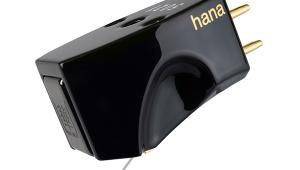
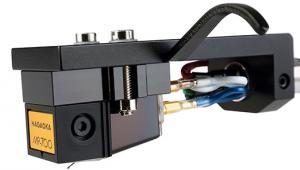
Hana Umami Black MC cartridge Boxout
The cantilever is the single connection between the stylus in the groove and the coils that cut through the lines of magnetic flux. Ideally it must be both infinitely stiff and have vanishingly low mass – an impractical ask, to be sure, although a diamond rod gets closest in the trade-off between stiffness and density. Diamond’s 1200GPa Young’s Modulus is twice that of boron (a more popular choice), about 3x that of ruby or sapphire, and a full 15x that of aluminium, though, as mentioned, it is slightly denser, increasing the cantilever’s mass.
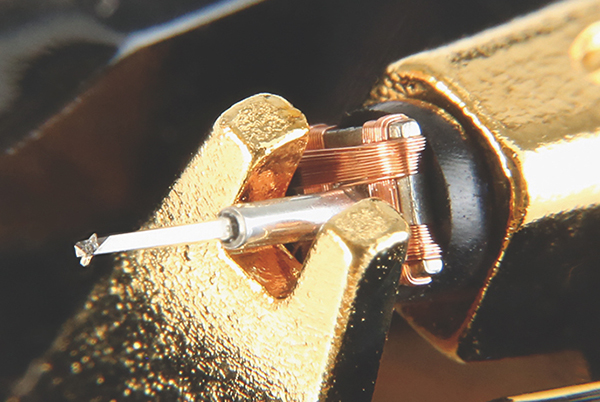
The latter influences transient and HF response, so while a diamond cantilever shifts its own bending/twisting resonant modes out beyond the audioband, the designers’ thinking must also turn to reducing the (moving) tip mass. Ortofon, for example, typically glues its styli in place [HFN Dec ’22], minimising the ‘size’ of the diamond tip. Hana, instead, uses less glue but a slightly larger diamond tip that’s bonded into a laser-cut hole in the end of the cantilever [see picture, above]. The diamond rod, in turn, connects to the square, carbon-infused nickel/iron armature, complete with 4N copper coils, via a duralumin sleeve. The latter side-steps the need for another glue joint while also providing additional high frequency damping – Hana uses the same technique to sleeve the boron cantilevers of its Umami Blue and Red models [HFN Dec ’20]. The main damper – a black polymer ring – can be seen behind the coils. PM
 | |||||||||||

|
|
| |||||||||













 SPONSORED VIDEO






| Equipment Reviews | |
Music Reviews Awards | |
Latest News Features | |
Resources Newsletters | |
Subscriptions |
WHERE TECHNOLOGY BECOMES ENTERTAINMENT
 © 2026 Hi-Fi News
AVTech Media Ltd
All rights reserved