Eversolo Play streaming amp
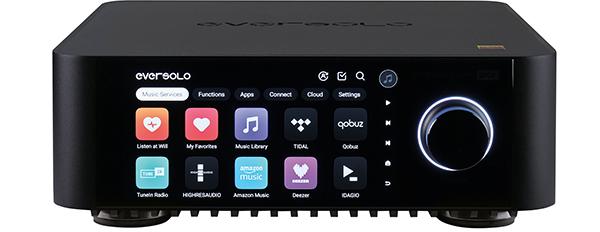

In the wake of well-established products such as the Sonos Amp and Bluesound’s Powernode, we’ve seen a slew of compact all-in-one amplifiers from brands including Denon, Marantz [HFN Aug ’24] and WiiM [HFN Nov ’24]. Now Chinese company Eversolo enters the fray with an offering that, while not the most affordable of its ilk, is keenly priced if you consider its extensive list of features. The Eversolo Play, at £599, even boasts a touchscreen displaying the Android-based interface also found on the brand’s DMP-A10 [HFN May ’25] and DMP-A8 [HFN May ’24] streaming DAC/preamps. Want more? For £699 there’s a CD Edition of the Play that is virtually identical but adds a side-loading CD drive for playback/ripping.
Trooping the colour
There’s no faulting the fit and finish of Eversolo’s affordable amplifier, from its curved-edge CNC-machined aluminium enclosure to its solid speaker binding posts. That 5.5in touchscreen, smartly integrated into the front panel, is an eye-catcher too, as is the large volume control next to it. This has an illuminated RGB ring that changes colour depending on music playback status, etc. It’s dimmable if desired, like the screen, but this fun side is part of the Play’s appeal. For the main screen, you can stick to a relatively subtle display of album art and metadata when listening to music, but more ‘showy’ options include various flavours of VU meter and bouncing equaliser bars.
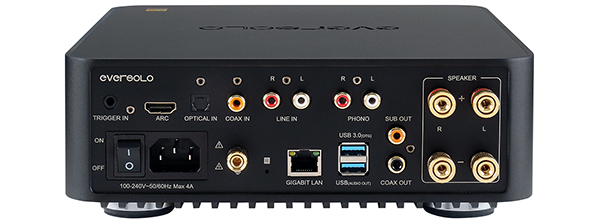
Compact streaming amplifiers tend to be true to their name – small and focused on wired/wireless music playback, with an HDMI eARC connection often thrown into the mix to handle TV audio. The Play fits this description, but it’s certainly not limited to those two functions. Considering its modest size, just 23cm wide and 7.5cm high, it’s impressive how many connections Eversolo has packed into the unit’s rear panel. Here, there are the HDMI and RCA line-level inputs you would expect, but also a pair of USB-A ports, optical and coaxial digital inputs, and a dedicated phono input.
As Eversolo believes very much in the ‘everything but the kitchen sink’ approach, the last of those caters to both MM and MC cartridges (albeit without adjustable loading or gain), while the USB ports are usable not just for storage but also for driving an external DAC or active speakers. Effectively, this means you can retain the Play as a dedicated streamer, should you later decide to upgrade to a more powerful integrated amplifier. Other connections include coaxial and subwoofer outs, the latter with extensive integration options.
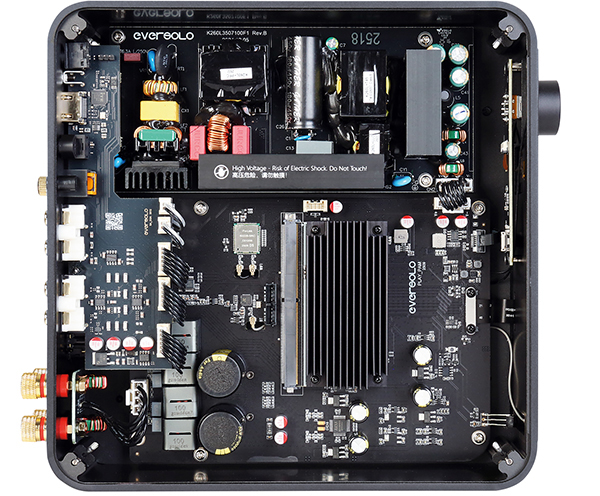
The Play features a major visual update to the company’s software, introducing an easier-to-use menu structure. Nonetheless, there are so many options here, reflecting the amplifier’s wealth of features, that you might feel a bit lost to begin with. It’s worth persevering, however, not least because the Play’s settings include useful sound adjustment tools. Next to bass management, there are wide-ranging EQ/DSP options, plus room calibration. This works with the mic built into your smartphone, but you can also wield a dedicated measurement mic with calibration file if you have one. Eversolo itself sells the EM-01, with tripod stand, for around £70.
The Android-based nature of Eversolo’s software means you can complement its many built-in music streaming options with extra installable apps. This opens the door to services such as Apple Music and Spotify, just two examples you won’t find fully integrated on other networked amplifiers (with the exception of Sonos). In fact, there are two ways to introduce Apple Music to the Play amplifier – one semi-official app with the best visual integration, or a ‘sideloaded’ option which looks less inviting but does offer the service’s hi-res (up to 192kHz/24-bit) audio streams.
Head in the clouds
Next to the built-in options, Eversolo’s amp also works with the Connect versions of Qobuz, Tidal and Spotify, should you be familiar with their own apps. Streaming over Roon is another option, as well as the JPLAY platform and Bluetooth. It can also play just about any music file from attached storage or over the network, or from cloud-based services like Dropbox or OneDrive. The list seems never to end. The analogue stage, meanwhile, features an AKM AK4493SEQ ‘Velvet Sound’ DAC chip.
Control of the Play is through either the touchscreen or the Eversolo Control app – there’s no supplied remote, although the company’s BTR-V16 handset is an optional extra. The app really benefits from improvements made to the UI, meaning it is easier than before to peruse a music library. Most of the amplifier’s menu options are accessible here, but if something is missing a ‘cast’ option mirrors the front-panel display of the Play on your mobile device. This is particularly handy with self-installed apps, as these aren’t natively integrated into Eversolo’s Control app.
During my time with the Eversolo Play I experimented with various speaker pairings. As PM’s Lab Report suggests [see Lab Report], in theory this 2x60W/8ohm-rated unit will drive a good variety of loudspeakers, but the combination will not always perform as expected [see boxout]. For example, the comparatively costly EPOS ES-28N [HFN Jul ’25] and Radiant Acoustics Clarity 4.2 [HFN Oct ’25] sounded rather ‘flat’ with this small amplifier. Triangle’s affordable BR04 bookshelf speakers seemed a far more fitting match, as did some upscale DALI Rubicon 2s.
 Surprising sounds
As well as using the Play as a network player, I connected a Technics SL-1200GR2 turntable [HFN Sep ’24] to its phono input. This proved to be a genuine surprise – fitted with a reasonably high-end Nagaoka MP-700 MM cartridge [HFN Aug ’25], the system reproduced Arlo Parks’ My Soft Machine [Transgressive 5400683101985] with wonderfully smooth detail. Nor did the Play’s phono stage disappoint with the brooding tracks on Radiohead’s A Moon Shaped Pool album [XLLP790X], giving the piano notes on ‘True Love Waits’ a strong, resonant tone while also unearthing the mechanical instrument sounds on this surreal closing track.
The amp’s phono stage is admirably quiet, allowing this detail to shine through, and listening with an Ortofon Quintet Bronze showed the Play is very MC-friendly too. That said, a dedicated phono amp will probably be more appropriate if you’ve invested in an expensive moving-coil cart!
There was no discernible difference in sound quality with digital music played from my own collection housed on a NAS, or via Qobuz, Tidal and Apple Music. Eversolo’s amp also performed well when fed various different file formats from local storage. An advantage here is the manufacturer’s custom EOS (Eversolo Original Sampling) engine, which allows for the Android back-end to pass a claimed ‘bit-perfect stream’ to the Play’s AKM DAC.
Pint-sized power
The fluid, lifelike flamenco guitar on ‘Hable Con Ella’, from the soundtrack to Pedro Almodóvar’s film of the same name [Milan; 44.1kHz/24-bit], was a reminder that even affordable hi-fi can offer an enthralling listen. This melodramatic piece by composer Alberto Iglesias weds a languid orchestra to the masterful playing of Vicente Amigo, a sweeping contrast that was crisply portrayed by the Play driving the DALI speakers. The pint-sized amp positioned these strands as discrete layers, although it should be noted that its out-of-the-box ‘tuning’ (with no EQ engaged) did seem to bring a gentle roll-off to the highest treble.
The Play also revelled in the startling musicianship across cellist Leyla McCalla’s A Day For The Hunter, A Day For The Prey [Jazz Village 33570116; 96kHz/24-bit], while ensuring her vocals were strongly presented throughout. At the start of the title track, McCalla’s plucking of slightly dampened strings has the potential to sound very artificial, but these small details were naturally defined, remaining present even when fiddle and banjo joined in. The cello was also rendered with the requisite texture, imbuing this album’s folk-inflected songs with plenty of character.
Smaller, atmospheric sounds, such as the triangle on ‘Les Plats Sont Tous Mis Sur La Table’, also emerged convincingly from the mix. The Play did a fine job of conveying the music’s spacious nature, and with good pacing. Indeed, this is an area where Eversolo’s amplifier showed itself to be a leader in its ‘affordable do-it-all’ class.
Although TI’s Class D solutions are a decent option for ‘budget’ amps, in my experience, when listening critically, the music is not always entirely free of harshness. Yet the Play was largely immune when streaming Anoushka Shankar’s Between Us... Live [Leiter; 96kHz/24-bit]. In this set, the sitar player performs with the Dutch Metropole Orkest, and her virtuoso playing is the highlight of tracks like ‘Maya’ and the nimble ‘Chasing Shadows’. The orchestra was not lost in the background, though, as this amp’s open, clean sound certainly added to the ‘live’ sensation.
While the partnering speakers clearly play a critical role here, the Play delivered the necessary drive and soundstage detail, allowing Shankar’s music to shine beautifully. The old ‘good things, small packages’ phrase comes to mind.
Hi-Fi News Verdict
Currently, no other compact amp offers the same wealth of streaming options, connectivity and features as Eversolo’s Play. And, despite the down-to-earth pricing, the brand’s software isn’t diluted here – essentially you get the same possibilities as its high-end streamers, albeit with a less advanced analogue stage. Build quality is also superb for the price, nicely complementing what is a strong sonic performance.Sound Quality: 87%
 | |||||||||||

|
|
| |||||||||










 SPONSORED VIDEO






| Equipment Reviews | |
Music Reviews Awards | |
Latest News Features | |
Resources Newsletters | |
Subscriptions |
WHERE TECHNOLOGY BECOMES ENTERTAINMENT
 © 2026 Hi-Fi News
AVTech Media Ltd
All rights reserved