EAR Yoshino V20
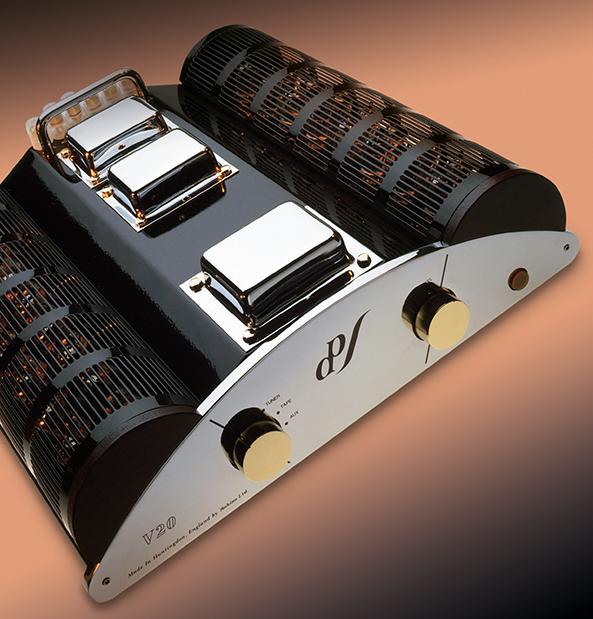

Leave it to Tim de Paravicini to come up with something so deliciously twisted that no tube crazy can resist it. The new EAR Yoshino V20 integrated amplifier, despite costing a not-unreasonable-by-today’s-standards £2495, looks like nothing else and sports a quantity of tubes rivalled by few. Hell, the only items I can think of off-hand with similar numerical appeal – more tubes than any sane person would deem necessary – are high-enders like the GRAAF GM200 OTL with its 16 output tubes per channel, and the recent Silvaweld design with 48 per monoblock.
Ten by two
Now the V20 isn’t quite up in that league in tube count, but neither is it in price. Better still, its profusion of glassware is of the common-as-muck variety, so here’s a rare chance to have a plethora of tubes without living in fear of the cost of re-valving the beast. That’s because Tim has chosen to use as output tubes ten ECC83s per channel – hence the model number.
Actually, the name ‘V20’ was inspired by Tim’s passion for cars (he is known to drive in a ‘spirited’ fashion), in particular the V12 Jaguar engine. The prototype amp had a dozen output valves, and the company was tempted to call it the V12 Amplifier Engine. However, Tim decided to uprate the project to the present V20 specification, with no fewer than 20 output valves. But then the amp is also known in-house and among cultists as ‘Mickey Mouse’ because, when viewed from the front at eye-level, its volume and source controls resemble a pair of eyes, and the half-cylindrical tube covers look like that famed rodent’s ears. Or EARs, if you prefer.
Steampunk style
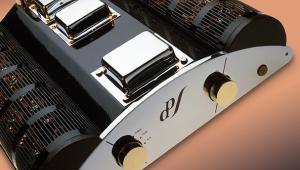
And it’s a gorgeous, covetable little thing, a tidy 427x139x426mm (whd), weighing a chunky 20kg, and sporting steampunk looks through its mix of materials. It’s that Victorian Modernist vision which makes this appear like a prop from Nemo’s Nautilus – gold-plated knobs and connectors, chromed fascia and transformer caps, black cages over the tubes and wooden end-pieces in what looks like a very dark rosewood. The lefthand knob selects one of five inputs, the right takes care of level, while at the far right-hand ‘point’ is an on/off button which glows orangey-yellow, as per earlier Yoshino products.
Neat touches abound, like a chrome rail protecting the CE-approved, yet still multi-way, binding posts mounted on the top, at the back of the row of transformers. For those who still use banana plugs, in defiance of the Brussels mandarins, deft use of a screwdriver removes the safety caps. Output terminals are provided for 4, 8 or 16ohm loudspeakers, and you’ll want to optimise the impedance matching because this is, after all, a mere 24-watter. The rear panel contains gold-plated binding posts for the five line-level sources and tape output.
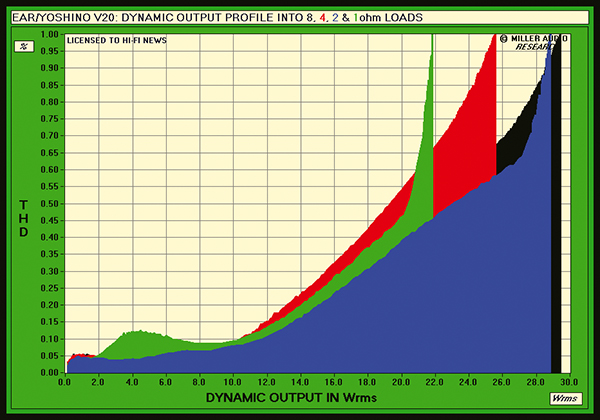
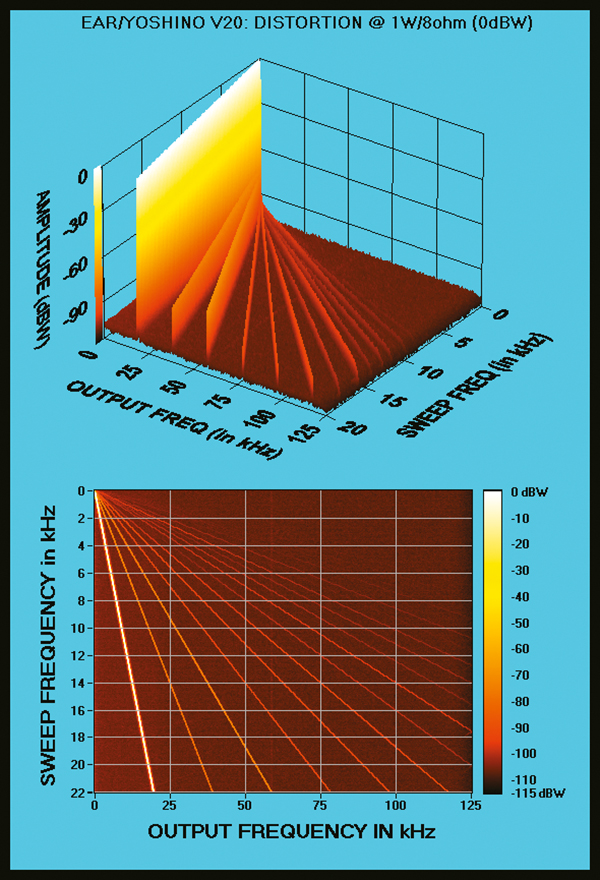
Above: Paul Miller provided the lab report to accompany Ken Kessler’s review. Above is an early example of the dynamic power profile graph seen in today’s HFN reviews while below is a 3D rendering of the V20’s THD versus frequency (re. 1W/8ohm)
As part of the Yoshino DNA chain, the V20 amplifier is a break away from what Tim describes as ‘the currently fashionable approaches of pentodes and tetrodes in ultralinear configuration and of large direct-heated triodes’ (although remember that Tim was one of the first in the West to get involved with the Single Ended Triode revival). Instead, the V20 uses parallel-connected ECC83 (aka 12AX7) indirectly heated double triodes in the output stage.
Most of us think of these only as preamp tubes, or drivers. Even so, Tim set them up to deliver just under 2.5W each, for an integrated amplifier rated at 24W/ch, in push-pull, pure Class A mode. A further five tubes per channel complete the lineup, including three more ECC83s for the input stages and a pair of ECC82 driver tubes. Again, this amp ain’t gonna break its owners when re-tubing time comes around.
Fun, fun, fun
For those who recognise the Yoshino line as a source of iconoclastic treasures, the V20 will prove to be as much fun and as much of a challenge as the still-hard-to-beat EAR 859 [HFN Nov ’94]. That 13W single-ended triode design will be looked upon by anachrophiles of the year 2025 as having been as much a pioneer in its genre as the Krell KAV-300i [HFN Apr ’96] and the Audio Research CA50 in theirs. This whole back-to-integrateds revolution is far from over – what’s so refreshing is that it has yet to impose design limitations in overall topology, so a firebrand like Tim de Paravicini can still come up with dazzling, innovative gems like this.
And a gem it is, a bijou tchotchke which confuses you thusly: does one take it po-faced seriously, or treat it as one would the EarMax or an X-Series module – as a source of grinning-ear-to-ear fun? However funky the styling, however much you want to cuddle it and give it a nickname and festoon it with white gloves, yellow shoes and a girlfriend named Minnie, something keeps telling you that you’re in the presence of a radical new listening tool. And that something is a freedom from colouration, nastiness and grunge which you simply do not associate with 20 tubes of the most blindingly ordinary variety.
The car analogy of Tim’s is perfect, because the way he’s transformed the ECC83 into an output tube of note recalls a point raised in Richard Williams’ stunning story of Damon Hill’s championship year, Racers. Williams reminds the reader of geniuses such as Colin Chapman, who took a complete piece of junk – the ludicrous and overrated-by-jingoists Austin 7 – and turned it into a world-beater. Not that the conditions are the same here: Chapman was working in shortage-riddled post-war Britain, whereas Tim and other modern tube designers are spoiled for choice. They can even buy brand-new 300Bs made by Western Electric if they so desire. But nearly the same spirit which inspired Chapman has been employed by de Paravicini, that of turning something intrinsically common and cheap into something truly wonderful.
 Think again
Now I’m not suggesting for a moment that the ECC83 is anything less than an all-time classic tube... but for preamp usage. Who’d have thought that it could ‘out-sweet’ an EL34? That it could match a KT66 for midband warmth, or rival a 6550 for speed? And without a single trace of edge, grit or any other artefact you might correlate with being over-driven?
But let’s get real: two dozen watts is still only a smattering of grunt, just right for 90dB-plus speakers, or oddballs like the 15ohm LS3/5A with its narrowly defined power handling, or the original Quad ESL, designed to work with 15W of Quad II juice. Although the V20 is far more generous than the average SET, it still imposes restrictions on the choice of loudspeakers you may use. But why worry? The V20 owner is just as entitled to create a system with horns or other high-sensitivity aberrations as would any SET user.
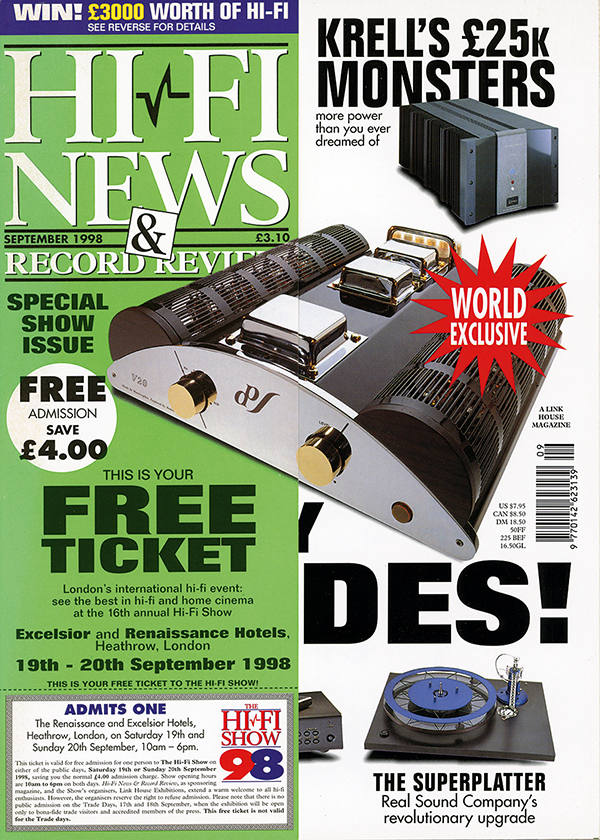
Above: There were two ‘world first’ reviews in HFN Sep ’98 – the EAR Yoshino V20 and Krell’s FPB-650 monoblock amp
Don’t confuse the V20’s performance with that of a typical SET just because it shares the latter’s limited power. EAR Yoshino’s amp assiduously eschews the very elements of SET sound which undermine the breed’s undeniable strengths. Where the latter is sweet but soggy, the V20 is sweet yet controlled and precise. Where a SET is so warm and forgiving that you feel something must have been sacrificed, the V20 is equally emotion-laden and lifelike, but also detailed, dynamic and commanding.
Having it all
Listening to this amplifier is very much a case of experiencing the same delights which make caviar more delicious than a pickled egg, a wristwatch more covetable than a wall clock, a Lotus 7 more fun to drive than a Ford Sierra (bad analogy: a rickshaw is more fun to drive than a Sierra). It’s quality over quantity. The V20 somehow manages to deliver the high-end virtues of a big, layered soundstage, fast dynamic swings, low colouration, natural timbre and everything else we crave, but in a package shorn of excess. If only to explain my indecision – is the V20 a novelty or a revolution? – the listener has to be re-educated to accept that you can have all of those highly desirable qualities in a package which doesn’t happen to include an overabundance of power as part of the recipe.
The only sacrifice you have to make is to stick with whatever high-sensitivity speakers suit your budget. Which is my way of saying that, alas, one of the dream loudspeakers for mating with the V20 in a small- or medium-sized room is the Wilson WATT/Puppy System 5.1 – possessing high sensitivity yet betraying none of the compromises associated with most speakers of that ilk. But the price is way out of the V20’s ballpark, so it’s back to old Quad electrostatics, LS3/5As and horns which don’t make you want to pour molten lead into your ears.
Conclusion
Again, why worry? However much harder is your task of finding the right speakers, the V20 is worth the effort, because what I think we’re witnessing here is Tim de Paravicini’s finest moment. And that’s scary, when you consider that even his disasters are better than most designers’ triumphs. Buy a V20 now, before EAR Yoshino’s tube supplier puts two and two together, and starts pricing ECC83s as if they were KT88s.
 | |||||||||||

|
|
| |||||||||










 SPONSORED VIDEO






| Equipment Reviews | |
Music Reviews Awards | |
Latest News Features | |
Resources Newsletters | |
Subscriptions |
WHERE TECHNOLOGY BECOMES ENTERTAINMENT
 © 2026 Hi-Fi News
AVTech Media Ltd
All rights reserved