EAR Yoshino V20 Boxout
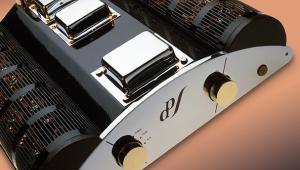
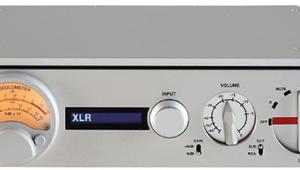
Given the unusual nature of the V20, it’s over to Tim de Paravicini for a succinct description of the circuitry: ‘The output stage is unique in several respects. First, it uses ten ECC83 “small-signal” triode valves, with ten triode sections in parallel per phase. Although this valve is normally only capable of passing small currents, it is used in EAR’s Enhanced Triode Mode (originally applied to triode-connected pentode valves), whereby the grid is maintained positive with respect to the cathode, so that the grid current normally flows. Under these conditions the valve behaves effectively as a current-controlled device, rather than the more normal voltage-controlled mode’.
Another of Tim’s signature features in the output stage is the use of his ‘Balanced Bridge’ connection: ‘Unlike the usual push-pull output, in which signal is taken only from the anodes of the output valves, the transformer windings are split equally between the anode and the cathode circuit of each phase, and opposite anodes and cathodes are coupled via a capacitor to ensure symmetry – especially at high signal levels where one phase turning on hard forces the opposite phase to turn off correctly.
‘Additionally, “Balanced Bridge” output connection provides, via the various primary windings on the transformer, signals suitable for the application of nested feedback and bootstrapping to earlier stages in the circuit. Because the output stage has only unity gain (referred to the grid of the output valves) and draws significant signal current, the second stage and the cathode follower stage (which provides the necessary current) must swing high signal voltages, so their anodes are bootstrapped from the output transformer to ensure linearity. Signals are also taken from the transformer to provide “nested feedback” to the cathodes of the input and second stages. Both stages are differential for optimum symmetry and noise rejection’.
 | |||||||||||

|
|
| |||||||||

















 SPONSORED VIDEO






| Equipment Reviews | |
Music Reviews Awards | |
Latest News Features | |
Resources Newsletters | |
Subscriptions |
WHERE TECHNOLOGY BECOMES ENTERTAINMENT
 © 2026 Hi-Fi News
AVTech Media Ltd
All rights reserved