Dynaudio Confidence 20A active loudspeaker
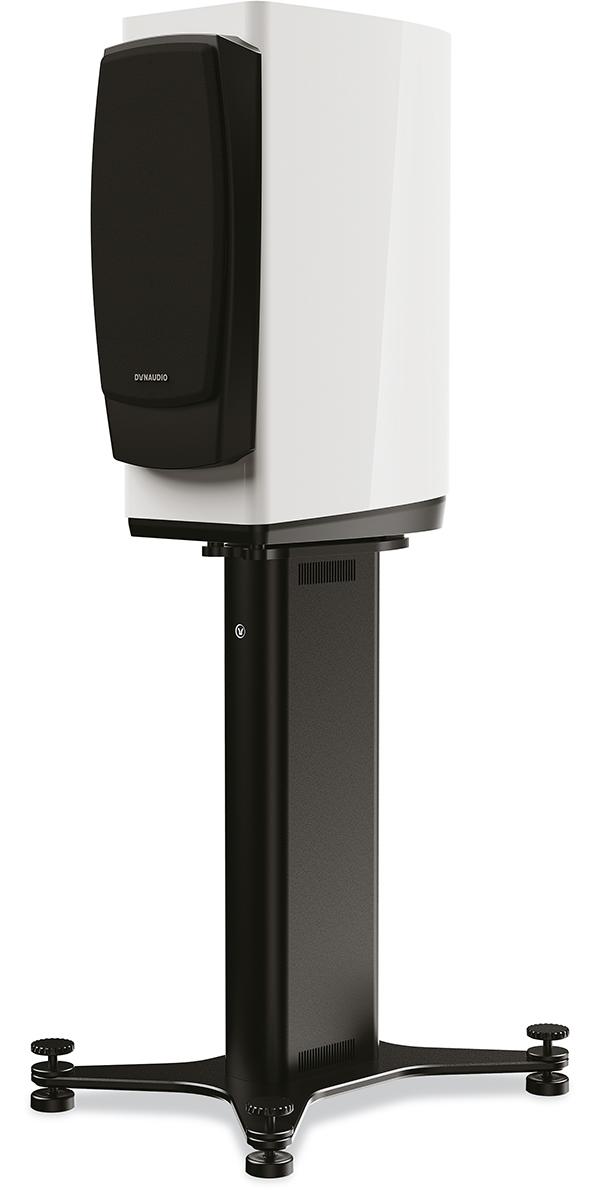

Dynaudio’s collection of passive loudspeakers is substantial. You begin with the Emit series and move through its Evoke line, various Contour models [HFN May ’25], and the Heritage and Special Forty one-offs, before you get to the flagship Confidence range [HFN Jan ’25]. On the other hand, active options are more limited, with – until recently – just the three-strong Focus series appealing to cable-cutters. Now, though, the Danish brand has added the Confidence 20A, priced £17,000.
You might infer, from the name, that this is ‘just’ an active version of the £9600 Confidence 20, but the Danish brand is at pains to point out there’s more to it than that. Certainly, the ’20A looks visually similar to its passive sibling, but Dynaudio says ‘the only untouched parts are the tweeter and the feet’ plus ‘some screws and the logo’. In effect, it’s an all-new design, and one that’s slightly smaller in all three dimensions to boot.
Focus finale
While an active speaker with onboard DSP and digital connectivity, the Confidence 20A isn’t networked. There’s no streaming provision, wired or wireless, and no companion app for system settings and music playback. These are features of Dynaudio’s Focus series, so we must assume their omission is deliberate – the ’20A, while having ease of use in mind, is aimed at existing audiophiles who want to continue using their high-end source hardware. Dynaudio also proposes the ’20A as the ‘end product’ of Focus owners – if they can be weaned off playing music direct from their smartphones…
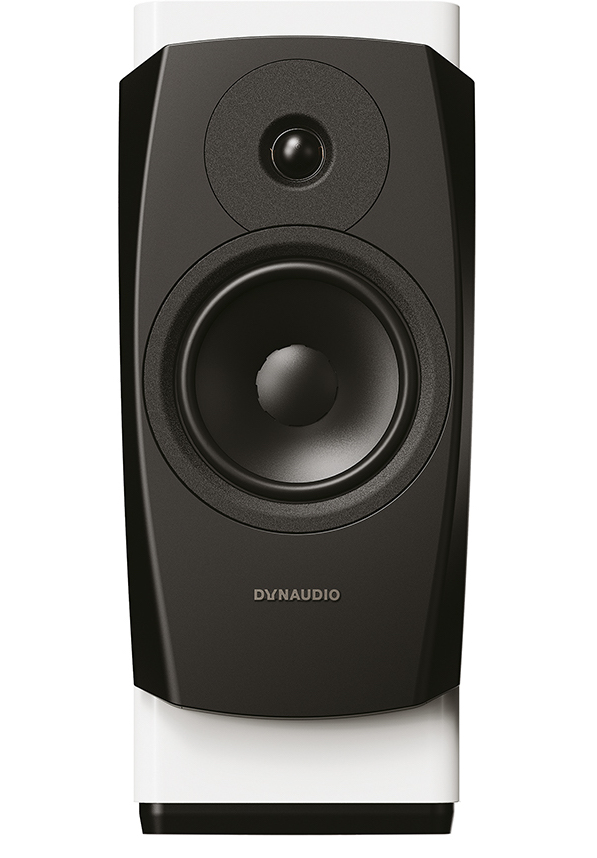
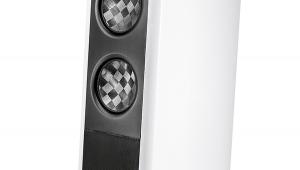
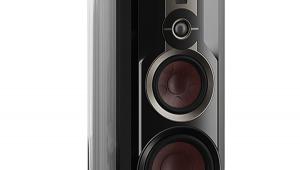
The speaker is a two-way standmount, quite slim at 206mm wide but tall at 500mm and nearly 400mm deep. The cabinet, like the passive Confidence 20, has curved sides and tapers to the rear, but that model’s blonde, ruby and raven wood colourways aren’t carried over. Instead, there are new High Gloss Space (black) or High Gloss Snow (white) options, both looking strikingly modern and beautifully finished. Choose either and you still get a black front baffle – sculpted from Compex, a hardened foam – to match the loudspeaker’s black driver housings.
Spikes ’n’ smarts
The slender stands, supported by outrigger feet with spikes/pads, are black too. As with the Confidence 20, these aren’t optional because the speakers feature a down-facing port (more on which later). In this instance, though, they also house the Confidence 20A’s amplification/electronics [see boxout] – clever, as it means Dynaudio hasn’t had to compromise on its enclosure design, driver integration or cabinet porting. The manufacturer also says that the aluminium stand, which is vented towards its top, acts as a heatsink for the amplification.
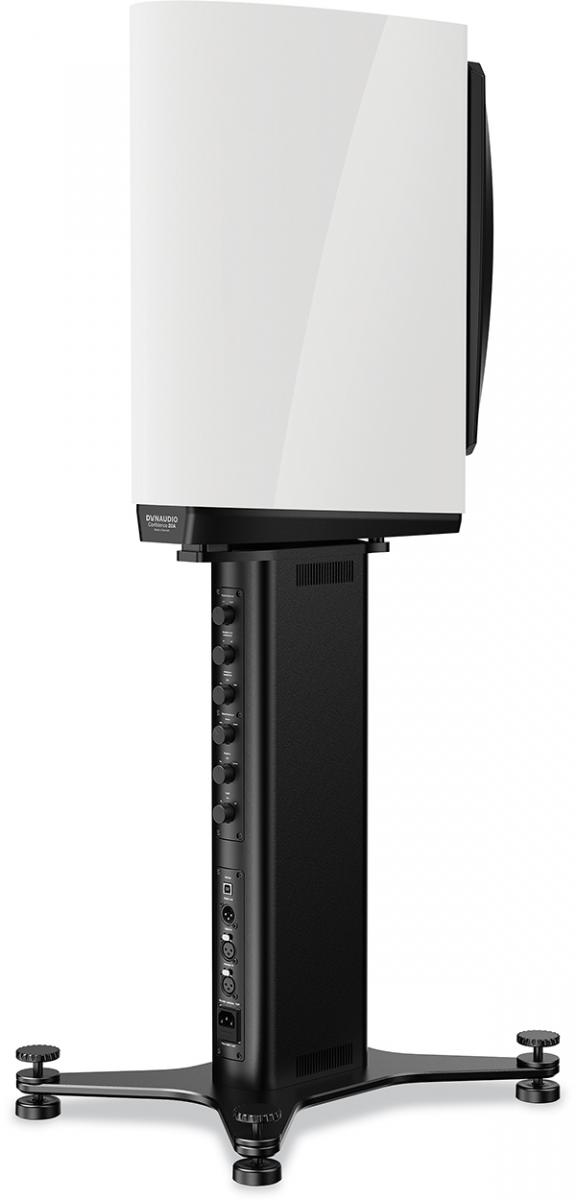
Connections, located on the bottom rear of the stand [see pic, below] for discreet, floor-level wiring, are single balanced analogue and AES/EBU digital inputs on XLRs. When using the digital in, a corresponding digital output links the two speakers together. The USB-B port is for service only and doesn’t allow a USB source to feed into the Confidence 20A’s DAC stage.
Above these sockets are control knobs for setup and day-to-day ‘tuning’. As these are on both stands it’s possible to make changes to one speaker and not the other – useful, perhaps, in sub-optimal rooms. There’s a ‘Position’ control, with its Free, Corner and Wall options, and a three-position ‘Sound Balance’ control [see PM's Lab Report]. Other options are dim/off/on for the illuminated power/status light located on the front of the stand; left/right channel assignment for when a digital source is used; ‘Analogue Sensitivity’ to match source to the speaker’s ADC (the status light flashes red if input clipping occurs); and digital sample rate conversion [see boxout].
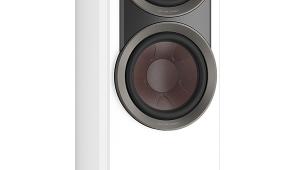
As for the drivers, the tweeter carried over from the Confidence 20 is Dynaudio’s Esotar 3, an evolution of a soft dome some 40 years in the making, and featuring a secondary internal ‘Hexis’ dome plus neodymium magnet. The 180mm NeoTec woofer, with MSP (Magnesium Silicate Polymer) cone and neodymium motor, is specifically optimised for this active iteration. Additional fettling can be found in the loudspeaker’s ‘Exponentially Shaped Dual Flared’ (ESDF) port, which promises to fine-tune airflow, reduce port noise and deliver both a more extended low frequency response and higher maximum SPL than the passive model.
 Full-scale fun
The first impression of the Confidence 20As is that, despite their modest dimensions, they don’t lack for performance scale. Their sound is focused and precise, rather than huge and enveloping, but used in the HFN Listening Room with Constellation’s Revelation 2 preamplifier [HFN Jan ’25] and the dCS Varèse DAC [HFN Feb ’25], and placed 3.6m apart, they didn’t feel dwarfed by the 50m2 space.
Part of this sense of scale comes from the low-end performance. Set to ‘Free’ positioning and with the Sound Balance control on ‘Neutral’, the Confidence 20As had no trouble digging deep into the bass effects and percussion of ‘Electrified’ by Boris Blank [Electrified, Universal Music; 88.2kHz/24-bit], at times layering a subtle, low swell that – with the 180mm driver in view – came as something of a surprise.
Indeed, the bass performance of the ’20A isn’t merely ‘good for a small speaker’, it’s good for a speaker, full-stop, strong not just in the upper basses but also deep down. ‘Rust’, by Black Label Society [Stronger Than Death; Spitfire Records] contrasts acoustic guitar arpeggios with long, low bass notes, and these oozed from the ’20As with solidity. Koan Sound’s ‘Infinite Funk’ [Destiny EP; OWSLA], moved from the ’70s nostalgia implied by the title of the track – all leading-edge slap bass and Nile Rodgers-style guitar – to full-on nightclub lunacy, as electronic bass surged in and out around staccato rhythms.
Sparkle in the rain
This transient snap is surely indicative of the active design – cabinet and direct-coupled amps and drivers are engineered to work together. And unsurprising, considering the manufacturer claims the DSP and amplification is leveraged from its studio-grade Core speakers, is the 20A’s neutral tonality. On occasion, such as with the synths and guitars of Dire Straits’ ‘So Far Away’ [Brothers In Arms, 2025 remaster, UMG; 44.1kHz/24-bit], I wouldn’t have minded more colour to the sound, the kind of warmth and rosiness that makes listening sessions utterly relaxing. Switching between the Dark, Neutral and Bright settings does not entirely rectify this, but there’s the scope to massage the sound through choice of partnering preamp.
This neutral voicing doesn’t come with any over-eagerness in the higher frequencies. Dynaudio’s Esotar 3 tweeter is very well-behaved, always sounding smooth and refined, so that the closely mic’d acoustic guitar on Mathilde Storm’s ‘Cries Like A Baby’ [self-released] had a natural, gentle sparkle. Equally, her vocals cut through the instrumentation with ease, giving insight into every lilt and pause in the breathy delivery. The speakers sounded sublime here: intimate, focused and captivating.
Swiss/American avant-garde artist Zeal & Ardor’s ‘Fend You Off’ [Greif; self-released] also benefited from this eloquent top-end, both in the light-touch rendition of the glockenspiel and a smoothing of the coarse, distorted guitars. True, after the crescendo midway, the staging of this track sounded cluttered and indistinct, but this is reflective of the low-fi vibe of the material. Better, and again showcasing the speakers’ ability to present a meaty sound, were the dramatic soundscapes of the same artist’s ‘Golden Liar’ [Zeal & Ardor, MKVA; 44.1kHz/24-bit], where a looped guitar line reverbs into a wide space, joined by floor-toms and ominous chants.
Speaking of space, these loudspeakers proved masters of describing the width and depth of recordings. During Billie Eilish’s ‘Ocean Eyes’ [Don’t Smile At Me, Interscope; 44.1kHz/24-bit], the popping electronica framing the central piano and vocal seemed to cocoon me from both sides. Similarly, Hans Theessink’s ‘St. James Infirmary’, recorded live for his 70 Birthday Bash album [Blue Groove; 96kHz/24-bit], painted a thrilling picture of the bluesman on stage, his baritone vocals resonating in the acoustic. Minor details, such as a tapped guitar body or finger slide, were vividly rendered, as was the enthusiastic audience applause.
Runnin’ Right
Once again, I was convinced by the Confidence 20A’s ability to draw you in with its controlled, accurate demeanour. But what about letting loose? Given Van Halen’s ‘Runnin’ With The Devil’ [Van Halen; Warner Bros. 192kHz/24-bit], the speakers gave an upbeat, foot-tapping performance worthy of this classic album opener, from the slamming drums and David Lee Roth’s acrobatic vocals to the distinctive ‘brown tone’ of Eddie Van Halen’s guitar. That it all sounded deftly separated, detailed and tight, rather than ragged, is to their credit.
Hi-Fi News Verdict
An active speaker chiefly designed to work with audiophile analogue sources, the Confidence 20A stands apart from its all-singing, all-dancing networked rivals. This would be a concern if the performance didn’t merit the flagship positioning, but Dynaudio’s elegantly styled (and innovatively engineered) speaker offers beautifully judged sonics. Bass is a revelation, and there’s detail and dynamism to spare.
Sound Quality: 88%
 | |||||||||||

|
|
| |||||||||











 SPONSORED VIDEO






| Equipment Reviews | |
Music Reviews Awards | |
Latest News Features | |
Resources Newsletters | |
Subscriptions |
WHERE TECHNOLOGY BECOMES ENTERTAINMENT
 © 2026 Hi-Fi News
AVTech Media Ltd
All rights reserved