Canor Virtus A3 integrated amp with DAC
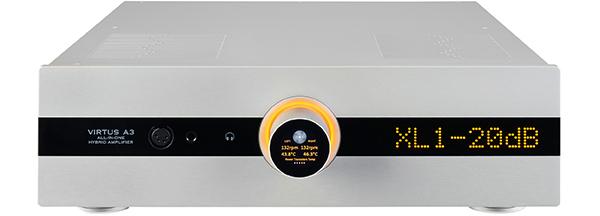

There’s a back story to the Virtus A3, Canor’s curious integrated dual-mono hybrid amplifier. I first encountered the design at the brand’s impressive factory in Prešov, eastern Slovakia, but this was in the summer of 2023, long before production versions rolled off the line. At the time the amplifier looked close to completion and was demonstrated playing into FinkTeam’s Borg loudspeakers. However, changes to the specifications along the way, including a decision to increase its power output to 2x100W/8ohm, ensured its development took rather longer than anticipated.
While Canor has a respectable track record designing and building tube-based amps in-house [HFN Jun ’24], next to extensive OEM manufacturing, it tapped roving designer, John Westlake, to aid in fashioning the Virtus A3. Westlake, something of a hi-fi celebrity, has designed lauded devices, including Audiolab’s M-DAC [HFN Sep ’12 & Jun ’16] and multiple products for Pro-Ject [HFN Sep ’19], a company which just happens to have strong ties to Canor. For the Virtus A3 he has dusted off the venerable current-dumping design from P.J. Walker unveiled in the Quad 405 [see boxout].
Twist and shout
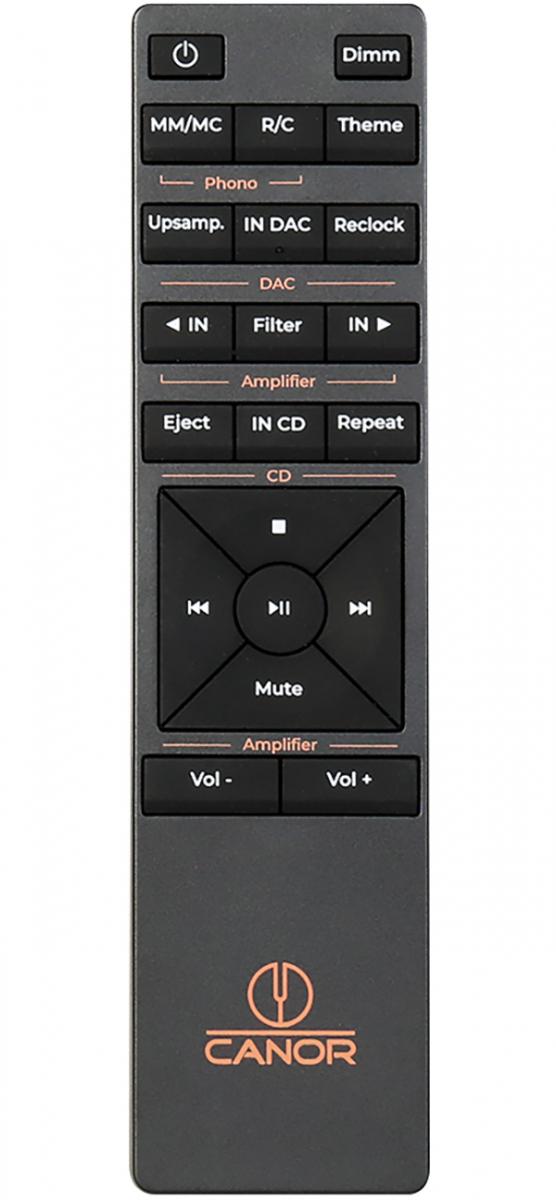
The Virtus A3 is Canor’s first all-in-one amplifier. Usually, such a label suggests streaming onboard, but that’s one area the manufacturer has always avoided. Instead, it provides a high-quality MM/MC phono stage and a headphone amplifier, next to a broad range of digital and analogue inputs. Not HDMI ARC, though, something of a standard on do-it-all amps. Still, while this £6000 all-in-one doesn’t include the usual feature set, it does have other intriguing things to offer – starting with a novel volume control.
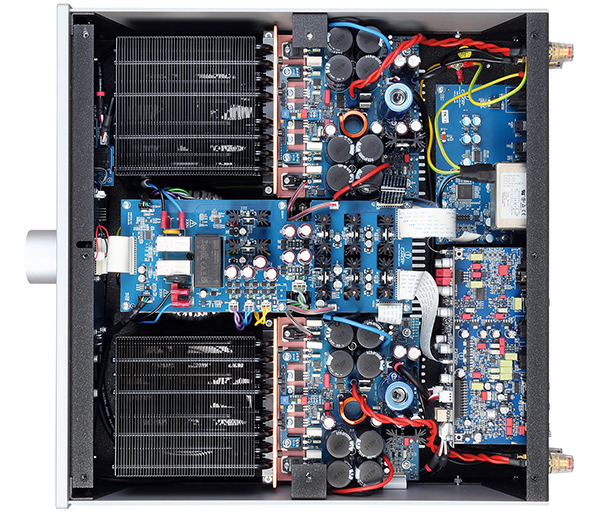
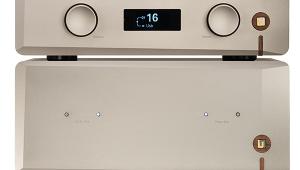
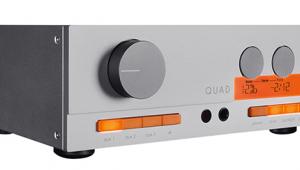
The application of a consistent ‘design language’ is a strength of the company as virtually all its products feature luxurious-looking aluminium housings, anodised black or silver. Another recurring feature is a front facade dissected by a black strip of glass, which harbours a large orange dot-matrix display [see pic, below]. The latter gives Canor products, including the Virtus A3, a very distinct look, intended to reference glowing tubes.
A large, centrally positioned rotary is part and parcel of Canor’s design philosophy too, but this is where the Virtus A3 amplifier breaks new ground. There is a chunky control, but its centre remains fixed. Why? Because this is actually a touchscreen providing access to the amplifier’s input settings, configuration menus and status displays, including temperature and fan operation [see p75]. There’s also some smart technology behind this attention-grabbing display, including a CCD photoelectric sensor that captures the movement of the rotary’s edge to offer very precise ±0.5dB volume adjustments. Neither is this rotary/display a one-off, as Canor’s upcoming Virtus I4S, an affordable solid-state amp, is set to feature a slightly larger version still. This is a good thing, as the A3’s 1.3in/33mm-diameter display does feel a touch cramped.
Under the hood
Over the past 30 years Canor has focused on tube electronics, with in-house burn-in and pair-matching for all its valves. Indeed, with few exceptions, all Canor amplifiers, D/A converters, phono preamplifiers and CD players contain tubes. The Virtus A3 is no exception to this rule, incorporating two E88CCs in the differential input/voltage stage of what is a two-part dual-mono current dumping amplifier.
Both the analogue and digital signal paths remain ‘dual mono’ in layout with a pair of ES9038 DACs handling audio data from six alternative digital inputs. This includes USB for a PC or a digital transport, and this has received extra attention in the form of galvanic isolation, with RF filtering and data reclocking to attenuate jitter. The five analogue inputs include two pairs of balanced XLRs and a decent, fully discrete phono input, offering MM and MC compatibility. That’s uncommon, and even rarer is that you can adjust the cartridge loading via that touchscreen interface.
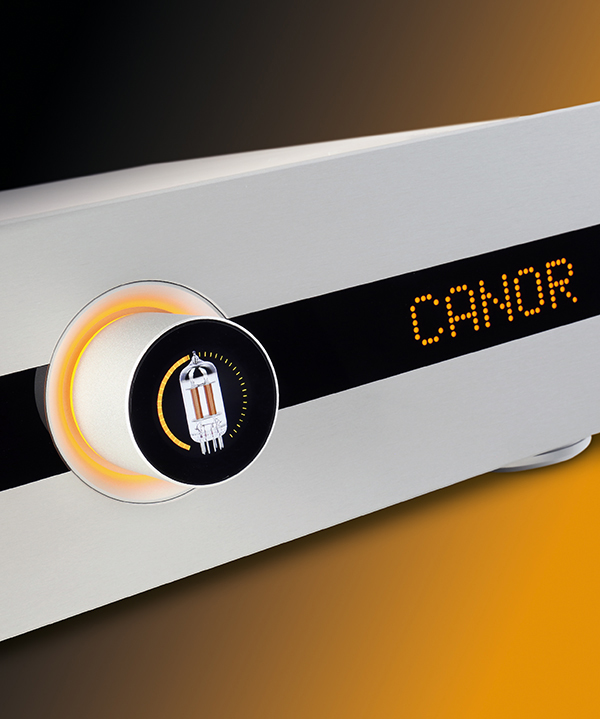
The least you can say when peering under the hood is that the interior of the Virtus A3 is densely packed. Typical for the brand are Canor’s ‘etched’ blue PCBs populated with a huge number of components. This ‘stuffed’ feeling is increased by the presence of an elaborate fan-assisted cooling system, and because Canor has elected to use discrete circuitry over op-amp ICs in the audio signal path.
 Going for gold
I auditioned the Canor amp with two very different sets of floorstanders. Monitor Audio’s Gold 300 6Gs [HFN Oct ’24] are all-round performers and dovetailed particularly well with the Virtus A3, while some pricier Børresen X2s, which possess a more revealing character, would perhaps have benefitted from an amplifier with a bit more dynamic ‘pep’. While this model’s sound could never be described as soft, I enjoyed the smoothness the Virtus A3 added to the midrange and treble of the Børresen loudspeakers. Yes, there are tubes in here, but they don’t impart any ‘tube-y’ distortion [see PM's Lab Report].
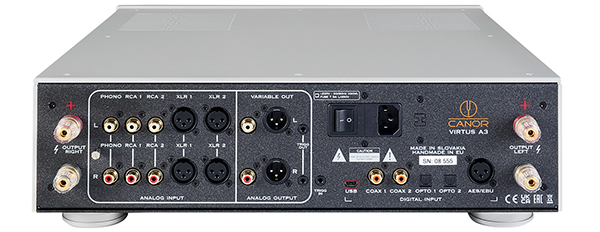
To assess the amp’s internal DAC, an Eversolo DMP-A8 [HFN May ’24] was employed as a digital transport, feeding the Virtus A3 via USB and streaming mainly from Roon. (As most amplifiers and DACs feature a USB-B port, the USB-C connection here required a moment of mental recalibration – and a hunt for a different cable.) Playing Riceboy Sleeps [Parlophone 50999 963002; 44.1kHz/24-bit], the 2009 collaboration between Alex Somers and Sigur Rós stalwart Jonsí, the amp gave a natural and lifelike portrayal of the album’s calming, ambient soundscapes. Through the Monitor Audio speakers, ‘Atlas Song’ encircled me with layers of Icelandic-style singing, and instruments (including piano and strings) retaining a discrete character.
The Virtus A3’s DAC stage also deftly handled the delicate detail throughout Chopin’s ‘Nocturne in B Minor, Lento Con Gran Espressione’, arranged by Mischa Maisky and played by cellist Camille Thomas [The Chopin Project: Trilogy, Deutsche Grammophon DG4858451; CD resolution]. A slight touch of warmth made the piano from Julien Brocal less direct, but overall, there wasn’t any sense that resolution had suffered.
Spirited away
In fact, the fast, flighty piano runs during ‘II. Larghetto’, from Chopin’s ‘Piano Concerto No.1 in E Minor’, had a light and organic feel. Just as importantly, there was sufficient airiness to deliver a convincing impression of the acoustic of the Emil Berliner Studio in which these compositions were recorded. Texturing on the cello – Thomas here uses an instrument once belonging to Chopin’s compatriot Auguste Franchomme – was also excellent, with the Virtus A3 proving its ability to serve up a rich, full-bodied midrange.
Staying with the cello, but swapping the Monitor Audio Gold 300 6G for Børresen’s X2, Four Spirits [Warner Classics 5021732778604; 96kHz/24-bit] presented more of a challenge. This 2025 album fuses European melodies with African traditions, and features Selaocoe both playing his instrument and singing. Canor’s amplifier coped easily with the increased complexity, starting with a beautiful rendition of the South African musician’s vocal, brilliantly conveying the raw texture when he veers into something more akin to roaring than singing. And when Selaocoe is joined by a choir, the amplifier’s performance grew in scale, the listening experience shifting from centre-stage focus to big and immersive.
Pops ’n’ clicks
What was undeniably present was that sensation of sitting in a large venue (in this case London’s Queen Elizabeth Hall), not far from the stage and soaking in a live, semi-improvised performance. This was especially true of ‘III. Tschepo’, which backs up its dissonant melodies with percussive thuds, and guttural pops and clicks. These unfamiliar sounds were placed precisely around the soundstage by the Virtus A3, the wide presentation coupled to a good feeling of depth.
Canor makes standalone phono preamps, including the Asterion V2 of its ‘Premium Line’ [HFN Jun ’24], and this paves the way for the high-quality phono stage in the Virtus A3. By supporting MM and MC with adjustable loading values, it’s more flexible than many phono inputs found on contemporary integrateds – budgeting for a separate phono amp may not be necessary in light of its performance. EAT’s F-Dur [HFN Nov ’25], equipped with an Ortofon MC Quintet Bronze, didn’t sound compromised playing through the Virtus A3.
Cunningham Bird’s homage to the classic Buckingham Nicks album [Cunningham Bird; Loma Vista LVR04544] made for a superb listen. The gentle, warm character of these cover versions was fully on show, but there was also plenty of finer detail to appreciate, plus the tonal contrast between Andrew Bird’s acoustic guitar and Madison Cunningham’s soft vocals.
As I continued with Tori Amos’s Boys For Pele [Atlantic/Rhino 081227947774] on a Technics SL-1200GR2 [HFN Sep ’24] with Nagaoka MP-700 cartridge [HFN Aug ’25], I was struck by the amp’s handling of her vocals. Those high, somewhat manic moments in ‘Professional Widow’ remained bright yet rounded, never once becoming fatiguing. This is a top-flight vinyl-playing front-end and the Virtus A3 allowed it to shine.
Hi-Fi News Verdict
The Virtus A3 is a very particular take on an all-in-one. While it sidesteps streaming and TV audio, a terrific phono stage and a superb DAC more than redress the balance. Putting fun at the forefront of listening, this Canor amplifier is a masterful performer that prioritises smooth sounds above brute force. Moreover, the splendid technical design may also eat into your desire for a full-on hi-fi separates system.Sound Quality: 85%
There’s a back story to the Virtus A3, Canor’s curious integrated dual-mono hybrid amplifier. I first encountered the design at the brand’s impressive factory in Prešov, eastern Slovakia, but this was in the summer of 2023, long before production versions rolled off the line. At the time the amplifier looked close to completion and was demonstrated playing into FinkTeam’s Borg loudspeakers. However, changes to the specifications along the way, including a decision to increase its power output to 2x100W/8ohm, ensured its development took rather longer than anticipated.
While Canor has a respectable track record designing and building tube-based amps in-house [HFN Jun ’24], next to extensive OEM manufacturing, it tapped roving designer, John Westlake, to aid in fashioning the Virtus A3. Westlake, something of a hi-fi celebrity, has designed lauded devices, including Audiolab’s M-DAC [HFN Sep ’12 & Jun ’16] and multiple products for Pro-Ject [HFN Sep ’19], a company which just happens to have strong ties to Canor. For the Virtus A3 he has dusted off the venerable current-dumping design from P.J. Walker unveiled in the Quad 405 [see boxout].
Twist and shout
The Virtus A3 is Canor’s first all-in-one amplifier. Usually, such a label suggests streaming onboard, but that’s one area the manufacturer has always avoided. Instead, it provides a high-quality MM/MC phono stage and a headphone amplifier, next to a broad range of digital and analogue inputs. Not HDMI ARC, though, something of a standard on do-it-all amps. Still, while this £6000 all-in-one doesn’t include the usual feature set, it does have other intriguing things to offer – starting with a novel volume control.
The application of a consistent ‘design language’ is a strength of the company as virtually all its products feature luxurious-looking aluminium housings, anodised black or silver. Another recurring feature is a front facade dissected by a black strip of glass, which harbours a large orange dot-matrix display [see pic, below]. The latter gives Canor products, including the Virtus A3, a very distinct look, intended to reference glowing tubes.
A large, centrally positioned rotary is part and parcel of Canor’s design philosophy too, but this is where the Virtus A3 amplifier breaks new ground. There is a chunky control, but its centre remains fixed. Why? Because this is actually a touchscreen providing access to the amplifier’s input settings, configuration menus and status displays, including temperature and fan operation [see p75]. There’s also some smart technology behind this attention-grabbing display, including a CCD photoelectric sensor that captures the movement of the rotary’s edge to offer very precise ±0.5dB volume adjustments. Neither is this rotary/display a one-off, as Canor’s upcoming Virtus I4S, an affordable solid-state amp, is set to feature a slightly larger version still. This is a good thing, as the A3’s 1.3in/33mm-diameter display does feel a touch cramped.
Under the hood
Over the past 30 years Canor has focused on tube electronics, with in-house burn-in and pair-matching for all its valves. Indeed, with few exceptions, all Canor amplifiers, D/A converters, phono preamplifiers and CD players contain tubes. The Virtus A3 is no exception to this rule, incorporating two E88CCs in the differential input/voltage stage of what is a two-part dual-mono current dumping amplifier.
Both the analogue and digital signal paths remain ‘dual mono’ in layout with a pair of ES9038 DACs handling audio data from six alternative digital inputs. This includes USB for a PC or a digital transport, and this has received extra attention in the form of galvanic isolation, with RF filtering and data reclocking to attenuate jitter. The five analogue inputs include two pairs of balanced XLRs and a decent, fully discrete phono input, offering MM and MC compatibility. That’s uncommon, and even rarer is that you can adjust the cartridge loading via that touchscreen interface.
The least you can say when peering under the hood is that the interior of the Virtus A3 is densely packed. Typical for the brand are Canor’s ‘etched’ blue PCBs populated with a huge number of components. This ‘stuffed’ feeling is increased by the presence of an elaborate fan-assisted cooling system, and because Canor has elected to use discrete circuitry over op-amp ICs in the audio signal path.
Going for gold
I auditioned the Canor amp with two very different sets of floorstanders. Monitor Audio’s Gold 300 6Gs [HFN Oct ’24] are all-round performers and dovetailed particularly well with the Virtus A3, while some pricier Børresen X2s, which possess a more revealing character, would perhaps have benefitted from an amplifier with a bit more dynamic ‘pep’. While this model’s sound could never be described as soft, I enjoyed the smoothness the Virtus A3 added to the midrange and treble of the Børresen loudspeakers. Yes, there are tubes in here, but they don’t impart any ‘tube-y’ distortion [see PM's Lab Report].
To assess the amp’s internal DAC, an Eversolo DMP-A8 [HFN May ’24] was employed as a digital transport, feeding the Virtus A3 via USB and streaming mainly from Roon. (As most amplifiers and DACs feature a USB-B port, the USB-C connection here required a moment of mental recalibration – and a hunt for a different cable.) Playing Riceboy Sleeps [Parlophone 50999 963002; 44.1kHz/24-bit], the 2009 collaboration between Alex Somers and Sigur Rós stalwart Jonsí, the amp gave a natural and lifelike portrayal of the album’s calming, ambient soundscapes. Through the Monitor Audio speakers, ‘Atlas Song’ encircled me with layers of Icelandic-style singing, and instruments (including piano and strings) retaining a discrete character.
The Virtus A3’s DAC stage also deftly handled the delicate detail throughout Chopin’s ‘Nocturne in B Minor, Lento Con Gran Espressione’, arranged by Mischa Maisky and played by cellist Camille Thomas [The Chopin Project: Trilogy, Deutsche Grammophon DG4858451; CD resolution]. A slight touch of warmth made the piano from Julien Brocal less direct, but overall, there wasn’t any sense that resolution had suffered.
Spirited away
In fact, the fast, flighty piano runs during ‘II. Larghetto’, from Chopin’s ‘Piano Concerto No.1 in E Minor’, had a light and organic feel. Just as importantly, there was sufficient airiness to deliver a convincing impression of the acoustic of the Emil Berliner Studio in which these compositions were recorded. Texturing on the cello – Thomas here uses an instrument once belonging to Chopin’s compatriot Auguste Franchomme – was also excellent, with the Virtus A3 proving its ability to serve up a rich, full-bodied midrange.
Staying with the cello, but swapping the Monitor Audio Gold 300 6G for Børresen’s X2, Four Spirits [Warner Classics 5021732778604; 96kHz/24-bit] presented more of a challenge. This 2025 album fuses European melodies with African traditions, and features Selaocoe both playing his instrument and singing. Canor’s amplifier coped easily with the increased complexity, starting with a beautiful rendition of the South African musician’s vocal, brilliantly conveying the raw texture when he veers into something more akin to roaring than singing. And when Selaocoe is joined by a choir, the amplifier’s performance grew in scale, the listening experience shifting from centre-stage focus to big and immersive.
Pops ’n’ clicks
What was undeniably present was that sensation of sitting in a large venue (in this case London’s Queen Elizabeth Hall), not far from the stage and soaking in a live, semi-improvised performance. This was especially true of ‘III. Tschepo’, which backs up its dissonant melodies with percussive thuds, and guttural pops and clicks. These unfamiliar sounds were placed precisely around the soundstage by the Virtus A3, the wide presentation coupled to a good feeling of depth.
Canor makes standalone phono preamps, including the Asterion V2 of its ‘Premium Line’ [HFN Jun ’24], and this paves the way for the high-quality phono stage in the Virtus A3. By supporting MM and MC with adjustable loading values, it’s more flexible than many phono inputs found on contemporary integrateds – budgeting for a separate phono amp may not be necessary in light of its performance. EAT’s F-Dur [HFN Nov ’25], equipped with an Ortofon MC Quintet Bronze, didn’t sound compromised playing through the Virtus A3.
Cunningham Bird’s homage to the classic Buckingham Nicks album [Cunningham Bird; Loma Vista LVR04544] made for a superb listen. The gentle, warm character of these cover versions was fully on show, but there was also plenty of finer detail to appreciate, plus the tonal contrast between Andrew Bird’s acoustic guitar and Madison Cunningham’s soft vocals.
As I continued with Tori Amos’s Boys For Pele [Atlantic/Rhino 081227947774] on a Technics SL-1200GR2 [HFN Sep ’24] with Nagaoka MP-700 cartridge [HFN Aug ’25], I was struck by the amp’s handling of her vocals. Those high, somewhat manic moments in ‘Professional Widow’ remained bright yet rounded, never once becoming fatiguing. This is a top-flight vinyl-playing front-end and the Virtus A3 allowed it to shine.
Hi-Fi News Verdict
The Virtus A3 is a very particular take on an all-in-one. While it sidesteps streaming and TV audio, a terrific phono stage and a superb DAC more than redress the balance. Putting fun at the forefront of listening, this Canor amplifier is a masterful performer that prioritises smooth sounds above brute force. Moreover, the splendid technical design may also eat into your desire for a full-on hi-fi separates system.Sound Quality: 85%
 | |||||||||||

|
|
| |||||||||











 SPONSORED VIDEO






| Equipment Reviews | |
Music Reviews Awards | |
Latest News Features | |
Resources Newsletters | |
Subscriptions |
WHERE TECHNOLOGY BECOMES ENTERTAINMENT
 © 2026 Hi-Fi News
AVTech Media Ltd
All rights reserved