Simaudio MOON 371 integrated amplifier
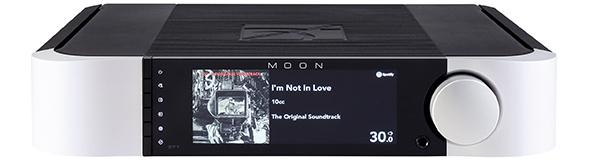

Seasoned audiophiles will remember MOON once being the name of Simaudio’s ‘reference-grade’ hi-fi hardware. But these days, the website for this Canadian marque is headlined ‘MOON by Simaudio’, and MOON, rather than Simaudio, is the branding that graces the front of its products. Moreover, Simaudio has also started curating new releases into ‘Collections’. The first of these, the North Collection, arrived in 2023 as a home for flagship models. Now we get the second-tier Compass Collection, led by the MOON 371 streaming amplifier on test here.
Priced £6250, this has both the look and specification of a thoroughly modern integrated, although the colour display that takes up the middle portion of its fascia is not, as might initially be presumed, a touchscreen. Sure, the column of illuminated icons on the left-hand side look as if they can be tapped by a finger but, in practice, it’s the discreet black buttons next to them that are used to flick through inputs and menu options.
Feedback free
The MOON 371 treads the familiar ‘just add speakers’ amplifier path, combining a bevy of wired and wireless connections with operation via smartphone/tablet app [see boxout], and a compact design. Similarly styled to previous Simaudio products, with curved cheeks at either end of a fascia that comes in either a black or silver finish, the unit looks pleasingly smart. And dimensions of 429x87x385mm (whd) should help it fit in just about anywhere.
This first product in the new Compass Collection leverages aspects of models from elsewhere in the Simaudio stable. Chief among these is the ‘MOON Distortion-Cancelling Amplifier’ (MDCA) technology, which is where the manufacturer says it ‘breaks away from traditional feedback-based’ amplifier designs by eschewing global feedback.
Key factor
Naturally, compensation is still applied to manage gain and bandwidth, and suppress both distortion and output impedance [see PM's Lab Report], but this is a proprietary ‘real-time error correction’. The 371’s MOON Hybrid Power (MHP) power supply [see pic, below] is a custom design too, a switch-mode type previously used in the company’s DACs/processors but reimagined here for duty in an integrated amplifier. The MHP is a key factor in the unit’s modest chassis size and 9kg weight without restraining the Class A/B power amp itself – conservatively rated at 2x100W/8ohm, doubling into 4ohm.
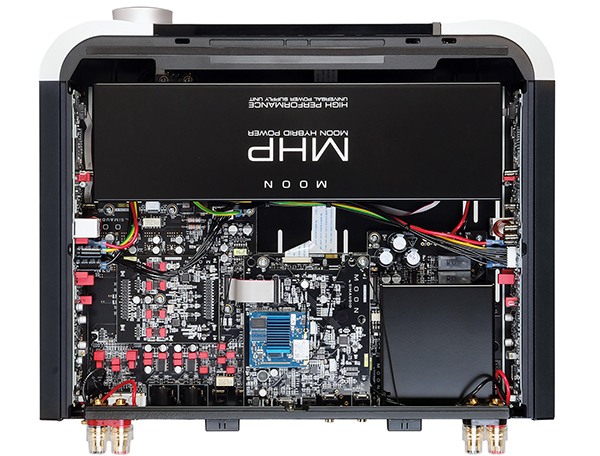
Above: Packed interior is dominated by a universal switchmode PSU [top] feeding a Stream810 module [blue, bottom] and digital PCB [left], with AK5552 ADC and ESS9039Q2M DAC, and Class A/B power amps [far left/right] each with two pairs of high current devices
On the front of the amp is a smooth-feeling volume control that switches from 1dB to 0.5dB steps as the level increases. To the left of this is a 6.35mm headphone output, which mutes the speaker outs when in use, and then the display, which offers album artwork, volume and source during playback. This screen is also used to make changes to the MOON 371’s user settings – display brightness, preset volume levels, screen saver mode, etc. Particularly useful is the ability to rename inputs via a text editor, which makes a change from selecting from a predefined list. This is a bit fiddly, however!
Back-panel connectivity is wide-ranging, although the lack of a computer-friendly USB-B input feels like a missed trick – you can, however, play from external storage through the MOON 371’s USB-C host input. For analogue sources there are balanced XLR and unbalanced RCA ins, plus a phono input switchable between MM or MC configurations, with 40dB and 60dB gain, respectively. Meanwhile, a further set of RCAs acts as a preamp output.
Digital inputs comprise optical, coaxial and HDMI ARC connections, Bluetooth, and built-in Wi-Fi and Ethernet. Two RJ45 sockets are provided, enabling the amp to work as a network extender to another device, or to become part of a ‘MOONLink Group’ whereby several MOON products can be controlled as one. Multiroom functionality extends to streaming any of the amp’s inputs to other networked MOON products. For this, an AKM AK5552 A/D converter handles analogue sources, but this is only used for the amplifier’s main output if the user selects ‘Synchronised’ mode in multiroom settings (to ensure no latency between zones).
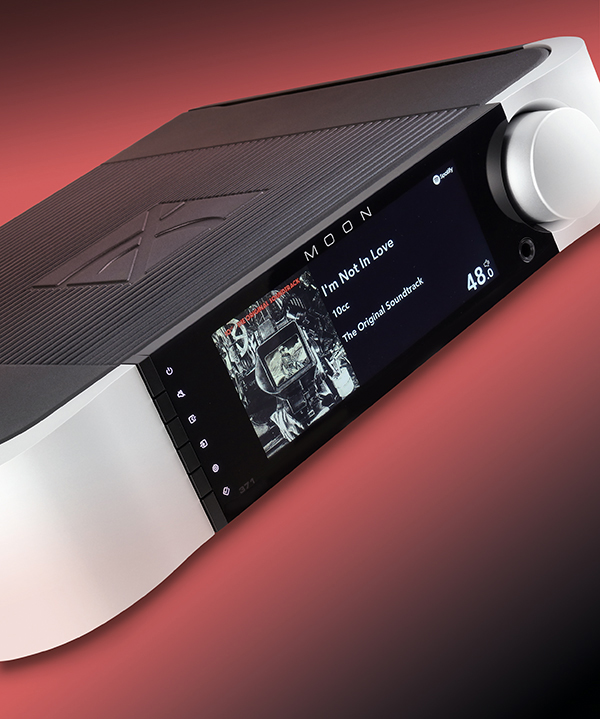
Above: The discreet black buttons next to the display are used to flick through inputs and menu options
This is, then, a very flexible device. It’s also Simaudio’s only current integrated amplifier with a DAC onboard, as models in the North Collection are intended for use with one of the series’ networked DAC/preamps. Those units – the MOON 681, 791 and 891 – utilise different configurations of ESS Sabre chips in conjunction with FPGA-based reclocking/jitter reduction. The digital stage here is less advanced, being based around a single, but well proven, ESS9039Q2M DAC.
 Clean sweep
Taking pride of place in the HFN Listening Room [HFN Yearbook ’25], driving loudspeakers including both the Wilson Audio Alexx Vfx and B&W 801 D4 Signatures [HFN Sep ’23], the MOON 371 proved that you don’t necessarily need a huge slab of electronics, or to follow the separates route, to create largescale, involving music. Yes, it’s slim of stature and rich in features, but hearing this amplifier power floorstanders through big movie soundtracks and hard rock anthems might have you wondering why you’d ever want more grunt than is on offer here.
Hand in hand with this speaker-driving ability is its very natural rendering of leading-edge detail. So the MOON 371 is quick to rise to the occasion, ensuring music never sounds sluggish. By the same token, there’s no overt warmth or diluted treble. Rather, the amplifier adopts a clean and largely neutral approach that uncovers the nature of a recording.
Given Randy Hanser’s ‘Underwater Lazarium’, from the American musician’s Funtown album [Jazzhaus Records JHR 115], the MOON 371 dug deep into the fat basslines and electric guitar licks, delivering a tangibly full-range and rich sound. It was also able to coax the big Wilson Alexx Vfx speakers into the immersive, wall-to-wall presentation with which I’ve become familiar. There’s a vast price gap between those speakers and this amp, but the latter was clearly not operating out of its depth.
Weight and see
The more ‘ethereal’ aspects of Hanser’s nine-minute piece carried a little bit of grain, lacking that last touch of air and sweetness. These include his slightly processed vocals, delivered in the style of Mark Knopfler, and the high steel strings on his acoustic guitar. Yet this didn’t prevent the piece from sounding superb overall, with fine dynamics and weight – a performance of scale and tonal richness.
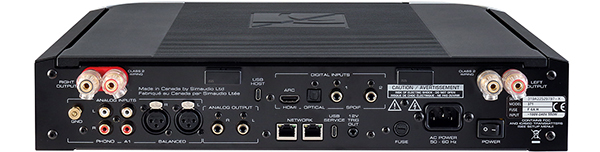
Above: Single 4mm speaker binding posts and preamp outputs (on RCAs) are joined by MM/MC phono and two line ins (one balanced on XLR). Streaming is offered via wired Ethernet (x2) and wireless with digital ins on optical, two coaxial (to 192kHz), a USB-C host port for external drives (to 384kHz and DSD256) and HDMI ARC (48kHz)
The MOON 371 gave a spirited, revealing rendering of Katie Melua’s ‘On The Road Again’ [Piece By Piece, BMG; CD res], which spotlights the singer’s exemplary vocal talents against a bluesy backdrop of acoustic guitar, brass and piano. There was nothing shy or receding about this performance, the sound leaping forward to almost touch the listening seat, every transient detail leaned into with gusto. By comparison, her twee breakout hit ‘Nine Million Bicycles’ took on a sweeter, more flowing feel, without the amp veering into honeyed, softly-softly territory.
Bass bounty
Just as Melua’s vocals sounded floaty and smooth through the MOON 371, the cigarettes-’n’-whiskey growls of Johnny Van Zant across Lynyrd Skynyrd’s acoustic Endangered Species [Volcano 82876 55128 2] were roughly detailed, as appropriate. However, listening to ‘Devil In The Bottle’ it did feel as if the singer was spread a little too wide, not quite drawn sharply centre stage amid the instrumentation. This vaguely diffuse flavour was also noted with Ry Cooder’s ‘Theme From Southern Comfort’ [Ry Cooder Anthology: The UFO Has Landed; Warner/Rhino 8122-79891-9]. Yes, the snap and twang of his slide guitar was all there, but perhaps it was not so ruthlessly defined.
The Mathilde Storm ballad ‘Cries Like A Baby’ [Propeller Recordings download] has a sparkling vocal track that runs the risk of listener fatigue. The MOON 371 delivered it with no shortage of presence and detail, while avoiding the gritty treble that has one reaching for the volume control. The fulsome bass on this recording, both soft yet robust-feeling, was another standout element.
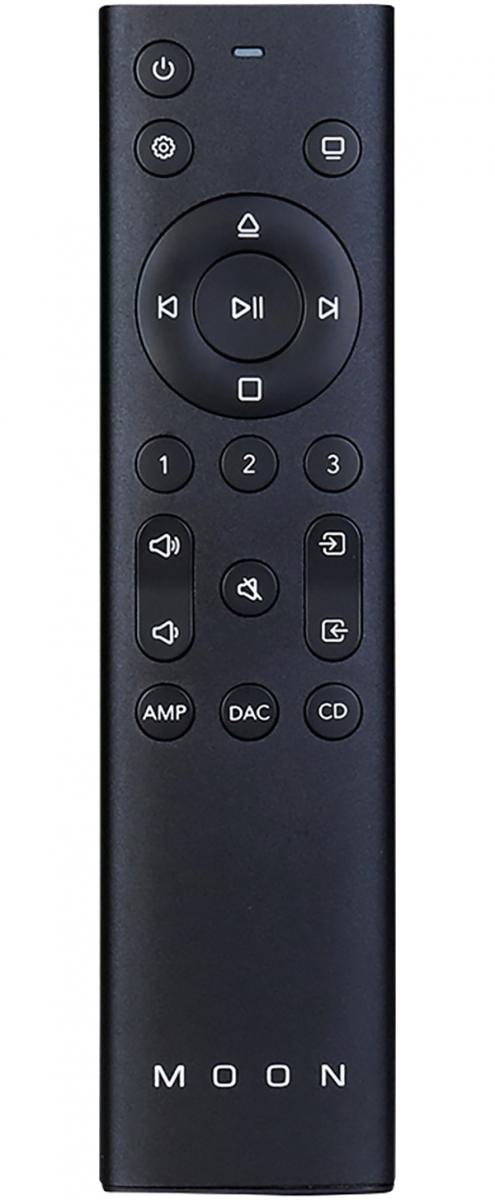
Above: The partnering MOON remote caters for DAC, CD and amp functions. For the latter this includes input, volume, mute and access to the setup menu
Although very much an all-in-one amp, the MOON 371 doesn’t provide any way of fine-tuning its sound. As such, you might view it as a more single-minded model than rival units that pack in DSP tools and room calibration – it sounded authentically purist when playing ‘In On It’, from Pat Metheny’s Side-Eye III+ [Go Forward; 96kHz/24-bit], through its own streaming module/DAC stage. In this album opener, alongside drummer Joe Dyson, keyboardist Chris Fishman and bassist Daryl Johns, the guitarist unleashes sweeping jazz licks atop a samba rhythm and tinkling percussion, and the MOON 371 seemed to resolve every small detail.
Flexible friend
When the band comes to a stop midway through the track, the hi-hat strike fading away, I noticed how involved I’d become in this music, and how much scale and depth the compact amp had mustered.
Yet it was equally captivating, in a different way, playing the serene overture to Verdi’s Aida [George Solti/Rome Opera House, Decca; 96kHz/24-bit], where it delicately extracted the myriad string strands, rose and fell with the dynamics of the piece, and truly offered a widescreen view of the orchestra. The MOON 371 is playfully flexible – but also a serious performer.
Hi-Fi News Verdict
Simaudio kicks off its Compass range with a high-quality take on the do-it-all integrated. The MOON 371 is generously specified with its connections, from Roon to MM/MC phono, but this user-friendly nature goes hand-in-hand with a mature sonic delivery that combines clarity and insight with dynamic flair and heft. A thumbs up for the amp’s styling too – although the MiND app could do with a refresh.Sound Quality: 88%
 | |||||||||||

|
|
| |||||||||












 SPONSORED VIDEO






| Equipment Reviews | |
Music Reviews Awards | |
Latest News Features | |
Resources Newsletters | |
Subscriptions |
WHERE TECHNOLOGY BECOMES ENTERTAINMENT
 © 2026 Hi-Fi News
AVTech Media Ltd
All rights reserved