Atlas Ailsa Duo OCC interconnect cables
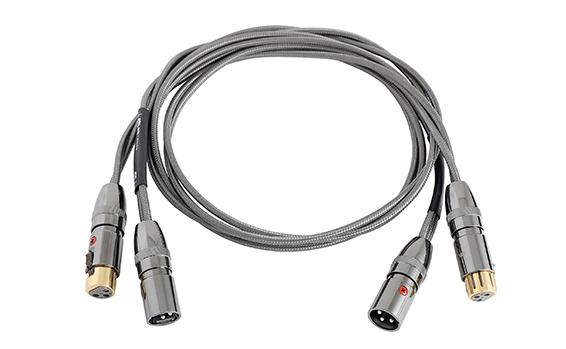

If you’ll pardon the pun, there’s been a redrawing of the map at Atlas with the Scottish cable company now clearly dividing its wares into three distinct ranges dubbed 'Upgrade', 'Aspire' and 'High End'. The Ailsa Duo OCC interconnect featured here is joined by the established Hyper cable in the brand’s mid-ranked Aspire range, both these cables now bearing the ‘Duo’ moniker.
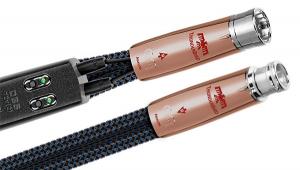
Fitted with the very smart ‘dark chrome’ XLR plugs – featuring silver-plated copper pins – prices for the Ailsa Duo OCC start from £1510 for a 0.5m stereo set, increasing to £1650 for a 1m pair and then by £280 for each additional metre thereafter. Atlas also offers an RCA-terminated version of the cable, the Ailsa Duo Ultra L, at the same price(s).
Pronounced ‘Ale-suh’
Beneath the silver-grey woven polyethylene jackets of its two principal conductors, the Ailsa Duo employs two OCC (Ohno Continuous Casting) copper cores for both the signal (XLR pin 2) and return (XLR pin 3). Strictly, these are not the ‘solid cores’ discussed on Atlas’s website but are each a multistrand of seven ‘naked’ 0.2mm2 OCC wires insulated in a foamed polyethylene. These two cores are gently twisted, packed in a cotton filler and surrounded by an OFC braid and alloy foil screen that’s terminated on the ground (XLR pin 1).
It’s this identical signal/return geometry, each with its own screen terminated at both ends of the cable, that lies behind the ‘Duo’ naming of the balanced versions of both the Ailsa and more affordable Hyper interconnects. Neither the Hyper nor Ailsa Duo cables are marked for directionality, even though heated, die-drawn OCC copper directly embraces the concept.
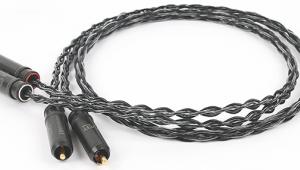
The Ailsa Duo’s limited cross-sectional conductor area pushes its loop resistance up a little higher than the finer-stranded Hyper at 94mohm/m, but our measured values of a 65pF/m parallel capacitance and 0.65µH/m series inductance offer a picture of a more ‘rounded’ cable than Atlas’s own 40pF/m and 0.8µH/m specification, respectively. The latter figures are influenced by the geometry of the cable which is not entirely fixed by the loose twisting of the final loom [see picture, above].
 Scottish silk
As the system in the Hi-Fi News Listening Room [HFN Yearbook ’25] is fully balanced, the XLR-equipped Ailsa Duo OCC segued seamlessly between our dCS Varèse streamer/DAC [HFN Feb ’25] and Constellation Revelation 2 preamplifier [HFN Jan ’25]. That the Varèse also has parallel stereo outputs enables instant A/B comparisons between two balanced interconnects, revealing the Ailsa Duo OCC to be a very even-handed and smooth-sounding customer indeed.
The contrasting vocal timbres of gospel singer Isaac ‘Dickie’ Freeman, et al, and Natalie Merchant in ‘The Peppery Man’ [Leave Your Sleep, Nonesuch; 88.2kHz/24-bit] retained their delicious juxtaposition with the Ailsa Duo in tow despite the scope of the soundstage sounding slightly more compact than experienced via our (vastly more expensive) Transparent Reference XL interconnects.
The metronomic percussion, and rolling bass, that provides Francine Thirteen’s Queen Mary [self-released, CD res] with its foundation sounded as powerful as ever through the Ailsa Duo, her voice vivid and articulate, the message as pointed as ever. Moreover the synthesised flash of brush-like percussion that shoots across the musical landscape still sounded appropriately raw, but not so raw that it jarred with the precision of the principal ‘instruments’. Depending on your choice of source components, amplifier, loudspeakers and, indeed, cables, this effect can veer from prominent to recessed, and lush to gritty. The Ailsa Duo was none of these things, but our system was still singing.
Hi-Fi News Verdict
For the curious, ‘Ailsa’ is of Scottish/Norse derivation and a feminine given name, meaning ‘Elf Victory’. It’s also an island off the west coast of Scotland called Ailsa Craig. These two factoids are probably related, but provide little clue as to the sonic influence of Atlas’s Ailsa Duo OCC! In practice it has a self-effacing influence that demures in the face of bright, brash transient detail. If ever a cable could blend with and subtly enhance your system, this is it.
Sound Quality: 86%













 SPONSORED VIDEO






| Equipment Reviews |  |
Music Reviews Awards | |
Latest News Features | |
Resources Newsletters | |
Subscriptions |
WHERE TECHNOLOGY BECOMES ENTERTAINMENT
 © 2026 Hi-Fi News
AVTech Media Ltd
All rights reserved