Wadia 6 CD player
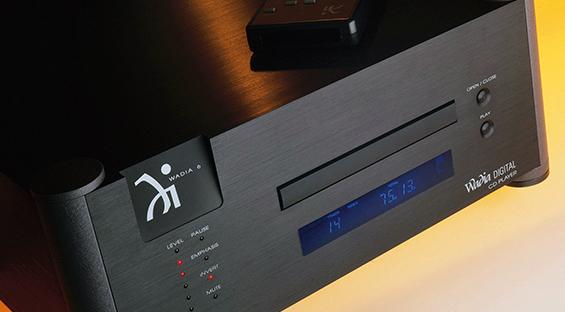

Sexy hardware – strange use of the term ‘sexy’. But Wadia’s new CD player is sleek in a catwalk model/Euro-chic way, the same reasons why a hot Italian V12 can be regarded as sexy. More accurately, the Wadia 6 is severe, a mere glance at its styling, finish and hewn-from-solid build quality telling you that it’s no toy. You don’t have to lift it to know that it’s chunky... like 35lb worth of chunk.
All of which has to do with thoroughness. No less than a page-and-a-third of the owner’s manual is devoted to the cabinetry and its utter rigidity, the use of aluminium plate, the thicknesses chosen by their resonant frequencies, the positioning of the boards relative to the transport and their shape, and how they affect the sonic performance. As the Wadia 6 is one of the very best single-box players I’ve heard, I’m taking these constructional claims salt-free.
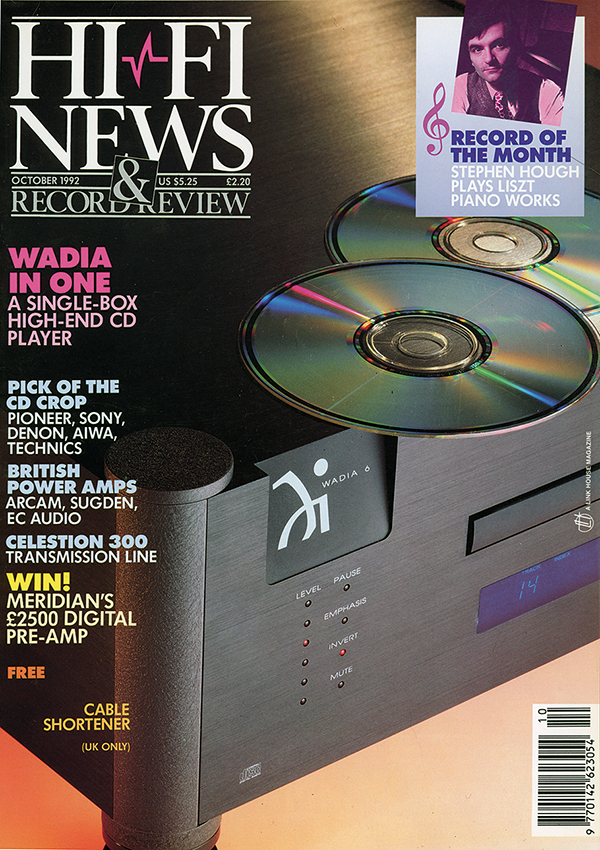
Love at first sight: when I saw the ’6 at CES I knew this was a player I’d put on my shortlist without hearing simply because it looks right. And with Wadia’s track record, it could sound as good as it looks.
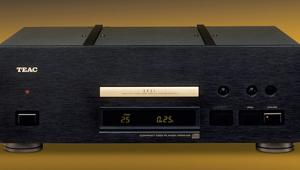
The recipe suggests nothing else.For starters, the transport is TEAC’s three-beam, linear motor creation with the company’s highly regarded VRDS (Vibration-free Rigid Disc clamping System) technology, so you mustn’t taint it with a clamp or mat. And that’s fine by me because I find such devices a pain in the kiester. The TEAC drive is regarded as one of the best, so we’re starting out healthy and Philips-free.
Custom DACs
Sharing space with it in the 355x150x405mm (whd) box is a CPU employing two premium-grade, pre-tested versions of the AT&T WE DSP-16A DSPs, in parallel at 36MHz and generating 36 MIPs. The software is Wadia’s own. The DACs are 20-bit proprietary designs with x32 oversampling and the section is said to offer never less than 16-bit resolution. There’s no direct equivalent to this decoder section in Wadia’s standalone catalogue, but it’s probably close to one of the current models in the mid-to-lower reaches. After all, this entire unit costs £2950, and two-thirds of that tariff will pay for a Wadia 8, the transport-only version of the ’6. So the DAC section is under a grand’s worth of the total price.
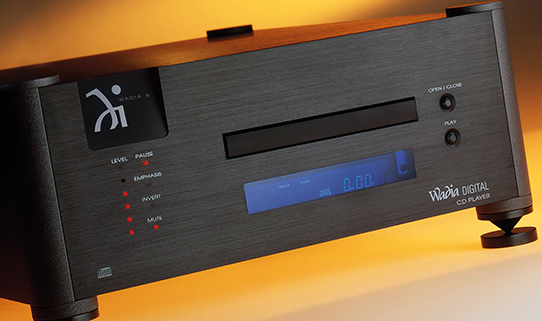
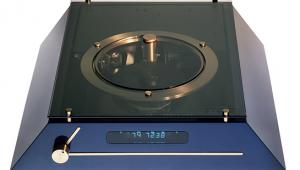
The chassis is an engineer’s delight. Resting on four metal cones (supplied with dimpled ‘place mats’ to prevent damage to shelves), the unit is clean and elegant, with machining that speaks with a Swiss accent. At each corner is a pillar reminiscent of Audio Innovations’ designs. The entire case is finished in black, with the pillars in charcoal to offset the panels.
Minimalism rules, so the front has only two controls: open/close and play. Nothing else aside from the track/time display and LEDs indicating volume level, pause, phase invert, mute and emphasis. The on/off switch is at the back, not an inconvenience as this machine takes a good two hours to warm up, and I left it on at all times.
Buttoned up
The lack of facilities on the fascia means a remote control sporting 34 buttons. Every feature you could want is represented, including programming via a numeric keypad, mute, phase invert, search, repeat, index skip, display mode, stop, pause, and auto-space (for four-second gaps when taping).
They’re all here along with volume keys, as Wadia has fitted the ’6 with a true digital volume control, which – if set at maximum for use through preamps – provides the 20-bit resolution. With digital volume controls, resolution increases with level. If you feed the ’6 directly into a power amplifier, though, the volume control maintains the highest resolution according to the amp’s gain capabilities.
Wadia states, however, that at even the lowest levels the resolution drops to no less than 16-bit. The example cited involves the playing of a 1kHz/–20dB, test tone, producing a reading of 66dB on an SPL meter. This is adjudged to be close to an ‘ambient’ or background listening level, while critical listening and listening for pleasure tends to be in the 90dB region, ±6dB, when Wadia’s 6 will offer its highest claimed resolution.
While I did play around with test tones and a meter, I must state that the condition which produces 16-bit resolution is too low for even casual listening. Conversely, this player did sound better the louder you set it. In practice, it means that the only users who will experience these changes in resolution will be those feeding the ’6 into a power amp. Anyone using it into a preamp should just set the player’s level to maximum and use the preamp’s volume control. (Although the remote is handy if you want to lower the volume from your seat.)
I have been looking for a dream transport for some time, and reviewing the ’6 was also a way of learning about the transport-only version. I’ve been told (unofficially) that the ’8 sounds better than the ’6 when the latter is used as a transport, because the ’8 has a power supply all to itself and it yields nothing to digital or analogue sections. But operationally, they’re identical. Both models feature coaxial, AES/EBU balanced and AT&T optical digital outputs, which means that either would be dandy for testing all manner of D/A converters. And, in order to vote with my feet, I would be buying a transport which shows two fingers to the evil Toslink connector. But two aspects of Wadia 6/8 ownership may keep my credit card in my wallet.
Mutual enemies
First, there’s the wholly unnecessary need to hit the volume control to switch out of mute every time you select the Wadia 6 from another input. This makes A/B-ing sheer hell, as the unit goes into mute every time you switch sources. To cancel the mute, you have to tap the volume control. It’s irritating. I suppose I could learn to live with it, but it’s linked to the second gripe, which I don’t think I can suffer.
Whoever runs Wadia should find the person who approved the decision to remove the controls from the fascia. He or she should have their pay docked immediately, while rabid chinchillas are inserted into his or her cycling shorts. A need for minimalism? You could have put all the controls in a row along the top or bottom of the fascia and hidden them under a panel if your precious Bauhaus mind couldn’t cope with the thought of so much visible buttonry.
Here’s a bunch of reasons why the controls should be duplicated on the front panel. Remote controls often disappear at whim, and they never last as long as that which is being controlled. Everyone has to go over to the player to insert a disc, so it’s stupid to have to carry the remote with you, for example, to start from other than Track 1, to de-activate the damned mute, or to program certain tracks. Moreover, some people don’t like/need handheld remote controls because they have their key components within arm’s reach of their listening seats. And batteries only die after the shops are closed for the day.
Now I know that the facilities are there to add fascia-mounted hardware. Expense? That argument doesn’t work when the machine costs this much. Musical Fidelity can argue the case with the sub-£500 CDT; Wadia has no excuse. If you think I’m going overboard, then perform a little experiment. Place masking tape over every control on your CD player, bar the play and tray access keys. Let me know how long you last before tearing off the tape.
 Listen and learn
I used the Wadia 6 as a single-box player via both the unbalanced and XLR balanced outputs, as a DAC with various transports, and as a transport through the Vimak DS1800 and other DACs. It was experience with the Vimak converter which made the transport version of the ’6 seem so enticing – at last I could feed a single unit into three of the Vimak’s four digital inputs (and who cares about the dormant Toslink?). I was A/B-ing my brains out, scrolling through the three types of input. It was reviewer bliss.
The results were fascinating, with at least two of us preferring coaxial to AT&T optical and AES/EBU. But I learned a lot, while also realising that AES/EBU is the pro standard for digital transfer not because of the XLR connections, but because it makes a pair of Sonus faber speakers sound like those Yamaha NS10s that studio types think are so marvellous. Bright? Hyperdetailed? AES/EBU is the D/A input to go for if you’ve blown a tweeter. (Note this is not reflected in XLR usage for analogue.)
With a California Audio Labs Tempest II SE and Marantz CD-12 as references, I tried the Wadia 6 in a number of set-ups. The best? The ’6 driving the Vimak DAC through XLO digital coaxial cables. The sound of the transport section, consistent regardless of the type of connection, is one of extreme openness, a soundstage fanatic’s dream. Front-to-back depth, especially on AAD transfers, arena-scale live recordings and certain gold CDs, reached Koetsu levels. The Wadia 6 matched the Tempest II SE in its ability to make speakers disappear. Even via its own DAC section, it impressed with its sheer scale.

Another notable area is its neutrality and ‘cleanliness’. Switching to the Wadia 6 on its own from other combinations, I could always count on slightly more detail, more ‘air’, less grunge. What wasn’t consistent with other converters – telling me as much about the various D/A converters and cables as it did the ’6 – was the change in bass performance. Extension and control remained constant, but rhythmic concerns were affected to a level where any listener just has to agree with PRAT fans about the importance of this aspect of playback. Without doubt, the ’6 sounded at its richest and most fluid in the lower registers when driving Vimak’s DAC via AT&T optics, but this meant a sacrifice in upper-level transparency and the realistic handling of transient decay.
Back to the standalone situation, though, which is not as much of a compromise as you might think. The Wadia 6 with its own D/A section, to clarify its position vis à vis the other converters, sounded most like the Vimak/Wadia pairing when the latter was setup with Siltech HF-6 coaxial cabling. Performance compromises were a slight dryness in the lower registers and a mild but artificial (and CD-dependent) sparkle in the treble region.
Conclusion
The player lacks the warmth of CAL’s Tempest II SE, which many would argue is tube colouration. This makes the ’6 only slightly less musical, but what it lacks in warmth and humanity is more than balanced out by the sheer overall competence, the coherence, the detail, the snap, the non-digital decay on acoustic instruments, the 3D realism and the drop-dead gorgeous looks. In a world full of £199 players, it seems daft to recommend a £2950 purchase, but what the hell. This is simply delightful. And I’ll probably buy an ’8 – when the Mk II arrives with front-panel controls.












 SPONSORED VIDEO






| Equipment Reviews |  |
Music Reviews Awards | |
Latest News Features | |
Resources Newsletters | |
Subscriptions |
WHERE TECHNOLOGY BECOMES ENTERTAINMENT
 © 2026 Hi-Fi News
AVTech Media Ltd
All rights reserved