MoFi SourcePoint V10 Master Edition loudspeaker
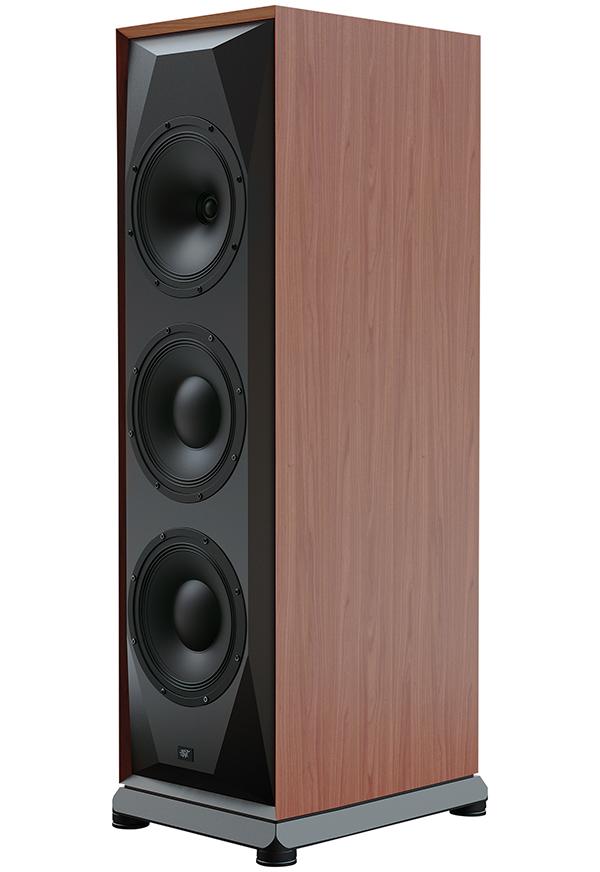

When we first saw MoFi Electronics’ SourcePoint 888 floorstander [HFN Jan ’25], its sheer size, at the £5599 price, raised an eyebrow. But designer Andrew Jones (ex-ELAC, TAD, KEF) hasn’t stopped there. Selling for £8800, the company’s new flagship takes the style and shape of the ’888 and scales it up, resulting in cabinets measuring 1239x394x505mm (hwd) and weighing 72.6kg. Music lovers with small listening rooms need not apply, and even those with larger spaces may be surprised by how imposing the V10 ME (Master Edition) looks.
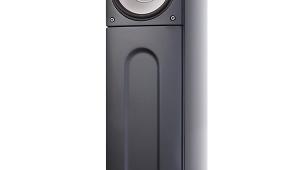
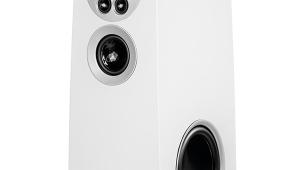
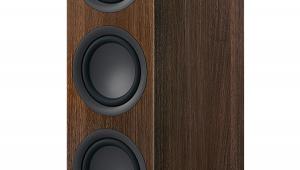
Much of this is down to the no-nonsense styling. Save for the slight tapering of the cabinet side walls, and the angled baffle – all part of the concentric mid/treble driver’s waveguide – the V10 ME is a boxy, serious-looking thing. Colour options are also sedate – choose from Walnut and Black Ash real-wood veneers, ‘book-matched’ and given a clear satin finish, but not the more glamorous Satin White of the ’888.
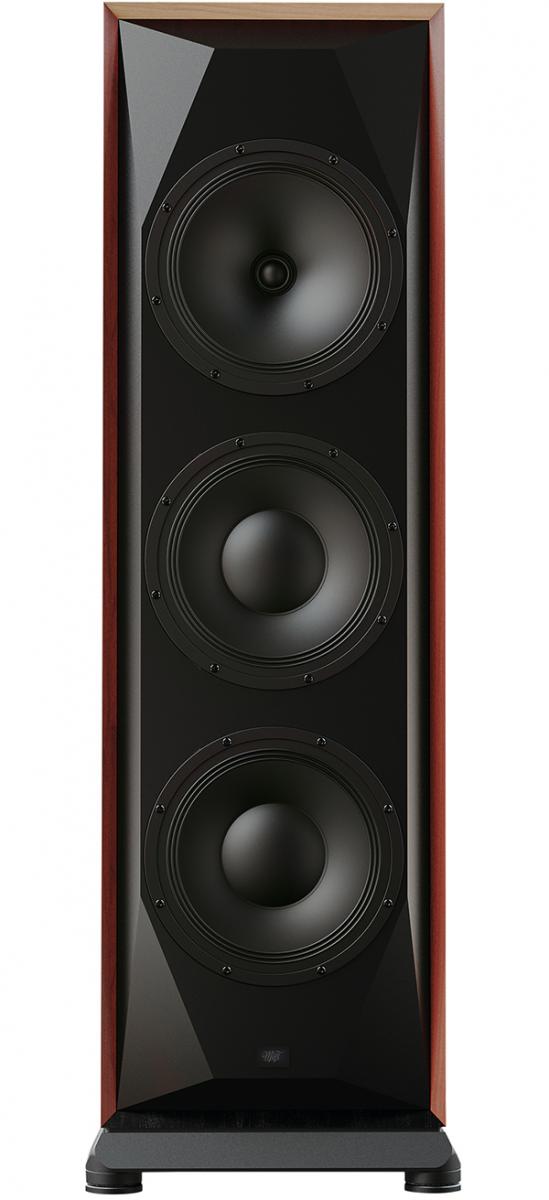
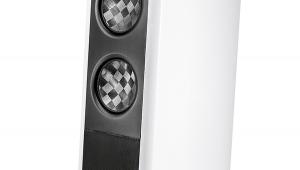
That might not matter, though, because regardless of your choice the front-on view is dominated by the black baffle and black drivers. Full-length grilles are supplied (grey for Walnut, black for Black Ash) but these should be removed for serious listening [see PM's Lab Report]. In other words, get used to the 2001: A Space Odyssey monolith look.
Cone quintet
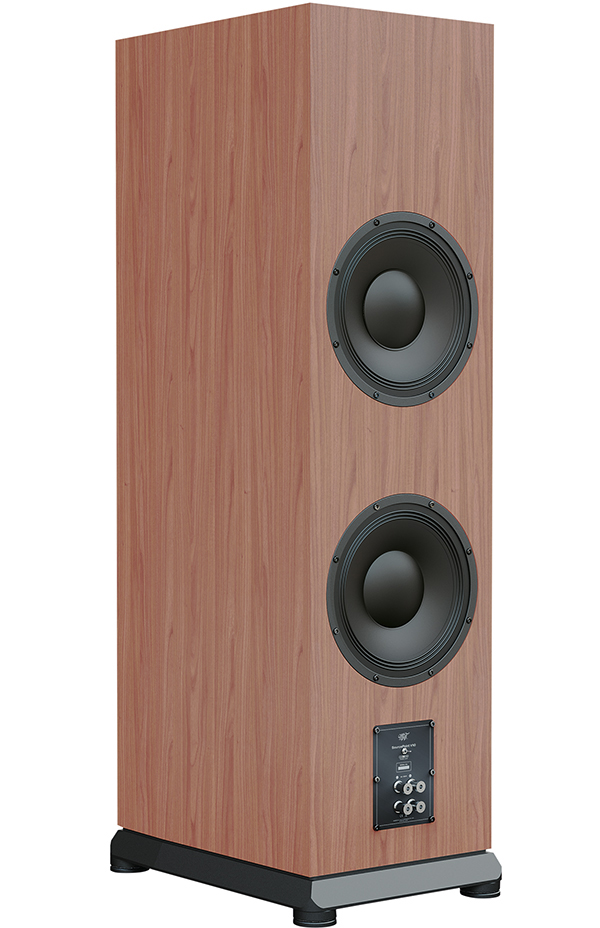
Just as the SourcePoint 888 took the concentric mid/treble driver array of the SourcePoint 8 standmount speaker [HFN Aug ’23] and augmented it with two 200mm woofers, the SourcePoint V10 ME leverages the 250mm mid/treble arrangement of the SourcePoint 10 [HFN Apr ’23] and adds 250mm woofers. So why V10 and not ‘101010’? Because there are five 250mm units here – the rear-firing reflex ports of the ’888 have been replaced by 250mm paper-cone auxiliary bass radiators. Says Jones, ‘due to the increased woofer area, I found that it wasn’t practical to use vents for the V10’.
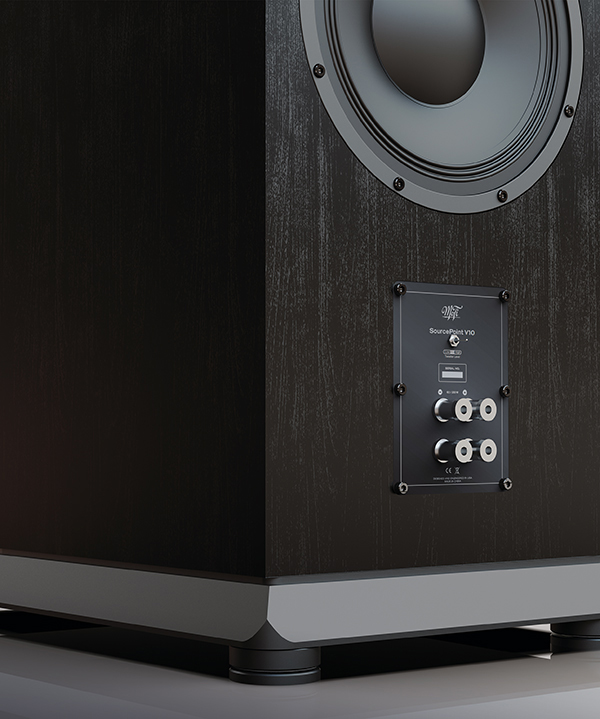
These ABRs are claimed to ‘reinforce low frequencies down to 27Hz without adding distortion or turbulence’ and are housed in separate internal chambers that also help brace the V10 ME’s cabinet, which combines 25mm-thick walls with that 50mm-deep baffle.
On reflection
Meanwhile, the main bass drivers – brand-new paper cone designs with underhung dual-magnet motor assemblies – are also internally isolated from the V10 ME’s concentric array. Here, a 32mm soft dome tweeter is mounted in the throat of a 250mm paper cone. As on all the SourcePoint speakers, the geometry of the outer cone has been modelled to both marshal the dispersion of the tweeter and manage reflections where it meets the baffle.
The crossover between the V10 ME’s tweeter and midrange is a relatively low 1.4kHz. The two bass drivers operate below 130Hz, but their addition isn’t only about boosting low-frequency extension and output. On this V10 ME model, compared to the two-way SourcePoint 10, less excursion is required from the midrange cone, which in turn reduces modulation distortion of the HF driver at its centre. This is why Jones’ previous concentric loudspeakers, including his designs for TAD [HFN Jan ’15], had always been three-way models.
As with the ’888, the V10 ME has dual sets of speaker terminals for bi-wired/amped systems. The connections plate on both is notably different, however, with MoFi’s new model adding a switch to adjust its ‘tweeter level’ [see pic, opposite]. Flick this to the ‘low’ position for a ~1dB cut, or ‘high’ for a ~1dB boost. This form of sound seasoning is part of the brand’s Master Edition crossover, which is also offered as an upgrade path for SourcePoint 10 owners [see boxout].
While the V10 ME uses ABRs rather than reflex ports, placement recommendations are the same as for the ’888. Clearance from rear and side walls should be between two and four feet, and a degree of toe-in (or toe-out) suggested to deliver a smoother HF response [see PM's Lab Report]. To assist, flat feet for hard floors, and cones for carpet, are supplied.
 Grand Entrance
Used with Constellation Audio’s Revelation 2 pre/power amps [HFN Jan ’25], the V10 MEs put on the grand, full-range show their size and driver count suggest. The bass runs deep, giving low instruments and drums believable weight, without the speakers sounding under strain. Treble delivery, while lacking ultimate extension, is both smooth and unfatiguing, following the template set by previous SourcePoint models. The speakers remain controlled and eloquent at high volumes, too – which certainly makes a good deal of sense, as it’s hard to imagine prospective owners planning to play them quietly…
With suitable music, the V10 MEs offer a soundstage with a great depth perspective and floor-to-ceiling height. With Ozric Tentacles’ ‘Strangeitude’, from the album of the same name Strangeitude [Madfish SMACDX1152], they gave a wide view of the electronic synths and Eastern-influenced instruments, which made it easy to focus on individual details. The overall presentation is somewhat set back, however, rather than throwing musical detail into your lap, and adding to this spatial character is a ‘dark’ rather than ‘bright’ skew to the sound (even with the treble switch set to ‘high’).
Listening to The Pointer Sisters’ ‘Neutron Dance’ [Break Out; RCA], I wouldn’t have minded more of a forward push to the vocals. All the same, the V10 MEs did great work with the synth effects popping across the stage, and the bounce and slam of the drums. Jon Bon Jovi’s ‘Blaze Of Glory’, from the Young Guns II OST [Vertigo 846 473-2], similarly benefited from this meaty performance, particularly the plump, punchy bass during the middle eight, and the following barrage of toms.
Sticking with rock, a superbly weighty drum sound ensured Aerosmith’s ‘What It Takes’ [Pump, Geffen; 192kHz/24-bit] sounded big and dramatic, without the rhythm section overshadowing Steve Tyler’s throaty vocals. Indeed, all the elements in this jam-packed track were nicely separated, including the backing vocals, various guitars and – oddly, considering the band’s rock ’n’ roll roots – accordion. MoFi’s speaker can convey the impact and scale of dense productions without becoming swamped with information.
This is an attribute that made Lalo Schifrin’s disco-funk cover of John Williams’ Jaws theme [Black Widow; CTI Records 506029 2] particularly involving, from the swirling wind sounds and flute to the tiny, metallic percussion. Hearing the speakers sink their bass drivers into its relentless rhythm also explained why this track was a favourite in the UK’s Northern Soul scene in 1976.
Pulling power
For all that the V10 MEs deliver musical lows with good form and depth, those two 250mm woofers meant I was guilty of expecting even more in the way of room-rattling, low-end pressure from Hans Zimmer’s ‘2049’ [Blade Runner 2049; Epic/Sony Music 19075803092]. But then remember these speakers sell for less than £10,000 – not an outrageous price in hi-fi terms – and don’t warrant criticism for falling short by a few Hz.
Playing Too Many Zooz’ ‘Warriors’ [self-released], another demo fave, the V10 MEs driver array and cabinet seemed to hit a mild resonance, causing the rhythms to become muddy. But other times, everything falls into place. Given the energetic techno of Dimension’s ‘Pull Me Under’ [MTA Records], the speakers thrilled with the liquid-y, molten bassline.
Music light on bass lets you better appreciate the V10 ME’s concentric driver. Joni Mitchell’s ‘River’ [Blue, Warner/Rhino; 192kHz/24-bit] showcased the whistly quality to her vocal and the long decays of the piano, and still sounded expansive without the woofers waking from their slumber. The title track from Shelby Lynne’s Just A Little Loving [Lost Highway Records; 192kHz/24-bit], with its echoing rim shots, spacious acoustic, and delicately recorded voice, sounded equally beautiful. Clearly, MoFi’s big speakers can do subtle too.
Hi-Fi News Verdict
MoFi’s SourcePoint V10 ME gives you a lot of loudspeaker for the money, and rewards with an authentically largescale, enveloping and weighty sound. Always easy to listen to, thanks to that smooth treble, this floorstander is also easy enough to drive, further bolstering its bang-for-your-buck appeal. The size and styling of these heavyweight cabinets means they won’t suit everyone, though!Sound Quality: 88%
 | |||||||||||

|
|
| |||||||||












 SPONSORED VIDEO






| Equipment Reviews | |
Music Reviews Awards | |
Latest News Features | |
Resources Newsletters | |
Subscriptions |
WHERE TECHNOLOGY BECOMES ENTERTAINMENT
 © 2026 Hi-Fi News
AVTech Media Ltd
All rights reserved