Lyngdorf TDAI-2210 streaming amplifier
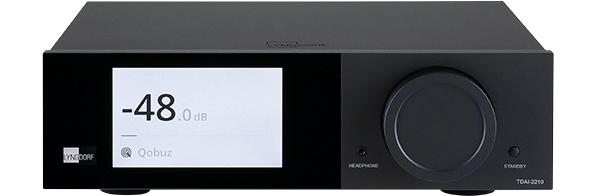

A stereo integrated amplifier offering network streaming, automated 'room calibration', modular upgrades and touchscreen/app control, Lyngdorf's TDAI-2210 is a well-featured entrant into the crowded 'just add speakers' market. But how does it stand out? The amplification technology itself is a good place to start.
Rated at 2x10⁵W/8ohm and 2x210W/4ohm [see PM's Lab Report], the TDAI-2210 has all the hallmarks of a Class D design. It's moderately sized, far from heavy at 4.8kg and cool-running. Yet its Class D amplification is a proprietary solution whose lineage goes back to the first practical digital amplifier, the TacT Millennium of the 1990s [see boxout]. So Lyngdorf's amp is a genuine outlier, the digital odd-one-out in a sea of analogue Class D solutions – TDAI means 'True Digital Amplifier Integrated'.
According to the company, the benefits of its approach are a streamlined signal path with 'no analogue conversion to degrade the sound right until the speaker outputs', in addition to the inherent efficiency of Class D operation. Indeed, it's tempting to think of the TDAI-2210 as a 'power DAC'…
Modular mix
The amplifier sells for £3499 in standard guise where connections, aside from its wired/wireless networking and speaker terminals, amount to five S/PDIF inputs (3x coaxial, 2x optical); USB-A and USB-C; HDMI eARC; two analogue inputs on unbalanced RCAs; and balanced XLR and single-ended RCA analogue outs. To this can be added a choice of upgrade modules, one priced £800 that expands the provision of HDMI 2.1 connections to make the amp even more of a 'system hub', the other a £500 analogue module with balanced XLR and MM/MC phono inputs plus two further sets of RCAs [see rear-panel pic, below].
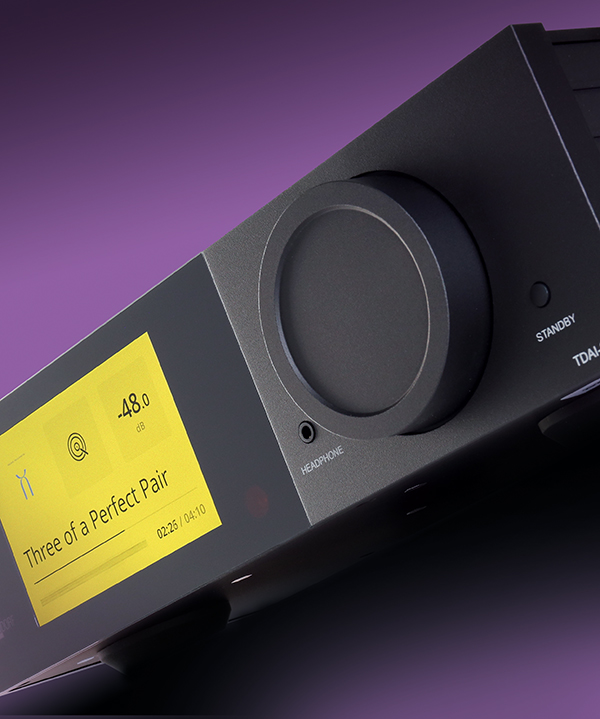
Above: Adjacent to its volume rotary and 3.5mm headphone out, the TDAI-2210's glass touch display shows source, volume, album art, etc, and is used to navigate the settings menus
All the TDAI-2210's analogue inputs are passed through an A/D converter (an Analog Devices AD1939 when using the standard connections, or higher-spec Asahi Kasei AK5572N that's part of the analogue upgrade module) and processed at 96kHz/24-bit. Additionally, while digital file support reaches 192kHz/24-bit over USB, HDMI and coaxial (and 384kHz over UPnP), any streams over 96kHz are downsampled. DSD streams are also converted to PCM.
Curve appeal
The digital heart of the TDAI-2210 allows Lyngdorf to add plenty of flexibility, from basic tone controls to a selection of preset EQ modes and support for its RoomPerfect calibration system. Those last two features are worth exploring. Lyngdorf's EQs (aka 'Voicings') are varied but subtle and can be used as a jumping off point for custom creations – the interface in the My Lyngdorf control app, newly launched for the TDAI-2210, allows for granular manipulation of gain, Q, and frequency response.
Flat out
RoomPerfect measures your system's characteristics before generating a corrective digital filter. In this regard it is akin to Dirac, Audyssey, etc, although Lyngdorf argues it is better suited to 'higher-quality stereo systems' because it doesn't strive for a completely flat response. 'The secret is that it actually corrects less than other calibrations', says director of product marketing Roland Hoffman. A calibrated XLR mic and adjustable stand are included with the TDAI-2210. Give yourself at least 30 minutes to run the initial measurements.
Other settings include Intersample Clipping Correction (ICC), which adds headroom to prevent distortion where specific combinations of digital (music) signals breach the 0dBFs ceiling. There's also a 'speaker limiter' that adjusts the amplifier's output in real-time to avoid overdriving the main PWM/Class D amp stage, and sound profiles that are tailored to Lyngdorf speakers. There are also tools for the integration of a subwoofer, and a subsonic filter operating at 24dB/octave below 18Hz.
With networking in mind, the TDAI-2210 is Roon Ready, and also supports playback through Tidal, Qobuz, AirPlay, Google Cast and Spotify. Airable is onboard for podcasts/Internet radio, and you can also connect to the amp over Bluetooth.
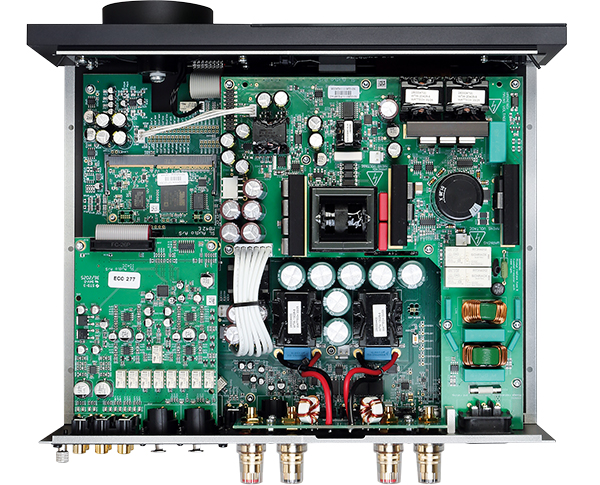
Above: Custom switchmode PSU is extensively filtered [right] before servicing the Analogue module (with AK5572N 768kHz-sampling ADC) [bottom left], SHARC DSP [top left] and H-bridge PWM amplifier output [centre]
The extremely slick My Lyngdorf app makes accessing these services, and switching between physical connections, a breeze. The glass touchscreen interface on the hardware itself is less intuitive, but looks great presenting album artwork, volume level, etc.
On which subject, the Lyngdorf TDAI-2210's volume control offers adjustment in 0.1dB steps, which is undoubtedly great news for the ultra-finicky among us!
 Clear winner
Anyone coming to this amp expecting a distinctive sound – given its rare-breed digital Class D status – won't be disappointed. The TDAI-2210 has such a clear, direct and communicative nature that everything played through it gains a level of vivacity and liveness that I found entirely alluring. Of course, your mileage may differ. This won't impress a tube enthusiast seeking warmth and relaxation, or an over-generous low-end.
Usefully, the TDAI-2210's sound doesn't progress from vivid into fatiguing. Even without recourse to its sound seasoning tools, the well-lit presentation comes with excellent control. I enjoyed exceptional clarity through my bright-leaning B&W 705 S3 Signatures [HFN Aug '24] without suffering from excess fizz or grit. But I will say this again: those used to a certain style, dare I say 'analogue-only', might find the amp's transparent, colour-denuded character somewhat overwhelming.
Fast track
Don McLean's American Pie, played via Roon/Qobuz at 96kHz/24-bit [Capitol Records], was instructive of the TDAI-2210's focused, dynamic performance. The up-tempo bassline on 'Everybody Loves Me Baby' was taut and distinct, any sense of warmth coming from the recording itself rather than the hardware. A lack of bloom, combined with the transient speed of the TDAI-2210, meant the subtle bends and stops in Robert Rothstein's playing were laid bare for close inspection.
McLean's vocals were brilliantly clear, here and on the album's title track, without losing any of their emotional character. Elsewhere, the picked acoustic guitar on 'Vincent' possessed a ringing, clear quality, while the drums on 'Winterwood' were forceful and incisive.
The performance of the Lyngdorf amp across this album was impressively dynamic, but always sympathetic to its folk music trappings. On the other hand, Jon Bon Jovi's 'Blaze Of Glory', from his soundtrack album for Young Guns II [Island Records], knows no boundaries. Snare drums erupted from the TDAI-2210 as if fired by a Colt Peacemaker and Jeff Beck's solo growled and snarled. Again, precision-guided delivery of the bassline anchored everything.
Focus pocus
Paradoxically, this amp's low-frequency performance is perhaps a strength and a weakness. I have rarely heard an integrated model at the price bring such grip, detail and definition to bass. Yet play Dominique Fils-Aimé's 'Made My Mind' [Three Little Words, Modulor; 88.2kHz/24-bit] and the TDAI-2210's rendition misses some of the lushness the production deserves. While not a 'dry' sound, it is straight down the line.
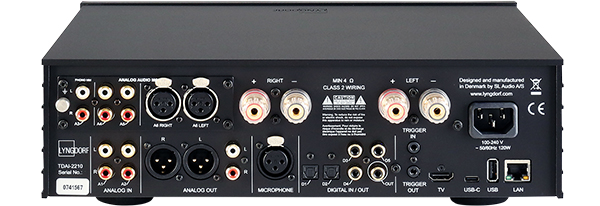
Above: Seen with the optional MM phono/balanced line 'Analogue' module, the TDAI-2210 includes two optical, three coax, USB-C, USB-A (storage) and wired/wireless Ethernet inputs alongside HDMI eARC. Single speaker outputs are joined by balanced preamp outs and a 96kHz digital coax out. An XLR mic input serves RoomPerfect
Otherwise, the amp gave a fine account of Fils-Aimé's jazzy, cleanly recorded ballad, easily capturing the character of her voice and the contrasting tonal shades of her backing band. Percussion sizzled above a rich layer of brass and strings, and once more I was struck by the way the TDAI-2210 offers an unobscured view.
To judge RoomPerfect effects, enable Bypass mode – once done, you can switch it off as well as flick between Focused and Global filters. The latter gives a wider, defined soundstage and should only be used in multi-seat rooms; for critical listening, Focused is the way to go.
Playing Van Halen's 'Beautiful Girls', from Van Halen II [Rhino/Warner, 96kHz/24-bit], I preferred RoomPerfect engaged: it tightened the bass and gave Roth's vocals lift. Yet playing 'Rat Trap' by Matrix & Futurebound [Universal Truth; Metro – Viper] I favoured having it bypassed – high-energy lows in this drum and bass track sounded beefier without Lyngdorf's software counteracting boundary gain.

Above: Lyngdorf's RC-34 remote facilitates menu navigation, display settings, volume, SRC (input selection) and many other features
RoomPerfect is a clever and welcome tool, but be prepared for nuanced rather than night-and-day differences. It had minimal impact on Martha Argerich's 1965 recital of Chopin's Piano Sonata No 3 [Warner Classics, 192kHz/24-bit], this being a solo piano recording with limited low-end reach. Auditioned sans EQ or RoomPerfect, the quality of Argerich's free-flowing playing, and the physical nature of the instrument, was never in doubt.
Hi-Fi News Verdict
A veritable box of tricks, Lyngdorf's TDAI-2210 doesn't just impress with its clear, dynamic and powerful digital Class D presentation. Even in its standard form this is an exceptionally well-featured integrated amp, helped by the superior 'My Lyngdorf' control/streaming app and its variety of user 'tweaks'. Once paired with a set of speakers, it may very well offer everything needed to set your music free.
Sound Quality: 87%
 | |||||||||||

|
|
| |||||||||









 SPONSORED VIDEO







| Equipment Reviews | |
Music Reviews Awards | |
Latest News Features | |
Resources Newsletters | |
Subscriptions |
WHERE TECHNOLOGY BECOMES ENTERTAINMENT
 © 2026 Hi-Fi News
AVTech Media Ltd
All rights reserved