KEF KC92 active subwoofer
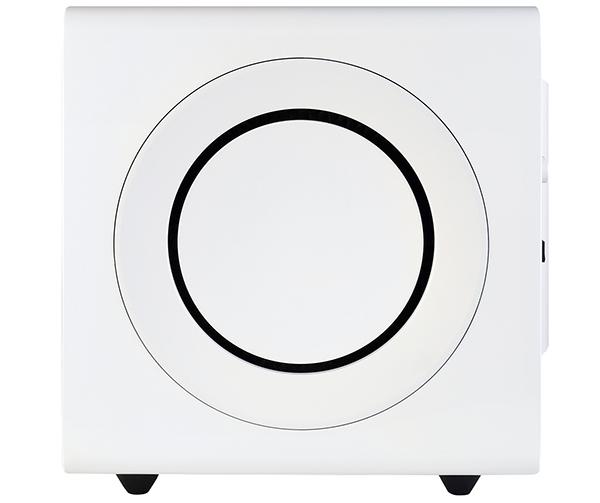

Visitors to KEF’s demo suite at the UK Hi-Fi Show Live in 2024 might have been surprised to see its Reference Meta 5 speakers [HFN Jun ’23] accompanied by four subwoofers, stacked in pairs. However, while acoustic thinking has long favoured two subwoofers over one, the idea of four being better than two will be financially prohibitive for many. But for a duet, the KEF model in question – the KC92 – is a very tempting £2499.
Offered in gloss white or black, this subwoofer is a fine visual match for the UK brand’s modern-looking speakers. And, in a market dominated by much larger subs, its near-cubic 330x353x361mm (whd) proportions are appealing, as is the modest 20kg lift. Coupled with the smart design, all subtly rounded corners and flush-fit drivers, and the KC92 shouldn’t upset your listening room’s feng shui.
Cone control
Launched in 2024 as the bigger brother to KEF’s ultra-compact KC62 [see boxout], itself priced £1499, the KC92 sits in the one-below-top position of the company’s subwoofer range. Above is the Reference 8b, which arrived alongside the previous generation of KEF’s Reference loudspeakers around a decade ago and is ticketed at £6000. Below it is the affordable, four-model Kube series, where prices range between £599 (for the diminutive Kube 8, with 8in/200mm driver) to £1149 for the Kube 15.
KEF’s Kube subwoofers feature a single, front-firing woofer, but the KC92 – like the KC62 and Reference 8b – have a dual-driver, force-cancelling configuration. This is an implementation with which the company is familiar, having launched the first ever force-cancelling loudspeaker over 40 years ago in the shape of the Reference 104/2 [HFN Sep ’84]. The technology is also a feature of its current Blade One Meta [HFN May ’22] and LS60 Wireless [HFN Sep ’22] floorstanders.
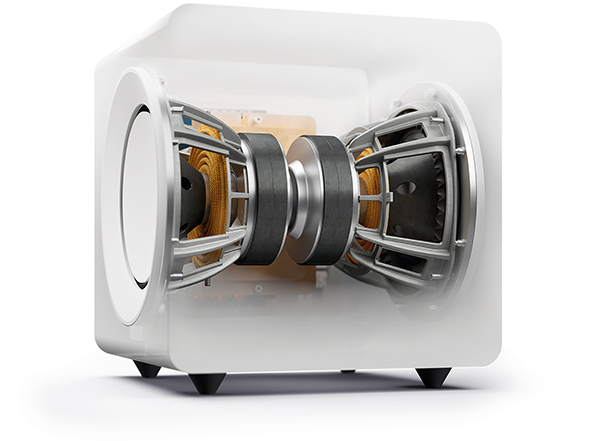
The KC92’s 228mm/9in woofers are hybrid types, with paper cones skinned with aluminium while being backed by oversized motors with vented voice coils [see KEF’s see-through render, below]. Around each cone, but hidden inside, is what KEF calls its P-Flex surround, with a pleated geometry said to resist deformation caused by pressure changes within the cabinet. Akin to ‘Origami folds’, says KEF, this proprietary surround is deemed an improvement on both a conventional half-roll surround, or a thicker, stiffer, and higher-mass design.
Bass brains
The two woofers are independently driven by a pair of 500W Class D amplifiers, downstream of KEF’s Musical Integrity Engine (MIE) signal processing platform. Also built into the manufacturer’s active speakers [HFN Sep ’22], this custom DSP aims to ‘ensure every component of the subwoofer works in perfect harmony’. One of its proprietary algorithms is Intelligent Bass Extension (iBX), said to maintain ‘deeper and precise’ bass at low listening levels.
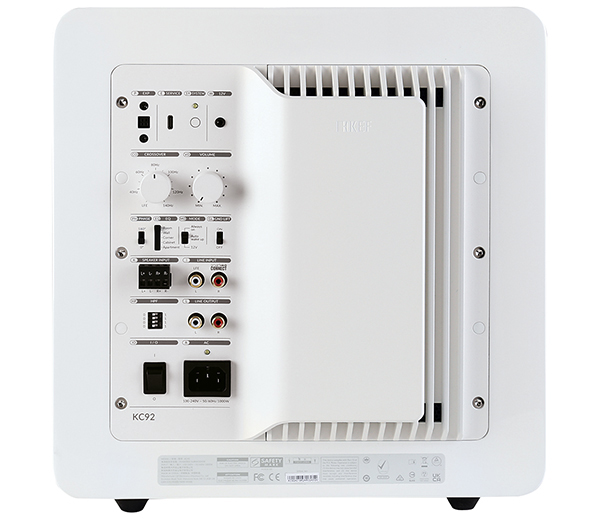
The sub’s rear panel is busier than most, because KEF has integrated some useful and not all-that-common technologies in the KC92, and because there is no complementary control app (or remote handset). Below the sub’s 40Hz-140Hz (24dB/slope) crossover and volume rotaries, and above its stereo RCA inputs and outputs, is a row of switches handling 0/180o phase and ground lift on/off, plus auto-power and preset EQ options [see p89]. The last of those runs to five settings, the sub’s DSP compensating for the boundary reinforcement of the possible Room, Wall, Corner, Cabinet and Apartment siting positions.
Underneath these is a speaker-level input, to be fitted with a supplied terminal block ready for a bare-wire connection. There’s also a bank of four DIP switches for setting the frequency of the KC92’s high-pass filter, between 40Hz and 120Hz. Using the sub’s RCA outputs to loop the filtered signal back to a power amplifier, and described by KEF as a ‘connection for small speakers in a stereo music system’, this enables the user to relieve their speakers/amp of low-frequency duty.
Another connection mode, and one that KEF’s R&D engineer Prathmesh Thakkar told HFN was ‘key to some customers’, is to use the optional KW1 wireless system. Priced £199, this includes separate transmitter and receiver units to connect to your preamplifier and the sub, respectively, and operates on either 5.2GHz or 5.8GHz. KEF claims a latency over this wireless link, which samples at 48kHz/24-bit, of <17ms, and a line-of-sight delivery up to 30ft. For multiple subwoofer installations, it also sells the KSK92 Stacking Kit (£200), which makes use of threaded inserts on the rear of the sub to mount up to three units on top of each other.
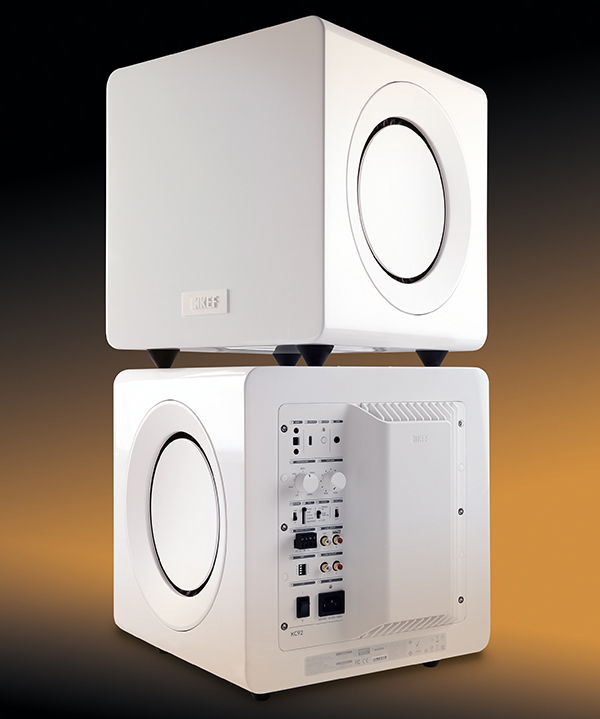
The KC92’s power modes include ‘always on’, which is welcome as the sibling KC62 relies on auto signal-sensing to wake from standby. Setup is all manual unless the sub is being used with a pair of KEF’s active speakers, in which case EQ presets, HPF settings, crossover, etc, can be established through the brand’s Connect app.
 Pair pressure
Our KC92 pair was setup in the HFN Listening Room with Wilson Audio’s Alexx Vfx loudspeakers and Constellation’s Revelation 2 pre/power amps [HFN Jan ’25], with the stereo pre-out from the preamplifier feeding into the left and right units. Because there were two subwoofers, calibration involved making sure that settings – including the Room EQ preset – were replicated on both boxes (which is where a control app would be useful). Following KEF’s recommendation, each subwoofer was positioned close to its partnering floorstander.
Even with two of them, the KC92s appeared a lot more… discreet than bigger units including SVS’s SB17-Ultra R|Evolution [HFN Apr ’25] and Wilson Audio’s Submerge [HFN Sep ’25]. However, in terms of the ability to augment the low-end output of the floorstanders, the pairing – with its quartet of drive units – appeared unfazed. Bass extension, as evidenced by the infrasonic details in Chase & Status’s ‘Murder Music’ [Rtrn II Jungle; Virgin EMI], or the ominous yet subtle swells in ‘No Dog, No Master’ from Thomas Holkenberg’s score for Zack Snyder’s Justice League [Water Tower Music; 44.1kHz/24-bit], was impressive.
Slam with stealth
Moreover, while the KC92s’ drivers were visibly moving in their surrounds during Holkenberg’s piece, there was no other indication of the subs’ presence. As the orchestral percussion and strings, mixed in with electronic effects, slammed rhythmically, the sound remained consistent and the cabinets subjectively quiet.
It was also with authentically deep music such as this that the benefit of the dual subwoofer installation was obvious. Switching one off made no difference to any perception of location (with an initial 40Hz crossover in play there was no directionality), but lessened the feeling of an all-round, even-handed performance.
The added low-end presence introduced by the KC92s was, as you’d expect, more apparent with some tracks than others. Listening to The Beach Boys’ ‘Good Vibrations’ [Smiley Smile 2012 remaster, Capitol Records; 192kHz/24-bit], there was only the slightest hint of a more dense, more robust character to the bassline and organs, a stronger canvas beneath the band’s exquisite vocal harmonies. Yet given Ozric Tentacles’ ‘Pteranodon’ [Jurassic Shift; Dovetail Records DOVE CD 6], the KEF pairing not only latched onto the lumbering bassline but reinforced the feeling of scale.
What had sounded wonderfully airy and expansive through the Alexx Vfx speakers on their lonesome now appeared even more three-dimensional, and even further removed from the notion of sound emanating from drivers and cabinets. As the track’s slew of samples and percussion danced around a massively wide stage, it was almost unnerving.
Bloat be gone
Talking Heads’ ‘Psycho Killer’ [Talking Heads 77; Warner Bros. 96kHz/24-bit] has a very of-an-era sound, with vocalist David Byrne recorded at the back of the room, behind the jangling guitars that frame the central image. Amid this there’s the almost marching band-style drumming and bassline, and the KEF subs really dug into this to give the track its angular rhythm.
Another ’Heads track, ‘Burning Down The House’ [Speaking In Tongues; Warner, 96kHz/24-bit], also proved useful for assessing the crossover selection. Those weaned on home cinema set-ups and THX recommendations will often default to an 80Hz crossover. Setting it at that position, however, with the Wilson Audio speakers, upset the integration, the thumping bassline and drums becoming too dominant. With anything in hi-fi, there’s no hard and fast rule, so experiment.
The KC92 is tight, clean and dynamic, dispelling any fears of bass bloat. Its DSP works cleverly too, so that deep bass remains apparent even at quiet listening levels. I was taken aback by the extra bounce and heft in Raury’s ‘Devil’s Whisper’ [All We Need, Columbia; 44.1kHz/24-bit] with the system volume dialled low. As I was with Kraftwerk’s ‘Electrocardiogram’ [3-D: The Catalogue, Parlophone; 44.1kHz/24-bit], with its stop-start drum programming.
Perhaps the proof of the value of the KC92 (or a pair of them) was hearing Don Henley’s ‘The Boys Of Summer’ [Building The Perfect Beast; Geffen Records GFLD 19267] with its synth intro and famous guitar riff. There was much more expansion, greater scale, a deeper floor and a grander overall sound with the subs in play. Henley sings ‘I feel it in the air’ and I knew what he meant. To mangle a Darth Vader line, the force-cancelling is strong with this one.
Hi-Fi News Verdict
This KEF subwoofer might lack the slick app control options of some rivals but will win over purist audiophiles with its selection of inputs and settings. Even more appealing is a superb performance of detail, depth and dynamism, all coming from a dual-driver implementation that ensures the cabinet can be kept sleek and discreet. Audition one, but budget for two, as doubling up yields tangible benefits.
Sound Quality: 89%
 | |||||||||||

|
|
| |||||||||












 SPONSORED VIDEO






| Equipment Reviews | |
Music Reviews Awards | |
Latest News Features | |
Resources Newsletters | |
Subscriptions |
WHERE TECHNOLOGY BECOMES ENTERTAINMENT
 © 2026 Hi-Fi News
AVTech Media Ltd
All rights reserved