JBL Summit Makalu loudspeaker


Named after the world's fifth highest mountain – presumably because the third highest, Kangchenjunga, is a bit of a mouthful – JBL's Makalu was unveiled in 2025 as the top model in its new Summit series, positioned only below the previously launched K2 S9900 [HFN Aug '10] and Everest DD67000 'Projects'. Priced £36,998, it arrived with a smaller floorstander, the £26,998 Pumori, and the £14,998 Ama standmount [HFN Jan '26].
More recently, at High End Vienna [HFN Aug '26], new versions of the Everest and K2 were added to the Summit series, giving JBL a unified premium line covering a range of budgets and room sizes – something that a manufacturer of its heritage has arguably missed for some time. Audiophiles should have no qualms about the Northridge, Californian-based company continuing to sell affordable, portable Bluetooth speakers by the bucketload if, at the same time, it can maintain a focus on hi-fi's high-end.
Bold 'n' gold
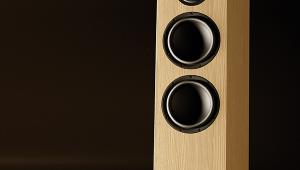
JBL says the Makalu has been engineered 'to anchor large, immersive listening spaces'. Although the height of 1.1m isn't extravagant, dimensions of 46cm wide and 39cm deep mean it cuts an imposing figure. At the same time, it is not unappealing in its styling if you don't mind the big and bold look, especially in the High Gloss Ebony Wood veneer, with 'Summit Gold' accents, of our review pair. An alternative finish option – High Gloss Black, with Platinum trim – is a touch more nondescript.
All four sides of the Makalu's cabinet are gently curved and the MDF enclosure (where minimum thickness is 25mm) is said to be heavily braced internally and damped with a 'multi-component' lining to improve rigidity and control resonances. Supporting this 69.2kg speaker are four vibration-absorbing feet designed in collaboration with IsoAcoustics. These allow for levelling by rotating their central disc, although there's not much clearance to get your hand in once the speaker is in place…
Triple treat
Like most JBL models [see boxout], the Makalu features a horn-loaded drive unit – in this instance a larger (75mm) version of the dual-dome, dual-motor Teonex compression driver found in the Summit Ama. Designated the D2830K, this sits deep in the throat of a 'High-Definition Imaging' (HDI) horn, formed from Sonoglass and geometrically modelled to optimise both horizontal and vertical dispersion. JBL claims a 33kHz (–6dB) HF extension for its tweeter, with an overall 88dB sensitivity and 4ohm nominal impedance [see PM's Lab Report].
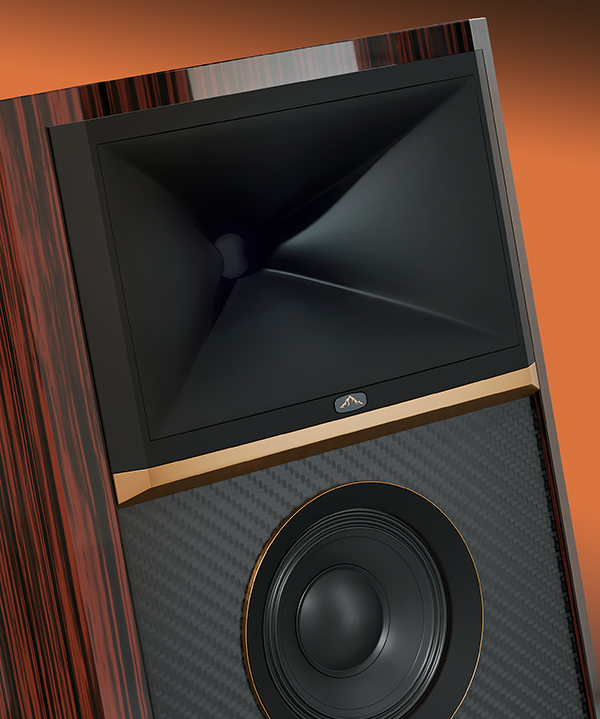
Above: The D2830K compression driver sits deep in the throat of a 'High-Definition Imaging' (HDI) horn
The size of the compression driver allows it to cross over at a low 1.1kHz to the Makalu's JMW200SC midrange. This measures 200mm and features a triple-layer 'HC4' cone, with outer layers of pulp/carbon fibre sandwiching a closed-cell foam core, that's claimed to give 'the proper stiffness, overall mass and structure to deliver high output, low distortion and high power handling'. The driver is framed by an 'accordion-edge' (ie, pleated) surround, and its motor system comprises a 63mm voice coil, neodymium magnet and dual inverted spider assembly, all held in a cast aluminium frame.
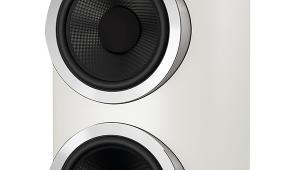
Below this, and making the most of the Makalu's generous width, is a 300mm/12in bass driver, again combining an HC4 cone with a dual-spider motor and large (75mm) voice coil. A ferrite magnet is employed here, while the surround is a half-roll design. To arrive at the speaker's rated 23Hz (–6dB) bass extension, the woofer is reflex-loaded by two rear-facing flared ports (the Pumori and Ama, meanwhile, feature just one). These are located below a panel housing two sets of speaker inputs for bi-amp/bi-wired set-ups – a jumper 'bar' is pre-fitted for standard, single cable use. The third/fourth-order crossover network, which dedicates the bass driver to frequencies below 285Hz, is again a 'MultiCap' design promising a low ESR via its use of multiple, small capacitors.
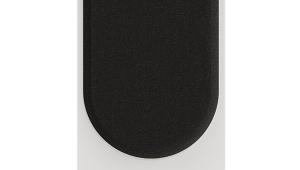
Black fabric grilles are provided to slot into place and cover the Makalu's mid and bass drivers. They have a moderate effect on the speaker's midband output and hide the carbon detailing on the baffle. As such, you'll probably want to leave them off.
 Simply swell
JBL recommends placing the speakers with the listener sitting off axis so that the tweeters are aimed to cross over behind the seating position [see PM's Lab Report]. There are no guidelines related to rear/side clearance, but suffice it to say these big, ported cabinets benefit from plenty of breathing space. Otherwise, they don't appear fussy about placement, easily fulfilling their room-filling promise with a sound that's both full-range and seamlessly constructed.
Testing was in the HFN Listening Room [HFN Yearbook '25] with amplifier systems including Constellation's Revelation 2 pre/power [HFN Jan '25], D'Agostino's Momentum Z [see p44], and the new 600 series pre/power from Mark Levinson. Notable was how the Makalu responded to each, its performance reflecting the different qualities of the amps themselves. The speaker has a general flavour, a tendency toward a dark rather than bright sound, but this can be augmented. Amplifier matching is thus a consideration, and not just in delivering enough grunt to counter its power-hungry nature.
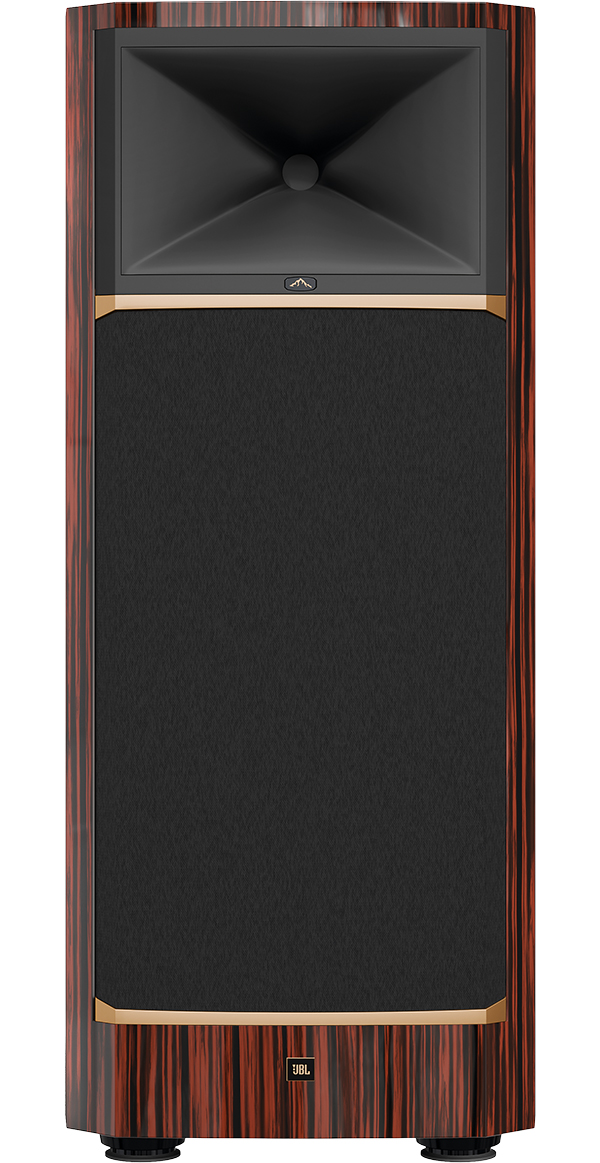
Above: Seen here in its High Gloss Ebony Wood finish with 'Summit Gold' trim, the Makalu's constrained-layer MDF cabinet stands on four compliant IsoAcoustics feet
Potent bass? Yes. Given the electronica of Boris Blank's Electrified [Polydor, 88.2kHz/24-bit], the Makalus relished the low-end information in tracks such as 'Midnight Procession' and 'Random Tox'. Viewed from the listening position, the speakers' woofers appeared to barely move as they set about handling the producer's penchant for long, decaying bass swells. The unerring impression was of every ounce of bass being found and delivered without fuss. The low-frequency output of some loudspeakers, even large cabinet floorstanders, can leave you feeling short-changed, but that's not the case here.
High society
Tighter, more organic lows were heard in Shostakovich's Symphony No 5 in D Minor [Boston Symphony Orchestra, Deutsche Grammophon, 96kHz/24-bit], where cello and double bass were well blended with the higher-register strings in the opening Moderato. This recording revealed not only the excellent integration of the three drive units, but the reach and poise of the Makalu's compression tweeter. Missing was the 'sparkle' heard from some – typically metal dome HF drivers, but the highest notes were still traced with ease and convincing believability.
Quiet riot
In the later Allegro non tropo, Shostakovich adds thumping timpani and rasping horns. These JBL speakers responded in kind, the presentation becoming more dynamic and vivid without losing sight of its inherent maturity and control. For those who still view big, horn-loaded speakers as boisterous, the balance of the Makalu may come as a shock. There's nothing rough around the edges, which should be a given from a £37k speaker.
Notwithstanding this lack of an 'attention-grabbing' sound, it doesn't take long to be won over by the Makalu. Listening to UFO's 'On With The Action' [No Heavy Petting, Chrysalis Records CHRX 1103], the Summit Makalu floorstander punched out the drums and heavy metal guitar riffs on a grand, powerful scale. Arriving at Michael Schenker's astonishing solo, with the band going at it hammer and tongs, the cohesive nature of the performance held up.
The Makalu's sound is related to that of the Ama, but bigger, more joined up, and deeper in the bass. There was a greater feeling of the music arriving out of thin air rather than from a set of speakers. A track I had played through the smaller Summit model, Antonio Forcione's 'Caruso' [Meet Me In London; Naim Label NaimCD021], was again startling in its blend of textures – stabs of electric bass interrupting nylon acoustic guitar and the vocals of Sabina Sciubba. But it sounded more naturally staged, open and flowing.
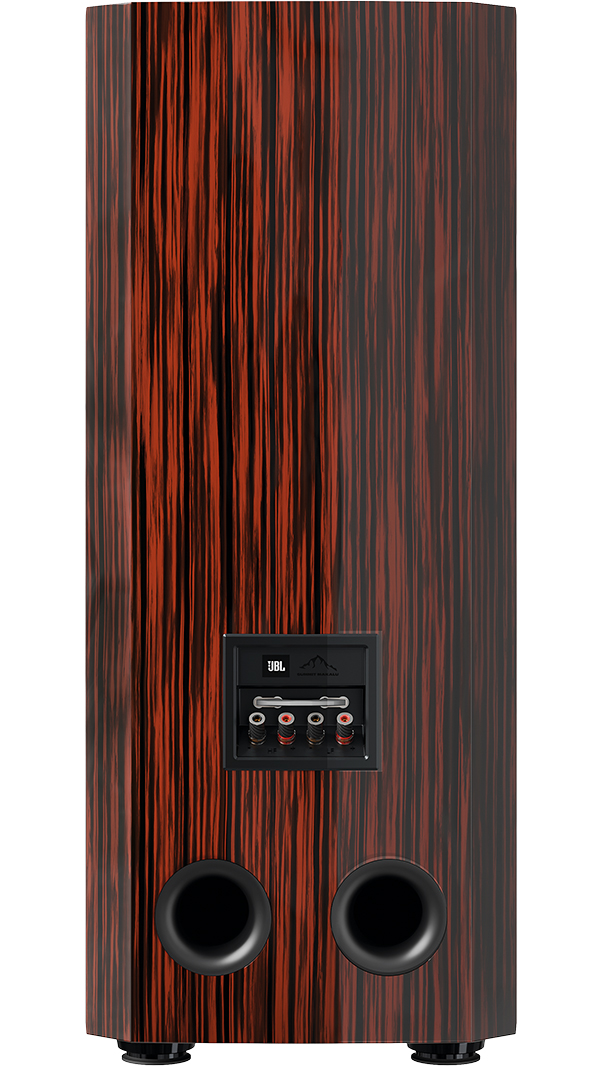
Above: Two large, flared bass-reflex ports exit below the Makalu's twin set of multiway terminals. Jumper bar is removed for bi-wire/bi-amp installation
Proof that JBL's new Summit speakers are nothing if not refined came from Karla Bonoff's 'The Water Is Wide' [Restless Nights; Columbia], which places the singer between acoustic guitars, accompanied by distant-sounding accordion. This was an expansive rendition, packed with tiny details and crowned by a mesmeric rendition of Bonoff's sweet, resonant vocals. As it built from gentle beginnings into something bigger, the Makalus sounded totally at ease. Music as an emotional experience? These speakers can do it.
Hi-Fi News Verdict
Sitting between the incoming K2 and Everest and the smaller Pumori and Ama, JBL's Makalu is very likely the Summit series' 'sweet spot' model, offering the scale and output for all but the largest rooms. Its sound merits the premium price tag, too, combining deep-diving bass and thrilling dynamics with detail and refinement. Despite the bold styling, this is not just a loudspeaker for rock 'n' rollers.
Sound Quality: 88%
 | |||||||||||

|
|
| |||||||||










 SPONSORED VIDEO







| Equipment Reviews | |
Music Reviews Awards | |
Latest News Features | |
Resources Newsletters | |
Subscriptions |
WHERE TECHNOLOGY BECOMES ENTERTAINMENT
 © 2026 Hi-Fi News
AVTech Media Ltd
All rights reserved