A visit to Magico
Barry Willis continues his whistlestop tour of West Coast audio marques with a visit to speaker maker Magico that leaves him feeling Lilliputian... and considering a listening room upgrade
Redundancy can be hilarious. As we passed a gym still packed at a late hour, a highly educated former girlfriend said: ‘Look! All those great big huge gigantic workout guys’ – a glorious string of adjectives describing enormity. Her vocabulary had momentarily defaulted to the level of an eight-year-old when she couldn’t come up with ‘bodybuilders’.
Visitors to the Magico factory in Hayward, California may feel similarly awed, a bit like Lilliputians, the tiny people in Jonathan Swift’s Gulliver’s Travels. Everything about the company’s production facility is enormous and oversize – from the building to its display areas, its assembly and shipping departments, its production equipment, and its ultra-impressive listening room.
Objects of desire
In early March, my friend Ken Askew and I enjoyed an invitation to tour Magico’s plant not far from Silicon Valley, a similar excursion to one I had made a few weeks earlier to amp brand MSB [HFN May ’25].
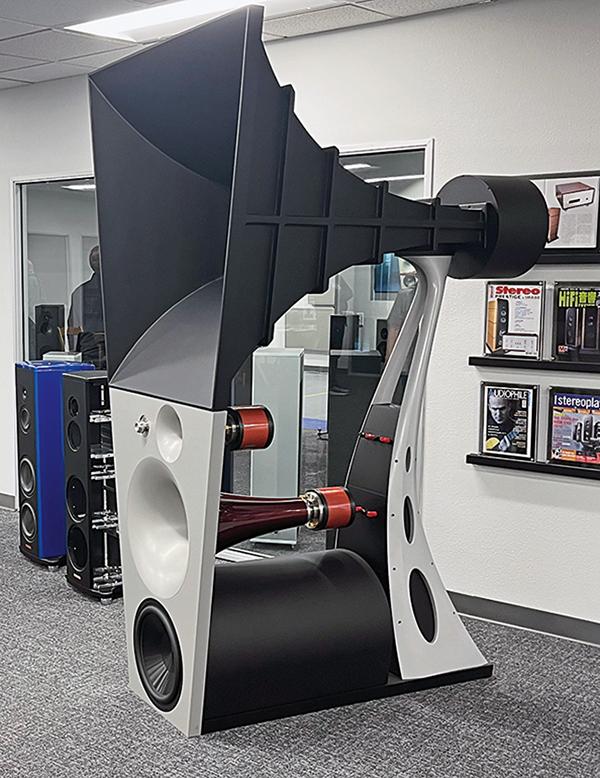
‘Enormity’ also applies to Magico products themselves. Many of them are cost-no-object loudspeakers in massive cabinets. Or no cabinets at all, as in the open-construction Ultimate models. Magico crossover networks feature the biggest imaginable components – polypropylene capacitors the size of institutional food cans, and coils that might look more appropriate in the engine room of a battleship.
The sheer size of the place implies that inside is a production line for high-performance automobiles or earth-moving equipment. It’s among the most capacious audio factories I have ever visited. Many Magico products get shipped in crates so large they would consume most of the space in a commercial lorry.
We enjoyed tutorials from Magico engineers about how the company’s products are designed and built, most of them with ultra-rigid internal bracing of aluminium. Some of the cutaway displays appeared to have been machined from single billets of the metal, an extremely rigid form of construction but one that wastes material in the production process.
Many of its midline products look like competitors’ models, ie, floorstanding loudspeakers with multiple drivers, but with suggested retail prices far in excess of similar-looking products from other brands. Most dominant in the display area are the giant cabinet-free horns, the ‘Ultimate III’ looking like a science-fiction weapon ready to vaporise the next intruder.
Ken couldn’t resist a joke. ‘If this is the Ultimate, is the previous model the Penultimate?’. We didn’t try that one on our tour guides.
Everything about Magico screams both ‘obsessive quality’ and ‘global reach’ – the interior walls are festooned with copies of audio journals throughout the world (including [HFN]) – and it’s clearly well funded. Our listening session, hosted by Magico chief designer Alon Wolf, took place in a cavernous demo room with walls as thick as those of an old castle.
Alive and kicking
We couldn’t hear a thing from outside, but inside was a revelation, with walls lined with what appeared to be tall sheets of folded paper, almost like the bellows of an accordion.
Acoustically neutral, but not dead, the room and the system in it – a pair of S5 speakers in an ‘aubergine’ finish – sounded as marvellously revealing as you might imagine, with music delivered by ‘files’ from an enormous streamer. Analogue source gear sat unused, to my relief – I prefer digital. The presentation was awe-inspiring, but as Ken remarked, ‘The room is so well designed, almost anything would sound great in it!’.






























 SPONSORED VIDEO






| Equipment Reviews |  |
Music Reviews Awards | |
Latest News Features | |
Resources Newsletters | |
Subscriptions |
WHERE TECHNOLOGY BECOMES ENTERTAINMENT
 © 2026 Hi-Fi News
AVTech Media Ltd
All rights reserved