Thinking small
When some hi-fi amplifiers and loudspeakers bring to mind that old Douglas Adams quote about the size of space, it’s good to see more bijou options breaking cover, reckons Mark Craven
There’s been an urban myth for years that the dimensions of the Solid Rocket Boosters used by NASA’s Space Shuttle were linked to the dimensions of Roman chariots. It’s a fun idea, based on the idea of a uniform wheel gauge lasting across two millennia, but also complete nonsense. What is apparently true, however, is that the width of my CD player is indebted to telecoms equipment of the 1920s.
I own numerous other ‘full-width’ hi-fi and AV components, including Blu-ray players, amps, AV receivers and preamps. All are more or less 435mm wide, and designed to fit neatly (with some clearance either side) in a 19in equipment rack. That specific rack size was chosen as the standard in telephone exchanges in the US to streamline installations as the network expanded.
Changing rooms
Once this standard became a feature of other businesses, including recording and broadcasting, it’s not surprising that consumer audio hardware followed suit. A century later, our music gear is still sized to sit in an industrial-type rack, although hi-fi furniture makers have at least stepped in to make some options that are more pleasing on the eye.
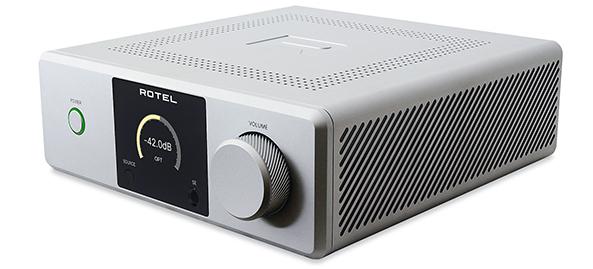
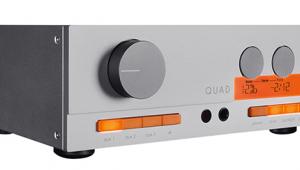
I got to thinking about this after seeing Rotel’s new DX-5 [HFN Dec ’25], an amplifier measuring 215mm across [pictured above]. As my colleague Andrew Everard discussed, it appears Rotel is joining the likes of WiiM, NAD and Eversolo in producing more compact products. This strikes me as a good thing.
As consumer habits change, so too should hi-fi. Or, at least, manufacturers should be aware that a literal one-size-fits-all approach isn’t ideal. Modern homes are often cluttered, the result of people simply being able to buy more stuff. At the same time, the average floor area in new build houses is, according to data from the Office for National Statistics and others, shrinking. And in many living rooms, hi-fi systems now have to battle with TVs measuring upwards of 55in, plus games consoles, soundbars and set-top boxes. Space is at a premium – yet we still see hi-fi separates where much of what’s inside the full-size chassis is fresh air.
Compact culture
I have no problem with the massive-sized, high-end market. You could probably fit around 20 of Rotel’s DX-5 amplifiers inside the InPoL Legacy [HFN Dec ’25], but that doesn’t mean Pathos’s £51,999 integrated won’t appeal to anyone with a large, dedicated room and a big budget. And you can say the same about towering, floorstanding speakers, or subwoofers the size of a washing machine.
I am, however, interested to see if a more compact hi-fi culture is really emerging (rather than it being just a fad) and what technological advances it might bring with it. After all, necessity is the mother of invention.
Two products spring to mind here already. Neither is actually a rack-mountable separate, but both combine a desire to save space with smart thinking.
KEF’s ultra-compact KC62 subwoofer, which hit the market in 2022, saw the speaker brand running dual opposed bass drivers from a single motor system, by virtue of an overlapping ‘UniCore’ voice coil.
More recently, the Clarity 4.2 speaker from Radiant Acoustics [HFN Oct ’25] delivers a sound with bass and scale that you wouldn’t think possible considering the 260x164x194mm (hwd) cabinet. The key here is the brand’s use of Purifi’s innovative Ushindi drive unit, with its distinctive surround profiles enabling a long, linear throw. Small but mighty? Don’t be surprised if it catches on.






















 SPONSORED VIDEO






| Equipment Reviews |  |
Music Reviews Awards | |
Latest News Features | |
Resources Newsletters | |
Subscriptions |
WHERE TECHNOLOGY BECOMES ENTERTAINMENT
 © 2026 Hi-Fi News
AVTech Media Ltd
All rights reserved