Perlisten D15s active subwoofer
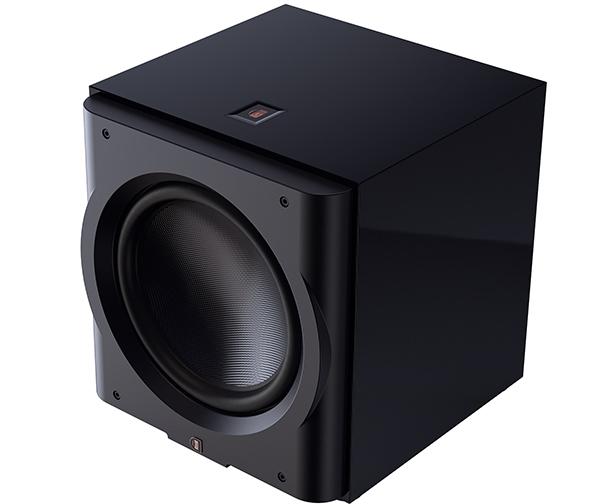

Just as the American audio manufacturer Perlisten sells a varied range of loudspeakers [HFN Apr/Jun/Aug ’22 and [HFN May ’25], it also features an equally expansive line of active subwoofers. They don’t quite come in all shapes and sizes – the shapes never vary beyond flavours of cuboid – but there’s a broad sweep of price and specification to match different room sizes. Towards the top of the lineup is the £5500 D15s, reviewed here.
Presently, this is the most expensive of Perlisten’s single-driver models. Above it in the hierarchy are two dual-driver units, the D212s (£7000) and D215s (£9000), while below are several models, single and dual-driver, in the D series and more affordable R series. The naming convention is straightforward, so you soon learn that the D15s has one 15in/380mm woofer, the D212s has two 12in/300mm woofers, and so on, down to the smallest R8s (£1500), with its lone 8in/200mm driver.
Seal of approval
As for the ‘s’, this simply signifies ‘subwoofer’ and not the use of a sealed, rather than ported, cabinet. Indeed, no such suffix would be needed, as all Perlisten’s subs are sealed. When I spoke last year to the brand’s chief technology officer, Erik Wiederholtz, he revealed a dislike of ported designs for their tendency to increase group delay, something that will affect the perception of a subwoofer’s ‘tightness’. And precision, as also seen in the Directivity Pattern Control (DPC) driver arrays on Perlisten speakers, is one of the brand’s chief concerns.
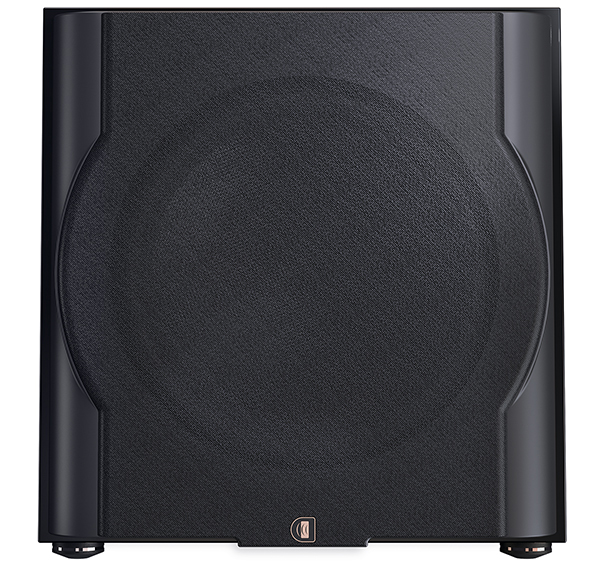
The ‘s’ certainly doesn’t stand for small, as any sub with a 380mm driver is going to be fairly big-boned. The D15s is almost cubic, measuring 528x500x500mm (hwd), and weighs 46kg. Pads for both carpet and hard floors are supplied to help slide the subwoofer into position. These are then removed to leave it standing on four, pre-attached rubber feet. Unusually, there’s no grille included, but you can buy one [see pic, below] for £120. Most probably won’t bother, and the D15s, in its smart piano black finish, isn’t unpretty even with its driver exposed.
Made from carbon-fibre and claiming a ±30mm linear excursion, this front-facing unit is framed by a half-roll surround and backed by an aluminium voice-coil, FEA-optimised Nomex spider and a ‘massive’ magnet using multiple aluminium shorting rings. The driver is set within an 80mm-thick HDF baffle, its outer edges curved to give the D15s a degree of living room respectability, while the rest of the cabinet (internally braced horizontally and vertically for rigidity) uses 30mm HDF.
Touch and go
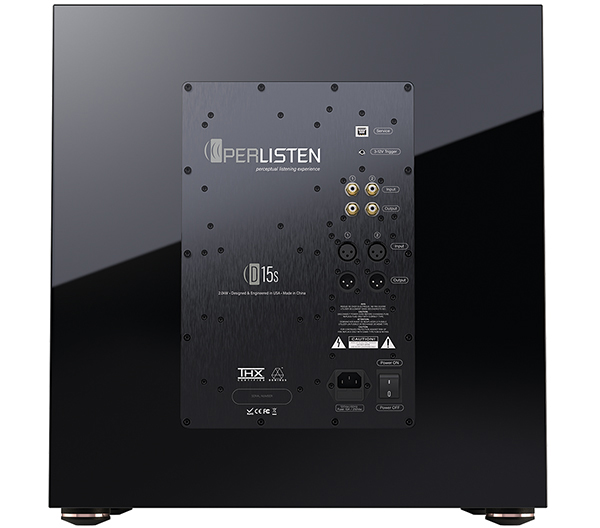
Central to the sub’s rear panel is a metal plate offering stereo inputs and outputs on RCA and XLR connections, plus trigger and service ports, and a power socket/switch. Missing here is any sort of control, because Perlisten – similar to fellow US marque SVS [HFN Apr ’25] – has done away with rotaries for crossover and gain, etc, and moved them to both a touchpanel (within the D15s’ top surface) and partnering app. Frankly, this is far better than having to delve around the back of a big cabinet to fiddle with settings.
The small touchpanel is useful but controlling the subwoofer with Perlisten’s app [see boxout] is best, as it’s only here that you have access to the full gamut of configuration and calibration tools. These are made possible by the same advanced 48-bit DSP platform and 32-bit ARM Cortex processor found across all its subwoofers, and this digital brain is also tasked with monitoring the voltage, current and temperature of the D15s’ Class D amp stage, rated at 2kW.
Another feature of Perlisten subwoofers is THX certification, which may well mean more to those of a certain ‘vintage’. The D15s carries the top-tier THX Dominus specification, meaning it’s been measured by THX to reach (unspecified) targets related to distortion, SPL and frequency response. It also means it’s recommended for rooms up to 185m3, although there’s nothing to stop you installing it in a more modest space. When used on its own in a hi-fi system, Perlisten’s recommendation is to position the D15s between the main speakers, around one-third of the total wall length, to ‘balance’ room modes.
 Measured might
Much like the company’s loudspeakers, the D15s is a controlled and focused performer. This is perhaps expected considering its price tag, and the digital signal processing and amplifier management at play, but the finessed sound here can still surprise. Even when pushed to showcase the full extent of its low-end reach, through film soundtracks mixed with subwoofers in mind, Perlisten’s model remains unflustered, not once veering into rambunctious territory. You can spend a quarter of the D15s’ money and get a subwoofer that sounds more ‘up-and-at-’em’. But you won’t get this model’s sense of poise, purity, and grip.
Paired with the big Bowers & Wilkins’ 801 D4 Signature floorstanders [HFN Sep ’23] in the [HFN] listening room, and following a manual calibration of crossover and level, the D15s showed a fine touch when filling out the bottom octaves – but also no shortage of sturm und drang when needed. There’s none of the slightly ‘agricultural’ vibe that large-driver woofers can give off, which means this sub’s impact on some music can be very discreet. The sealed cabinet is subjectively as quiet as a church mouse.
The D15s’ presence is always there, though, as on composer Lalo Schifrin’s ‘Main Title’ for the Steve McQueen classic Bullitt [Aleph Records; 44.1kHz/16-bit], where the delicate nature of the music, and the space between brass, wind and string instruments, wasn’t overshadowed by the subwoofer adding extra depth to the sound, with all the nimbleness of percussionist Larry Bunker. Follow-up track ‘Room 26’ has more of a Latin-tinged lounge jazz feel, and again the D15s gently bolstered the weight and scale of the jaunty bassline.
As our colleague Ken Kessler has remarked in the past [HFN Sep ’22], the benefit of a sub is sometimes more apparent when it’s removed from the system. Using Perlisten’s smartphone app for quick A/B comparisons, and playing Stevie Wonder’s ‘Living For The City’ [Innervisions, Motown; 96kHz/24-bit], the synth bassline seemed drier and less fulsome without the D15s, and the midrange that little bit less defined.
It was the same with the title track from Dire Straits’ Brothers In Arms [40th Anniversary Edition, UMC; 44.1kHz/24-bit], where the sub helped to not only underpin the storm effects in the opening and add extra body to the bass – there was also a better contrast between these lows and the keyboard and guitars, making for a more open, dynamic sound. The memorable drum fills on the same album’s ‘Money For Nothing’ were huge and resonant, the funk-fuelled slap bass on ‘One World’ snappy and attacking.
Thrilled to the bone
Turn to more bass-centric music, and Perlisten’s subwoofer really earns its crust. ‘Jumanji’, from Danish dance music producer Hedergaard [Oblivion, Universal Music; 44.1kHz/ 24-bit], features driving, Bangla-esque beats and these arrived with astonishing weight and substance, giving the track a bigger, more dramatic feel. This is music to be danced to, and the D15s guaranteed this came across. ‘Magenta Riddim’ by DJ Snake [Carte Blanche; self-released] is cut from a similar cloth, albeit reggae influenced, and here the D15s dug into the pounding beats with bone-crunching slam.
This ability to augment what’s there across all genres of music, without upsetting the balance of the system, is this subwoofer’s calling card. In unison with the B&W speakers, and with careful setting of the level, the D15s slotted slickly into place. There was no sense of colour to its sound, just solidity and effortless extension, so that both the deep drums and low piano notes of Michael Giacchino’s theme to The Batman [Water Tower Music; 48kHz/24-bit] appeared bigger, but naturally so. Then, once the piece segued from foreboding introduction to more optimistic tones, the subwoofer threw its weight into the swelling strings without muddying the sweet detail higher up the audio band.
So, what we have here is a sub that combines hair-raising power and slam with speed, delicacy, and control – and even if your taste in music doesn’t benefit much from the former, it will from the latter. Whether it was The Doors’ ‘The Changeling’ [L.A. Woman, Warner/Rhino, 192kHz/24-bit], with its propulsive blues groove and staccato keyboards, or Club For Five’s ethereal 2009 cover of Kate Bush’s ‘Running Up That Hill’ [WM Finland; 44.1kHz/16-bit], the D15s always elevated my enjoyment.
Hi-Fi News Verdict
Being a single-driver, sealed cabinet subwoofer, Perlisten’s D15s carries a premium price compared to similarly specified rivals. Yet there are excellent rewards for those who invest, from the power, control and deftness of its performance, to its extensive calibration tools and ease of use. And if your budget won’t stretch, you’ll find the same features and technologies further ‘down’ the Perlisten line.
Sound Quality: 88%
 | |||||||||||

|
|
| |||||||||











 SPONSORED VIDEO






| Equipment Reviews | |
Music Reviews Awards | |
Latest News Features | |
Resources Newsletters | |
Subscriptions |
WHERE TECHNOLOGY BECOMES ENTERTAINMENT
 © 2026 Hi-Fi News
AVTech Media Ltd
All rights reserved